

One safety course cannot prepare every UAE workplace for the same risks. Occupational safety training in the UAE can include NEBOSH and IOSH courses, industry-specific HSE training, and emergency response learning. Choose the mix according to work activities and employee responsibilities, with the practical aim of helping people recognize hazards and work safely.
Choosing training that fits your workforce matters as much as choosing a recognized course. This guide explains how HSE and IOSH options differ, what industry-specific and emergency response courses can cover, and how companies can match training to workplace needs across the UAE. It also outlines how Shebin Abraham, IDIP NEBOSH, CertIOSH, MIIRSM, an ADOSH-SF Senior OHS Practitioner with 21 years of OHS experience, brings a practitioner’s perspective to workplace safety and compliance.
Key Takeaways
- Match internationally recognized HSE qualifications to the learner’s role, experience and professional goals.
- Choose between IOSH Working Safely and Managing Safely based on whether the learner needs core safety awareness or management-focused guidance.
- Shape industry-specific learning around the hazards and work activities found in construction, manufacturing, food, healthcare, and oil and gas settings.
- Consider first aid, fire safety and emergency response training alongside routine safety learning to prepare teams for urgent situations.
- For company-wide training needs, align learning with workforce roles and operational risks; OHS consulting can help address wider compliance and workplace safety priorities.
Internationally accredited HSE and occupational safety courses
International courses can build practical safety knowledge and support career development. In the UAE, compare each qualification’s assessment format, course content, and recognition with the learner’s role and goals.
NEBOSH offers qualifications at different levels, from focused learning to advanced study. The NEBOSH HSE Award in Managing Risks and Risk Assessment at Work and the NEBOSH Certificate in Health and Safety Leadership both include online study and examinations. These options provide structured learning in risk management and leadership.
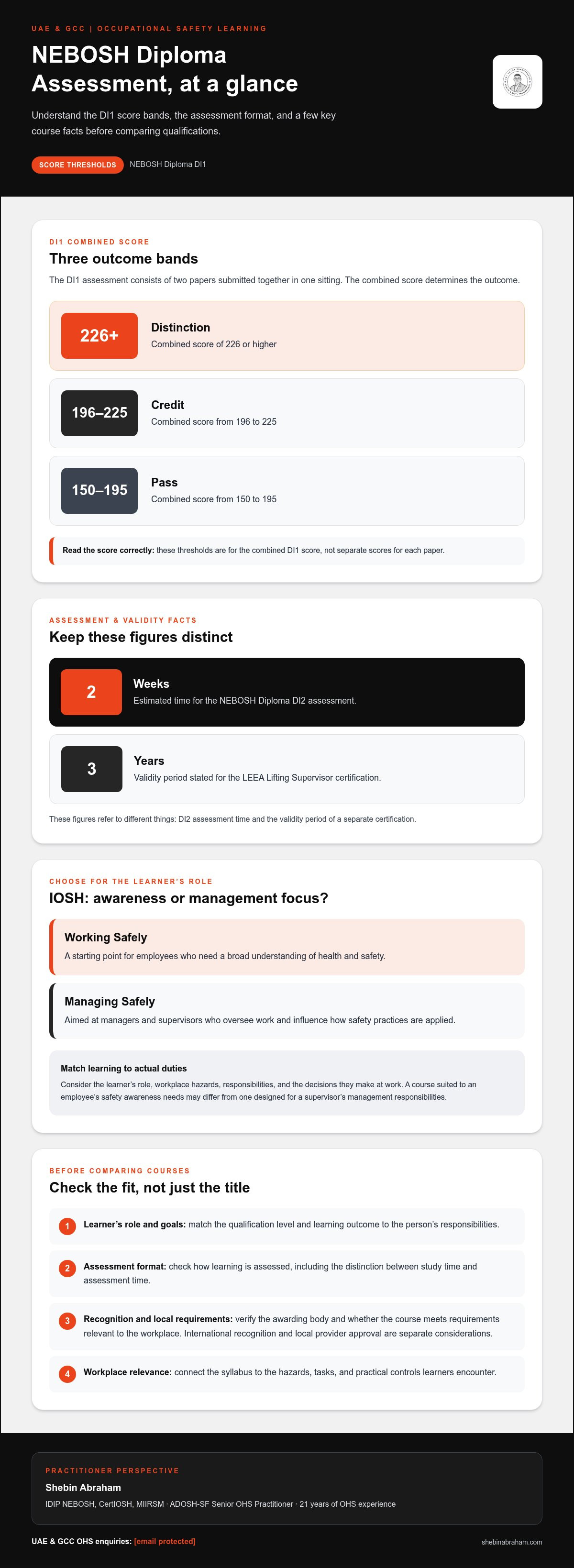
For advanced study, the NEBOSH Diploma uses staged assessments. Its DI1 assessment consists of two papers submitted together in one sitting. A distinction requires a combined score of 226 or higher; credit applies from 196 to 225, and pass from 150 to 195. Those thresholds help learners understand the qualification’s assessment framework.
Highfield health and safety and risk assessment courses are another option. Compare the syllabus with the learner’s responsibilities: a risk assessment course should connect hazard identification with practical controls. Review the assessment method and exact qualification awarded, rather than relying on the course title alone.
Course Duration and Certificate Validity
Duration depends on the qualification and its assessment design. For example, the NEBOSH Diploma DI2 assessment is estimated to take 2 weeks. Certificate validity is a separate consideration: the LEEA Lifting Supervisor certification is valid for 3 years. Before enrolling, distinguish study time from assessment time, and note any stated renewal period.
Provider Accreditation and Approval
International accreditation and UAE provider approval are separate considerations. NEBOSH and IOSH offer internationally recognized qualification pathways, while local approval can depend on the applicable emirate, sector, and course. Check which awarding body issues the certificate and whether the training meets requirements relevant to your workplace. A course certificate alone does not establish every form of local approval.
Course Costs in the UAE
Course costs in the UAE depend on the qualification level, study format, assessment arrangements and included learning materials. A short risk assessment course and a NEBOSH Diploma involve different study and assessment demands, so their costs are not directly comparable. The price depends on the case and is given after a quote request; compare the full course scope, not tuition alone.
Other international options include training in ISO 14001:2015 Environmental Management Systems. For fire safety or general HSE learning, match course content to the hazards and decisions learners face at work. The right occupational safety training in the UAE should connect its syllabus, assessment and certificate to a clear workplace or professional need.
IOSH Working Safely and Managing Safely
IOSH courses help employees and managers develop workplace safety knowledge suited to their responsibilities. Choose a course based on the learner’s role, workplace hazards, and the decisions they make at work.
Training for Safety Officers and Managers
IOSH Working Safely is a starting point for employees who need a broad understanding of health and safety. Managing Safely is aimed at managers and supervisors who oversee work and influence how safety practices are applied. Safety officers can compare the course content with their responsibilities and existing knowledge to decide whether it complements their professional development or a deeper qualification.
Workplace Safety Training Requirements
Training needs depend on what people do and the hazards in their workplace. Managers, supervisors, and employees who need a broad understanding of health and safety are among the intended learners for HSE courses. Consider each role: a supervisor coordinating tasks needs relevant oversight knowledge, while an employee working around equipment needs instruction connected to that environment. This makes learning relevant without assuming one course suits every worker.
Working Safely and Managing Safely meet different learning needs. Working Safely builds employee awareness, while Managing Safely better suits people with management responsibilities. A team member may need to recognize hazards and follow workplace procedures; a supervisor must also consider how work is organized and safety expectations are communicated. Compare the intended audience and course outcomes with actual duties rather than choosing by title alone.
For safety professionals considering NEBOSH IGC alongside IOSH Managing Safely, start with the learning outcome they need. IOSH Managing Safely focuses on management, while NEBOSH IGC is another health and safety qualification to consider for broader professional learning. Compare the syllabus, assessment format, and learner’s current responsibilities. A course suited to a supervisor’s immediate role may differ from study intended to build a safety career.
ISO 45001:2018 provides a recognized framework for occupational health and safety management systems, and UAE course offerings include training in this standard. Training explains the framework; consultancy is a separate activity that can help an organization apply management-system principles to its own processes. Keep training, implementation support, and certification distinct. A course certificate does not itself certify an organization’s management system.
To make training deliver value, map job roles to learning objectives, then connect those objectives to workplace examples. Use a task such as contractor coordination or routine equipment checks to discuss hazards, responsibilities, and communication. Review whether learners can apply the material in their environment, not only recall course terms. For support aligning learning with operational risks, explore practical HSE guidance for UAE workplaces.
Construction, manufacturing, food, healthcare and oil and gas safety
Industry-specific learning connects health and safety principles with the tasks people perform. Across the UAE, select training based on work activities, occupational health risks, and requirements relevant to the workplace.
Training Across Industry Sectors
Construction teams can work through examples involving site coordination and changing hazards. Manufacturing learners can focus on equipment, materials, and safe operating procedures. Food workplaces call for attention to hygiene-related tasks and safe handling practices. Healthcare teams benefit from examples involving patient-facing duties and workplace wellbeing. Oil and gas learning should reflect site operations and the hazards workers encounter. In every sector, use scenarios relevant to employees’ actual responsibilities.
NEBOSH occupational health and safety qualifications provide a structured route for developing safety knowledge. NEBOSH stands for the National Examination Board in Occupational Safety and Health. The right level depends on the learner’s existing knowledge, intended responsibilities, and professional goals. For example, a safety professional seeking broader understanding can compare an international qualification with focused, task-based learning for their current workplace.
ISO 45001:2018 is the Occupational Health & Safety Management System standard included in UAE training offerings. Learning about the standard can help students understand how an organization structures occupational health and safety management. Apply that knowledge by connecting procedures, worker participation, hazard controls, and review processes to a workplace example. Training on a management system standard is distinct from certification of an organization.
Requirements Across UAE Emirates
Across the UAE, consider applicable emirate-level and sector requirements when choosing training. Identify the worksite, job duties, hazards, and relevant client or site rules, then match each role to learning that supports its tasks. This helps avoid assuming one course automatically suits every employer or workplace.
Occupational safety training should address health risks as well as immediate physical hazards. A healthcare team’s duties, for example, differ from a manufacturing operator’s, so relevant training examples and controls differ too. Review how work is organized, what exposures employees may encounter, and which procedures guide daily tasks. Use this information to identify whether learners need foundational awareness, role-specific instruction, or advanced qualifications.
For practical course selection, map roles against three considerations: workplace hazards, the decisions workers make, and the procedures they follow. A construction supervisor may need learning that supports coordination, while a food-handling team needs examples grounded in its work environment. Safety professionals can assess whether course outcomes support workplace needs and the organization’s health and safety approach. This helps make training relevant across industries without treating a qualification as a substitute for site-specific instruction.
First aid, fire safety and emergency response
First aid, fire safety, and emergency response courses develop practical skills for urgent workplace situations. In the UAE, choose training that reflects the site, workforce roles, and hazards employees may encounter.
Fire safety training can help professionals understand how to recognize fire hazards, communicate concerns, and follow workplace emergency procedures. The NEBOSH Fire Safety Certificate was introduced as new for 2021. It is one named qualification to consider when comparing fire safety learning, alongside awareness courses designed for employees who need practical familiarity with their site’s arrangements.
Firefighting awareness should connect learning to the workplace environment. A course might use a site layout to discuss how people raise an alarm, follow evacuation instructions, and reach an assembly point. These training examples do not replace an organization’s own emergency plan. Managers can use drills and debriefs to identify unclear roles and improve how instructions are delivered.
First aid and emergency response training address different learning needs. First aid focuses on the initial response to an injury or sudden illness, while emergency response learning can cover how employees communicate and act within workplace procedures. UAE training offerings include first aid, fire safety, and emergency response courses. Choose objectives that match work activities and the responsibilities assigned to learners.
Food safety and fire safety can intersect in kitchens, catering operations, and food production areas. A useful scenario might ask staff to follow an emergency procedure while protecting people and maintaining clear communication. Construction training needs a different emphasis, with examples from active work areas and team coordination. In both settings, practical scenarios help learners connect safety principles to decisions they may face.
Build a course plan around the skills employees need to use, not just the course title. Consider these steps:
- Identify relevant emergencies, such as a fire alarm, injury, or evacuation.
- Separate general awareness from role-specific response responsibilities.
- Use site examples to practise communication and procedure-following.
- Review learning after drills or changes to the workplace environment.
An international diploma may support broader professional development, while focused courses can address immediate workplace needs. Compare their scope and intended learners before deciding. Neither replaces site-specific instructions. Connect course learning with clear responsibilities, accessible procedures, and follow-up discussions. This helps professionals turn training into skills that support colleagues during an emergency, rather than treating a certificate as the only outcome.
Safety training for companies across industries
Company-wide learning works best when it reflects different roles, sites, and hazards. In the UAE, employers can organize training around workplace tasks and keep clear records of participation and assessment.
Start with a role-and-risk map. List each team, its routine tasks, and the hazards employees may encounter. A construction crew, for example, may need different learning from office-based staff or food production workers. Connect each need to a course objective, such as recognizing hazards, following procedures, or understanding emergency arrangements. This gives the training plan a practical purpose beyond collecting certificates.
Next, decide how to deliver the learning. Corporate group training can take place at the client’s site, allowing teams to use familiar workplace examples. Companies can also consider online or live virtual sessions when the subject and employees’ access suit that format. For either approach, assign a coordinator to manage dates, attendance, learning materials, and participant communication.
Build an assessment into the plan. Ask learners, for example, to identify hazards in a work scenario, explain a relevant procedure, or complete a knowledge check. Choose a method that matches the course objective. Keep the course title, provider and awarding body details, date, participant names, assessment outcome, and certificate information together. These records help employers review who attended and what learning was completed.
Keep training records useful. A simple register can link each employee’s role with completed learning and any identified follow-up. Record absences and rescheduled sessions, and note when a change in tasks creates a new learning need. For example, moving an employee to equipment operation may require a review of role-specific instruction. This keeps the register connected to actual work rather than turning it into a static archive.
Use the following sequence to maintain a consistent process:
- Identify job roles, tasks, and relevant workplace hazards.
- Set learning objectives and select suitable course content.
- Arrange delivery, communicate schedules, and record attendance.
- Assess learning, retain completion evidence, and identify follow-up.
- Review the plan when work activities or procedures change.
Organize documentation by employee, course, and date. Distinguish attendance from successful completion when a course includes an assessment. Keep certificates with the corresponding training record, and make the information accessible to those responsible for workplace safety. Records support internal review and should accurately reflect what employees completed, not imply that training alone resolves every risk.
For help aligning company OHS priorities with workplace training records, discuss your company’s safety training approach.
Shebin Abraham: OHS Services
Shebin Abraham provides OHS Services for organizations seeking practical support with workplace health and safety priorities. His credentials include IDIP NEBOSH, CertIOSH, and MIIRSM, and he is an ADOSH-SF Senior OHS Practitioner with 21 years of OHS experience.
Turn to Shebin Abraham’s Freelance HSE Service when your organization needs focused occupational health and safety consulting. For relevant compliance needs, he also provides Freelance ADOSH-SF OHS consulting and Trakhees OHS consulting. These services help organizations address regulatory requirements and strengthen their approach to workplace risks.
For a conversation about your OHS needs, contact Shebin Abraham or visit shebinabraham.com.
Turn safety learning into consistent practice
Connect training decisions with how work is planned, supervised, and reviewed. Set clear learning priorities for each role, then revisit them when tasks, equipment, or workplace procedures change. This keeps occupational safety training in the UAE relevant to daily operations, rather than treating course completion as the final measure of progress.
When your organization needs support connecting training priorities with workplace requirements, Shebin Abraham provides OHS Services, Freelance HSE Service, and Freelance ADOSH-SF OHS consulting. These consulting services can help address operational and compliance priorities and are distinct from course delivery. Choose the next step that fits your organization’s needs and responsibilities.
Contact Shebin Abraham about your training priorities and take a considered step toward safer, more capable teams.
Frequently Asked Questions
What occupational health and safety training courses are available in the UAE?
Courses include NEBOSH qualifications, IOSH Working Safely and Managing Safely, risk assessment, ISO management-system learning, first aid, fire safety, and emergency response. The right occupational safety training in the UAE depends on learners’ duties and workplace hazards. A supervisor may need management-focused learning, while a new employee may need practical hazard-awareness instruction. Compare course outcomes and assessment methods before selecting a course.
What UAE laws and regulations require occupational safety training?
Applicable occupational safety training requirements depend on the governing framework, sector, and workplace. ADOSH-SF provides an occupational safety and health framework, while Trakhees OHS requirements apply to operations within its remit. Identify the framework governing your site, then map role-specific training to relevant requirements and internal procedures. A generic certificate alone does not establish compliance across every UAE workplace.
How long do UAE workplace safety courses take, and how often must workers renew training?
Course duration and renewal intervals vary by qualification and workplace needs. A course schedule may include taught learning, independent study, and assessment, while renewal depends on the certificate’s terms and applicable site requirements. Employers can maintain a training register showing completion dates and any stated validity periods. Review learning when duties, procedures, or hazards change, and schedule refreshers where workers need updated instruction.
What certificates are offered, such as IOSH, NEBOSH, and OSHA, and how do they compare in the UAE?
IOSH offers learning for workplace awareness and management responsibilities; NEBOSH includes award, certificate, and diploma qualifications. OSHA-related training covers OSHA safety and health regulations. These names represent different course frameworks and learning objectives, so compare the syllabus, assessment, awarding organization, and intended learner. A manager may prioritize oversight skills, while a safety professional may seek a qualification for deeper technical development.
What are the penalties for failing to provide required safety training in the UAE?
Consequences depend on the applicable UAE framework, the nature of the training gap, and the circumstances of any related breach. There is no single penalty amount that applies to every workplace or sector. Identify the requirements governing your operations, document completed instruction, and address gaps promptly. Clear records help demonstrate what training workers received and where further action is needed.
What occupational safety training is required for construction, oil and gas, and other high-risk industries in the UAE?
Training should reflect each role’s tasks, site hazards, and emergency procedures. Construction examples may focus on coordinating work and recognizing changing site conditions; oil and gas learning should relate to the hazards and processes workers encounter. Other high-risk workplaces need similarly task-specific instruction. Match course objectives to job duties, then reinforce them with site procedures and practical learning relevant to the work environment.


