
What if your safety procedures look complete on paper but don’t reflect what happens at work? A safety compliance gap assessment UAE employers can rely on compares applicable requirements with workplace evidence, helping turn gaps into practical actions rather than a report that sits on a shelf.
It can be difficult to determine which occupational health and safety requirements apply, which records matter, and whether everyday practice matches written procedures. The answer depends on your activities and the frameworks that apply to your operations. These may include relevant federal requirements, ADOSH-SF or Trakhees requirements.
This guide explains how to set the scope, review documents and workplace evidence, and turn findings into prioritized actions with clear ownership and follow-up. It also covers how to distinguish regulatory requirements from internal procedures and voluntary management-system commitments.
Shebin Abraham, IDIP NEBOSH, CertIOSH, MIIRSM, is an ADOSH-SF Senior OHS Practitioner with 21 years of OHS experience. He provides freelance HSE and OHS consulting across the UAE and GCC. His practical approach connects applicable requirements with workplace evidence, then helps teams make improvements that strengthen safety arrangements.
Key Takeaways
- A safety compliance gap assessment UAE employers can use compares applicable requirements with documented arrangements and what is observed at work.
- Set the assessment scope around your organization’s activities, workforce, sites, and relevant frameworks.
- Combine document reviews, workforce discussions, and workplace observations to identify gaps that written procedures alone may miss.
- Prioritize findings by potential harm, exposure, existing controls, and applicable requirements, then assign practical actions and follow-up.
- Shebin Abraham, IDIP NEBOSH, CertIOSH, MIIRSM, an ADOSH-SF Senior OHS Practitioner with 21 years of OHS experience, provides practical assessment and compliance support.
What a Safety Compliance Gap Assessment in the UAE Reveals
A safety compliance gap assessment UAE employers can use is a structured comparison of applicable requirements with documented and observed workplace arrangements. It shows not only what procedures say, but whether responsibilities and controls are understood and applied during day-to-day work.
A gap assessment compares defined requirements with workplace evidence, then identifies findings that need ownership and follow-up. The criteria and scope should reflect the organization’s activities, workforce, sites, and applicable frameworks. Depending on the operation, these may include relevant federal requirements and authority frameworks such as ADOSH-SF or Trakhees requirements. Defining the scope upfront keeps the review relevant and makes its conclusions easier to act on.
What does a safety compliance gap assessment examine?
Within the agreed scope, a review may examine OHS responsibilities, risk controls, worker communication, training, and relevant records. It should draw on more than documents: compare procedures and records with workforce discussions and observations of work activities.
For example, a written procedure may describe how to control a task, but the document alone can’t show whether workers understand or follow it. Comparing the procedure with training records, workers’ understanding, and observed practice can reveal whether the arrangement works as intended or needs clarification or improvement.
How is a gap assessment different from an audit or certification?
A gap assessment identifies shortfalls against defined criteria within an agreed scope. A workplace inspection typically focuses on conditions or practices observed during a visit. An audit evaluates arrangements or performance systematically against defined criteria and may examine whether a management system is implemented and effective.
A certification audit is part of a formal process to assess conformity with a specified standard. ISO 45001 is an occupational health and safety management system standard; the ISO 45001 Wikipedia overview provides background on its purpose and development. Regulatory compliance and alignment with ISO 45001 are related but distinct questions. A gap assessment can inform improvement or readiness work, but it doesn’t award ISO certification or guarantee compliance.
Shebin Abraham, IDIP NEBOSH, CertIOSH, MIIRSM, is an ADOSH-SF Senior OHS Practitioner with 21 years of OHS experience. His approach is to match the review to the applicable framework and support findings with evidence, accountable actions, and follow-up.
How to Conduct a UAE Safety Compliance Gap Assessment Step by Step
A sound assessment follows a traceable sequence. Each conclusion should connect the requirement being assessed to evidence, the affected work activity, and any associated risk. This makes it easier to distinguish a verified gap from an assumption or an open question that needs clarification.
How should employers define assessment scope and criteria?
Start by setting clear boundaries. Identify the activities, organizational locations, workforce groups, and contractors included. Then define the criteria: applicable UAE or GCC requirements, relevant authority frameworks, and internal procedures or commitments. Confirm that each requirement is current and applies to the activities in scope before using it to assess performance. Record exclusions and limitations so readers understand what the review did not examine.
What evidence should an assessor review and verify?
Gather evidence from more than one source. Relevant records may include policies, risk assessments, training records, permits, and incident information. Compare documented arrangements with workers’ understanding and observed practices during relevant activities. The International Labour Organization (ILO) Safety and Health at Work also highlights prevention and safe working conditions as important parts of occupational health and safety.
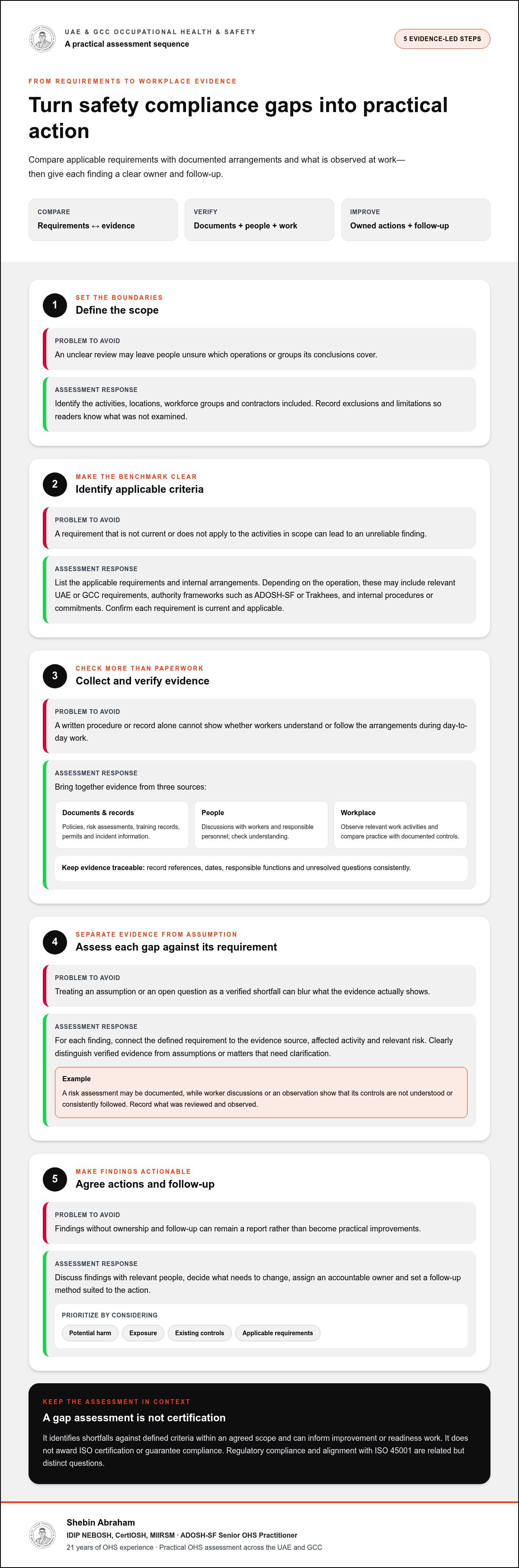
Use this five-step process:
- 1. Define the scope. Confirm the activities, locations, workforce groups, contractors, exclusions, and limitations included in the review.
- 2. Identify the criteria. List the applicable requirements and internal arrangements to be assessed. Make the reference clear for each topic.
- 3. Collect and verify evidence. Review relevant documents, speak with workers and responsible personnel, and observe work in scope. Record evidence references, dates, responsible functions, and unresolved questions consistently.
- 4. Assess each gap. Compare the evidence with the defined requirement. Link each finding to the requirement, evidence source, affected activity, and relevant risk. Separate verified evidence from assumptions or matters that need clarification.
- 5. Agree actions. Discuss findings with the relevant people, decide what needs to change, assign an accountable owner, and set a follow-up method suited to the action.
For example, a risk assessment may be documented, but a discussion with workers or an observation of the task may show that the controls are not understood or consistently followed. Record what was reviewed and observed rather than treating the document alone as proof of implementation. A clear assessment record gives decision-makers a reliable basis for action.
When the scope or applicable framework is complex, OHS consulting can help structure the review and make findings usable. Shebin Abraham provides freelance HSE and OHS consulting, including practical assessment and framework-specific guidance. Explore OHS compliance assessment support to discuss an approach tailored to your organization.
How to Apply UAE OHS Requirements Without Confusing Compliance and ISO
A clear assessment keeps three kinds of criteria distinct: applicable legal or authority requirements, the organization’s own procedures, and voluntary management-system commitments such as ISO 45001. These criteria may address related safety topics, but they answer different questions. A procedure can be followed consistently and still fall short of an applicable requirement. An ISO-aligned system may also need a separate review against the obligations that apply to the organization.
When might ADOSH-SF or Trakhees criteria be relevant?
Framework relevance depends on the organization’s activities and the authority requirements that apply to its scope. Include ADOSH-SF criteria when the assessment covers an entity or activity subject to that framework. Consider Trakhees OHS requirements when the organization and activities fall within their scope. Neither framework is a universal checklist for every UAE operation. Identify the relevant framework and verify current requirements before assessing conformity.
How should an employer distinguish compliance from ISO readiness?
A single review can consider both applicable obligations and ISO 45001 readiness, but label each criterion and finding separately. This helps managers see whether an issue concerns a specific obligation, an internal procedure, or a management-system expectation. ISO 45001 is a management-system standard, not a substitute for applicable legal or authority obligations.
Keep the distinction visible in the assessment record. For example, a finding about a missing required record should identify the relevant obligation as its reference. A finding about how the organization evaluates its OHS system should identify the management-system criterion. The actions may overlap, but the basis for each finding should remain clear.
| Assessment lens | Purpose | Reference criteria | Typical evidence | Possible output |
|---|---|---|---|---|
| Compliance | Assess applicable obligations | Relevant legal or authority requirements | Records, procedures, observations | Obligation-linked findings and actions |
| Internal arrangements | Check how the organization expects work to be managed | Internal policies and procedures | Documents, worker discussions, work practices | Procedure or implementation improvements |
| ISO readiness | Review alignment with a management-system standard | ISO 45001 criteria adopted by the organization | System documents and implementation evidence | Readiness gaps for improvement |
A safety compliance gap assessment UAE organizations use can examine these lenses together without merging their conclusions. An assessment can inform improvements or readiness work, but it doesn’t grant certification or replace the independent certification process. Shebin Abraham, IDIP NEBOSH, CertIOSH, MIIRSM, an ADOSH-SF Senior OHS Practitioner with 21 years of OHS experience, provides compliance assessment and management-system support informed by UAE framework requirements.
How to Prioritize Safety Compliance Gaps and Turn Findings into Action
A findings report is useful only when it helps change how risks are managed. Prioritize each gap by considering the potential severity of harm, who may be exposed and how, whether existing controls are reliable, and whether an applicable requirement is involved. Explain the reasoning behind each priority. A colour or score without context can obscure why one issue needs attention before another.
How should employers prioritize assessment findings?
Consider the work being done and the people affected. An absent or unreliable control during an activity with potential for serious harm may need prompt attention. A system improvement or routine record correction may still matter, but may call for a different response. If the assessment identifies an immediate serious concern, escalate it through the organization’s established safety processes rather than waiting for the final report.
Keep the priority rationale beside each finding. Note the potential harm, exposure, condition of the controls, and relevant obligation. This gives managers a sound basis for sequencing actions and revisiting priorities if work conditions or evidence change.
What makes a corrective action verifiable?
Make each action specific enough for someone to own and close. An action register can record:
- Finding and reference: the gap, affected activity, and relevant requirement or procedure.
- Owner and target date: the responsible role and a realistic completion date.
- Interim control: any temporary measure needed while the longer-term action is underway.
- Completion evidence: the record, observation, or other evidence that will demonstrate implementation.
- Closure status: progress, verification results, and any follow-up still required.
Evidence of completion should match the action. A revised procedure may show that a document was updated, but it won’t necessarily prove that workers understand or use it. Where appropriate, verify effectiveness through follow-up observation, discussion, or review of relevant records. Update the assessment record with what was checked and the outcome.
A report alone doesn’t close gaps. The organization must implement agreed changes, confirm they address the finding, and keep ownership visible until closure. A safety compliance gap assessment UAE organizations can act on connects findings to accountable improvements, not just recommendations on a page.
For practical support prioritizing findings and verifying corrective actions, explore OHS compliance assessment support.
When UAE Employers Should Use Specialist OHS Assessment Support
Specialist support can be useful when an organization has a complex scope, several work activities or workforce groups to consider, or needs to interpret framework-specific criteria. It can also help when internal teams are unsure how to turn findings into workable actions. The aim is not to replace operational knowledge, but to bring a structured OHS perspective that helps teams test assumptions and direct attention where it matters.
What should employers expect from a tailored assessment engagement?
A useful engagement begins with understanding the organization’s activities, the boundaries of the review, applicable criteria, and existing arrangements. The assessor can then examine relevant evidence, discuss findings with responsible teams, and explain recommendations in the context of the work involved. Findings should make clear what needs attention and why, while action decisions and ownership remain with the organization.
Recommendations should reflect the operation and applicable framework, rather than rely on a generic checklist. Shebin Abraham provides freelance HSE and OHS consulting across the UAE and GCC, including compliance assessments, management-system support, ADOSH-SF advisory, and Trakhees OHS consulting. He holds IDIP NEBOSH, CertIOSH, and MIIRSM credentials, is an ADOSH-SF Senior OHS Practitioner, and has 21 years of OHS experience.
How does assessment support connect to ongoing OHS improvement?
An assessment is a starting point for improvement, not a substitute for implementing and reviewing corrective actions. Organizations can use findings to strengthen responsibilities, controls, communication, and records over time. When recurring weaknesses point to broader system issues, employers may need to consider how to implement an OHS management system in the UAE and address common OHS compliance mistakes in the UAE.
Keep the purpose of each review clear. A gap assessment compares arrangements with defined requirements and identifies shortfalls. A workplace safety audit in the UAE can evaluate arrangements or performance against its own defined criteria. Treating these as related but distinct activities helps teams choose the right next step.
An experienced occupational health and safety consultant in the UAE can support assessment, documentation, implementation, and ongoing review of OHS arrangements. Shebin Abraham’s freelance consulting services include these forms of support, helping teams make findings understandable and actionable and maintain improvements that support safe work and organizational stability.
Turn Assessment Findings into Safer, Stronger Practice
A useful safety compliance gap assessment UAE employers can act on does more than compare documents with requirements. It checks evidence against workplace practice, distinguishes legal or authority criteria from voluntary ISO commitments, and turns findings into owned actions that are followed through and verified.
Keep the review grounded in your activities and applicable framework. Prioritize findings by potential harm, exposure, control reliability, and relevant obligations. Then record who is responsible and what evidence will confirm progress. That follow-through is what turns assessment into lasting improvement.
For practical support tailored to your organization’s needs, discuss your UAE OHS compliance assessment needs. Contact Shebin Abraham to take the next step toward clear findings and accountable action.
Frequently Asked Questions
What is a safety compliance gap assessment?
A safety compliance gap assessment compares requirements that apply to an organization with its documented arrangements and workplace practice. Within a defined scope, it can examine responsibilities, risk controls, worker communication, training, and relevant records. The aim is to identify where arrangements meet expectations, where they fall short, and what needs attention. Useful findings link evidence to the relevant requirement and lead to an owned action with follow-up.
How do you conduct a safety compliance gap assessment in the UAE?
Start by defining the activities, workforce, locations, and contractors within scope. Identify and verify the applicable UAE or GCC criteria before assessing compliance. Review relevant documents, speak with workers and responsible personnel, and observe work activities. Compare verified evidence with each criterion, then record gaps, affected activities, and risks. Agree actions with responsible teams, assign owners and target dates, and follow up to verify completion and, where appropriate, effectiveness.
Is a safety compliance gap assessment the same as an OHS audit?
No. A gap assessment identifies shortfalls between a defined set of criteria and current arrangements within an agreed scope. An OHS audit evaluates arrangements or performance systematically against its audit criteria. The activities can overlap, but their purpose and outputs may differ. A gap assessment can help identify improvement needs or inform audit planning; it shouldn’t be presented as an audit unless it has been designed and conducted as one.
Does an OHS gap assessment provide ISO 45001 certification?
No. An OHS gap assessment does not award ISO 45001 certification. It can review an organization’s arrangements against selected ISO 45001 criteria and identify areas to strengthen, but readiness support is separate from formal certification. Regulatory compliance and alignment with ISO 45001 are also distinct assessment questions. Keep findings labelled by their reference so teams can distinguish applicable obligations from voluntary management-system commitments and plan suitable actions.
When should a UAE company conduct a safety compliance gap assessment?
A company may conduct an assessment when its activities, workforce, sites, or applicable requirements change, or when it needs a clearer view of how written arrangements work in practice. It can also help before planning wider OHS improvements or reviewing a framework-specific scope. Set the review schedule around operational needs and the criteria that apply.
What should a safety compliance gap assessment report include?
A useful report records the assessment scope, criteria, evidence reviewed, and findings. Each finding should identify the relevant requirement, evidence source, affected activity, and risk, while distinguishing verified evidence from assumptions or unresolved questions. Include prioritized recommendations and an action register with responsible roles, target dates, any interim controls, completion evidence, and closure status. Record limitations or exclusions too, so readers understand what the assessment did not examine.
Who can help with an ADOSH-SF or Trakhees OHS compliance assessment?
Shebin Abraham provides freelance OHS consulting, including ADOSH-SF advisory and Trakhees OHS compliance support for organizations whose activities fall within the relevant framework’s scope. He holds IDIP NEBOSH, CertIOSH, and MIIRSM credentials, is an ADOSH-SF Senior OHS Practitioner, and has 21 years of OHS experience. His support can help tailor the assessment scope, review evidence, explain findings, and guide practical documentation and improvement actions.


