

A safety system can look complete on paper yet leave workers exposed during a shift. The common OHS compliance mistakes UAE employers overlook often begin when written procedures no longer reflect actual tasks, changing hazards, or the requirements that apply to a specific workplace. A document can pass a review and still fail the people relying on it.
UAE workplaces may be subject to federal requirements as well as emirate-specific, sector, or free-zone frameworks. A control that suits one operation may not fit another. Training gaps, weak contractor coordination, and corrective actions that stall can deepen the disconnect between policy and practice.
This article explains how to spot preventable OHS compliance weaknesses and decide what to address first. It covers risk assessments, safety documentation, worker training, contractor management, and follow-through, with practical checks for bringing controls into daily operations. The goal is a safety system that protects people at work, not just a file prepared for inspection.
Key Takeaways
- Compliance means turning applicable requirements into practical controls, supervision, and records, not simply maintaining paperwork.
- Use task-specific risk assessments that account for the people, equipment, and conditions involved, and revisit them when work changes.
- Check whether training and procedures help workers apply safety controls, rather than relying on attendance records alone.
- Clarify contractor responsibilities and investigate incidents well enough to identify why risks recur and what needs to change.
- Address common OHS compliance mistakes UAE employers face by confirming applicable requirements, ranking gaps by risk, assigning actions, and verifying results.
Common OHS compliance mistakes in the UAE: confusing paperwork with protection
Many OHS compliance gaps can be identified and corrected. Start by looking beyond whether documents exist: do they guide work as it actually happens? Compliance means translating the requirements that apply to your operation into effective controls, clear supervision, and accurate records. Occupational safety and health (OSH) is concerned with protecting people’s safety, health, and welfare at work. In practice, that protection depends on controls being used, not just written down.
A missing signature or outdated page may be an isolated paperwork issue. But if records repeatedly fail to match work, supervisors don’t check controls, or workers can’t follow the procedure, the gap can become a recurring failure that affects protection. Common OHS compliance mistakes UAE employers need to address often lie in this disconnect between documented expectations and daily practice.
Mistake one: treating a completed file as proof of safe work
A procedure may describe a task using different equipment, steps, or conditions from those workers encounter. Signatures show that someone acknowledged a document. They don’t prove the person understood it or can apply its controls consistently. Compare the procedure with the task as performed, and ask the workers doing it where the instructions are difficult to follow.
For example, a lifting procedure may require an exclusion zone, but barriers aren’t available when the lift begins. The file is complete, yet the control isn’t in place. Check what workers and supervisors can access at the point of work, then address the practical gap as well as updating the record.
Mistake two: assuming one OHS framework fits every UAE workplace
Requirements can vary with the relevant authority, sector, activity, and workplace context. Identify which requirements apply to your operations, then check that your management system, procedures, and records reflect them. Don’t assume that a framework used in one business or operating context automatically fits another.
For example, ADOSH-SF and Trakhees requirements apply in specific contexts, not as nationwide defaults for every employer. Confirm the current scope and applicability of relevant requirements before building them into your system. This helps prevent both missed obligations and controls that don’t address your workplace’s actual risks.
Documents matter because they support consistent, supervised work. Review them alongside work in progress, ask workers to explain the relevant controls, and correct gaps where practice and procedure diverge. That is how compliance becomes part of protecting people and operations.
Weak risk assessments and controls: a common source of UAE OHS gaps
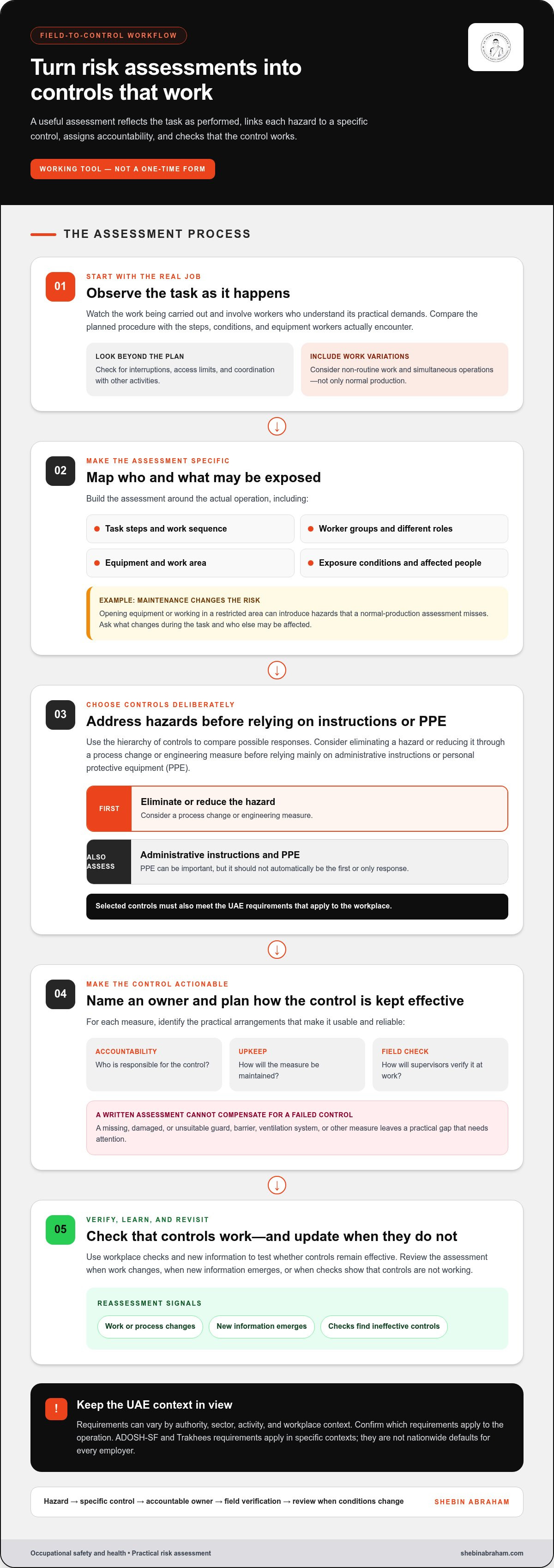
A risk assessment is useful only if it reflects the work people actually perform. Generic templates can overlook task steps, worker groups, equipment, and exposure conditions specific to an operation. Conditions also change. A new process, altered work area, different equipment, or temporary activity can introduce hazards that an earlier assessment doesn’t address.
A useful risk assessment links each identified hazard to a specific control, an accountable owner, and a way to verify that the control works. Treat the assessment as a working tool, not a one-time form. Review it when work changes, new information emerges, or checks show that controls aren’t effective.
Mistake three: copying generic assessments without validating the work
Start by observing the task. Watch it being carried out and involve workers who understand its practical demands. A procedure may describe the planned sequence, while the job includes interruptions, access limits, or coordination with other activities. Include non-routine work, simultaneous operations, and people who may face different risks because of their role or circumstances.
For example, routine operations may not involve opening equipment or working in a restricted area, but maintenance can introduce those hazards. If the assessment covers only normal production, it can miss the conditions created during repair. Ask what changes during the task, who else is affected, and whether controls remain workable throughout the job.
Mistake four: selecting controls that are weak or poorly maintained
After identifying hazards, use the hierarchy of controls to compare possible responses. Consider whether the hazard can be eliminated or reduced through a process change or engineering measure before relying mainly on administrative instructions or personal protective equipment (PPE). PPE can be important, but it shouldn’t automatically be the first or only response. The hierarchy doesn’t replace applicable UAE requirements, so make sure selected controls meet the obligations relevant to the workplace.
Controls can also fail through neglect. For each measure, identify who is responsible, how it will be maintained, and how supervisors will verify it in the field. If a guard, barrier, ventilation system, or other control is missing, damaged, or unsuitable for the task, the written assessment won’t protect workers on its own.
These are common OHS compliance mistakes UAE employers can address by linking assessment findings to clear actions and routine workplace checks. A focused compliance assessment helps translate identified hazards into practical controls and implementation priorities. OHS compliance assessment support can help connect that review to the safety system.
OHS documentation and training mistakes: why records often fail to change practice
Safety records should help people make sound decisions at work. Outdated procedures, incomplete inspection records, or corrective-action logs without clear owners weaken that purpose. They make it harder for supervisors to know what has changed, what remains open, and whether a control is effective. Common OHS compliance mistakes UAE employers need to watch for include treating document completion as the end of the process rather than evidence that the system is working.
Mistake five: keeping outdated or incomplete OHS records
Risk assessments, work procedures, inspection records, and corrective-action logs should reflect current operations. A change to equipment, a work process, or conditions may make earlier instructions inaccurate. Set clear review triggers so relevant documents are checked when changes occur, not only on a routine calendar.
Good document control makes the current version easy to identify and access where work happens. Assign ownership for review and approval, remove or clearly mark superseded copies, and ensure relevant workers can find the instructions they need. Keep records orderly and retrievable, following retention periods that apply to your workplace rather than assuming one period fits every document. If no one is responsible for updating a record or closing an action, it can remain incomplete indefinitely.
Mistake six: recording training without checking understanding
An attendance sheet confirms participation, not that a worker can carry out the task safely. Training should relate to the actual job, use language workers can understand, and leave room for questions. Workers need to know not only the instruction but also how to apply the control when conditions vary or something goes wrong.
Training completion records attendance; demonstrated competency shows that a worker can apply the control in practice. Check understanding through a short discussion, observation, or practical demonstration. For example, after explaining a safe setup, ask the worker to show the steps and describe what they would do if a required control were unavailable. Address misunderstandings before the task proceeds.
Refresh instruction when work, hazards, equipment, or responsibilities change, and record what was covered and any follow-up needed. Use the findings to improve training materials and supervision, rather than simply adding another signature to the file. Connecting records to workplace practice is central to a dependable OHS system.
Contractor, incident, and follow-up failures that allow OHS risks to recur
Contractor work can introduce hazards that aren’t covered by a site’s routine controls. If the employer, contractor, and supervisors have different assumptions about who communicates hazards or checks work, responsibilities can fall between them. Agree on responsibilities before work begins, then coordinate the plan with people affected by the activity.
Mistake seven: managing contractors without coordinating workplace risks
Effective coordination covers work planning, hazard communication, supervision, and interfaces with other activities. Consider a contractor carrying out maintenance while nearby teams continue their usual work. The task may affect access, create noise or other exposure, or require temporary changes to normal operations. Controls depend on the specific work and workplace, so don’t assume one rule suits every sector.
Before work starts, clarify who will brief workers, communicate changes, monitor agreed controls, and raise concerns. Make sure site rules and task-specific arrangements are understood by everyone involved, including teams whose activities may overlap. Clear coordination helps prevent a gap between what the work plan says and what happens in practice.
Mistake eight: closing incidents on paper instead of preventing recurrence
An incident report captures what happened, but an effective investigation also asks why. An immediate cause, such as a worker losing footing, may be only part of the picture. An obstructed route, inadequate planning, unclear responsibilities, or weak supervision may also have contributed. Examine relevant system conditions and establish the facts before assigning blame.
Corrective actions need an accountable owner and a completion measure that shows what has changed. “Remind staff” may be too vague on its own. Specify the action, who will complete it, and how a supervisor will verify that it works during the task. Check whether similar work or locations could be affected, then share relevant learning so the same weakness doesn’t reappear elsewhere.
Use a consistent follow-up sequence:
- Report the incident or concern and record the available facts.
- Assess immediate risks and take proportionate steps to protect people.
- Investigate causes and contributing conditions.
- Assign action to an owner with a clear measure of completion.
- Verify effectiveness in the workplace, then share learning where relevant.
Common OHS compliance mistakes UAE employers can prevent often stem from unclear ownership or actions closed without checking results. OHS consulting support can help review contractor controls and corrective-action follow-through.
How UAE employers can prioritize OHS corrections and sustain compliance
Once gaps are visible, turn the findings into a manageable plan. The common OHS compliance mistakes UAE employers identify don’t all carry the same level of risk or require the same response. Prioritize based on potential harm, how often people are exposed, whether similar failures have recurred, and which obligations apply to the workplace. Don’t rely on an invented score or a generic checklist to make that decision.
A practical sequence for correcting compliance mistakes
Use a clear sequence to move from uncertainty to verified improvement:
- Confirm requirements: Identify the relevant authority, applicable requirements, activities, and workplace scope.
- Identify gaps: Compare requirements and expected controls with actual work, supervision, and available records.
- Rank risks: Consider potential harm, exposure, recurrence, and applicable obligations to decide what needs attention first.
- Assign actions: Record each gap, its risk, a responsible owner, the corrective action, and a review point.
- Verify results: Gather evidence that the action is complete and that workers understand and can use the controls.
Keep the action plan practical. If a control is needed to protect workers from an immediate hazard, address it promptly while planning longer-term improvements. Set review points so supervisors can check progress and confirm that the change holds up in real work, not only in updated documentation.
When experienced OHS consulting can support improvement
OHS guidance can be useful when requirements are unclear, workplace gaps are connected, or internal teams need support turning assessment findings into implemented controls. Consulting can support compliance assessments, documentation, safety-system implementation, and targeted worker training. The aim is to connect regulatory requirements with practical steps that fit the operation.
Requirements are context-specific. ADOSH-SF and Trakhees advisory can support employers where those frameworks apply, but neither should be assumed to govern every UAE workplace. Confirm the current requirements and their applicability to your activities before building them into your system.
With over 20 years of QHSE and OHS experience, Shebin Abraham provides independent guidance to help employers assess gaps and strengthen workplace controls. His consulting services include compliance assessments, documentation, safety-system implementation, and training. A clear, risk-informed plan can help make safety part of daily operations and support the people who depend on it.
Make OHS compliance work in everyday operations
Common OHS compliance mistakes UAE employers need to fix often share one root cause: safety requirements, documents, and controls aren’t connected to the work people do each day. Confirm which requirements apply, address gaps according to risk, and check that corrective actions and training make a difference in practice.
Shebin Abraham brings over 20 years of QHSE and OHS experience to compliance assessments, documentation, implementation, and worker-focused training. His advisory includes ADOSH-SF and Trakhees requirements where they apply to the workplace, without treating any one framework as universal.
Discuss your workplace OHS priorities with Shebin Abraham to explore practical next steps for your team. A clear, steady approach can strengthen compliance while keeping the focus where it belongs: protecting people at work.
Frequently Asked Questions
What are the most common OHS compliance mistakes in the UAE?
Common gaps include generic or outdated risk assessments, controls that aren’t followed in practice, incomplete records, training that isn’t checked for understanding, weak contractor coordination, and corrective actions that aren’t verified. These common OHS compliance mistakes UAE employers can use as a starting point for a workplace review. The specific compliance implications depend on the operation, sector, and applicable authority, so treat a general list as a guide, not a compliance determination.
Do OHS requirements apply the same way to every employer in the UAE?
No. Requirements can depend on an employer’s activities, sector, operating context, and the authority or framework that applies. Don’t assume an emirate-specific or sector-specific system governs every workplace. Identify the requirements relevant to your operations and confirm their current scope. Then translate those obligations into practical controls, assigned responsibilities, and records that reflect how work is carried out.
Can an employer be compliant if all safety documents are complete?
Complete documents are useful evidence, but they don’t prove on their own that workers understand procedures or that controls work consistently. Compare records with actual work by observing tasks, speaking with workers, and checking equipment, supervision, and action close-out. For example, a procedure may be current while a required control is unavailable at the work area. Reliable protection depends on both accurate documentation and effective practice.
How often should an OHS risk assessment be reviewed?
Review timing should reflect applicable requirements, workplace risks, and changes to operations. Revisit an assessment when tasks, equipment, materials, staffing, or work conditions change, or after a relevant incident or evidence that controls aren’t effective. Don’t rely on a universal review interval unless it’s required for your workplace. Confirm the applicable review schedule as part of your compliance process.
What happens if a workplace safety corrective action is not completed?
The hazard may remain, allowing similar incidents or exposures to recur. Record who owns each action, what completion means, and how its effectiveness will be checked in practice. Escalate overdue actions in line with workplace responsibilities and the level of risk. If regulatory duties or reporting requirements may apply, establish the current requirements for the relevant operating context instead of relying on assumptions.
Is safety training attendance enough to demonstrate worker competency?
No. Attendance records show that a session took place, but may not establish that a worker understands or can apply the relevant controls. Use task-appropriate checks, such as discussion, demonstration, or observation. Consider whether the instruction is accessible to the worker and reflects their experience and responsibilities. Record the training delivered, competency checks completed, and any follow-up needed when work or hazards change.
When should a UAE employer seek OHS compliance advisory support?
Consider advisory support when requirements are unclear, repeated gaps emerge, operations change, or your team needs help turning assessment findings into practical action. Shebin Abraham provides OHS consulting with compliance assessments, documentation, safety-system implementation, and training, drawing on over 20 years of QHSE and OHS experience. ADOSH-SF or Trakhees advisory supports workplaces where those frameworks apply.
