
What good is a safety procedure if it doesn’t reflect the work happening on site? The right occupational health and safety consultant UAE organizations engage helps turn applicable requirements into practical controls, clear responsibilities, and routines teams can follow. That support is especially useful when it’s unclear which risks need attention first, or when safety documents look complete but are difficult to apply consistently.
In the UAE, Federal Decree-Law No. 33 of 2021 provides a workplace safety baseline for private-sector employers, while emirate, sector, and free-zone requirements may also apply. This guide explains what OHS consulting can cover, how advisory support connects requirements with day-to-day operations, and when an experienced adviser may be useful. It also outlines what a focused engagement should address, from risk assessment and workable safety arrangements to ADOSH-SF or Trakhees guidance where applicable. With more than 20 years of UAE and GCC experience, Shebin Abraham works collaboratively with organizations to make safety advice relevant to their operations. Consulting supports your team’s efforts, but it doesn’t transfer the organization’s own responsibilities.
Key Takeaways
- An occupational health and safety consultant UAE organizations engage can help turn workplace risks and applicable requirements into controls that fit real operations.
- A useful consulting process starts by understanding the work, then identifies relevant requirements, assesses risks, and sets practical priorities.
- Choose support that fits your need, whether that’s a focused review, ongoing advice, or guidance on ADOSH-SF or Trakhees requirements.
- Prepare available risk assessments, procedures, training records, and authority correspondence to make discussions more focused and useful.
- Shebin Abraham brings over 20 years of UAE and GCC experience to collaborative freelance HSE and OHS consulting.
What Does a UAE OHS Consultant Do?
An occupational health and safety consultant UAE employers work with helps them understand workplace risks and strengthen the controls used to manage them. The role is practical: connect hazards, procedures, and responsibilities with the tasks people actually carry out. The wider field of Occupational safety and health draws on different disciplines to prevent work-related harm and support workers’ well-being.
Effective advice also supports operational continuity. Clear work practices help teams reduce exposure to harm while making responsibilities easier to understand and apply. A consultant informs decisions and works alongside the organization. Management remains responsible for safety arrangements and for putting agreed actions into practice.
Consulting is more than an inspection or a report. It involves interpreting findings, discussing priorities with the people who manage and perform the work, and shaping recommendations to suit actual conditions. Advisory support is distinct from supplying equipment, providing emergency response, or issuing accredited certification. Its value lies in helping an organization make informed, workable improvements.
What problems can an OHS consultant help an employer address?
Support may begin with identifying hazards and assessing the risks associated with particular tasks, equipment, or work areas. An adviser can help the employer prioritize proportionate controls instead of treating every concern as equally urgent. For example, a maintenance procedure should account for the equipment, people, and work sequence involved, rather than simply read well on paper.
A consultant can also review safety procedures and records for clarity and practical use. Training and guidance help workers and supervisors understand their responsibilities, follow relevant safe work practices, and apply controls to their roles. The organization still owns and manages its safety system.
How does UAE regulatory context shape OHS consulting?
Requirements depend on an organization’s activities, site, relevant authority, and applicable regulatory framework. Federal requirements and authority-specific arrangements may intersect, so a framework that applies in one setting shouldn’t be assumed to cover every workplace in the UAE.
MoHRE requirements may be relevant to an employer’s obligations, while ADOSH-SF or Trakhees requirements may apply in particular circumstances. Good advice identifies which requirements are relevant, then connects them to workplace controls. Check current requirements and their applicability before relying on them. For organizations needing focused regulatory guidance, an experienced occupational health and safety consultant UAE teams work with should explain both what applies and how to put it into practice.
How an OHS consultant turns UAE requirements into workplace controls
Useful OHS advice follows a clear route: understand the work, then check whether safeguards are effective. Requirements matter, but they only protect people when they inform workplace decisions. The International Labour Organization describes safe and healthy working conditions as a fundamental principle and right at work, a reminder that regulatory alignment and worker well-being belong in the same conversation.
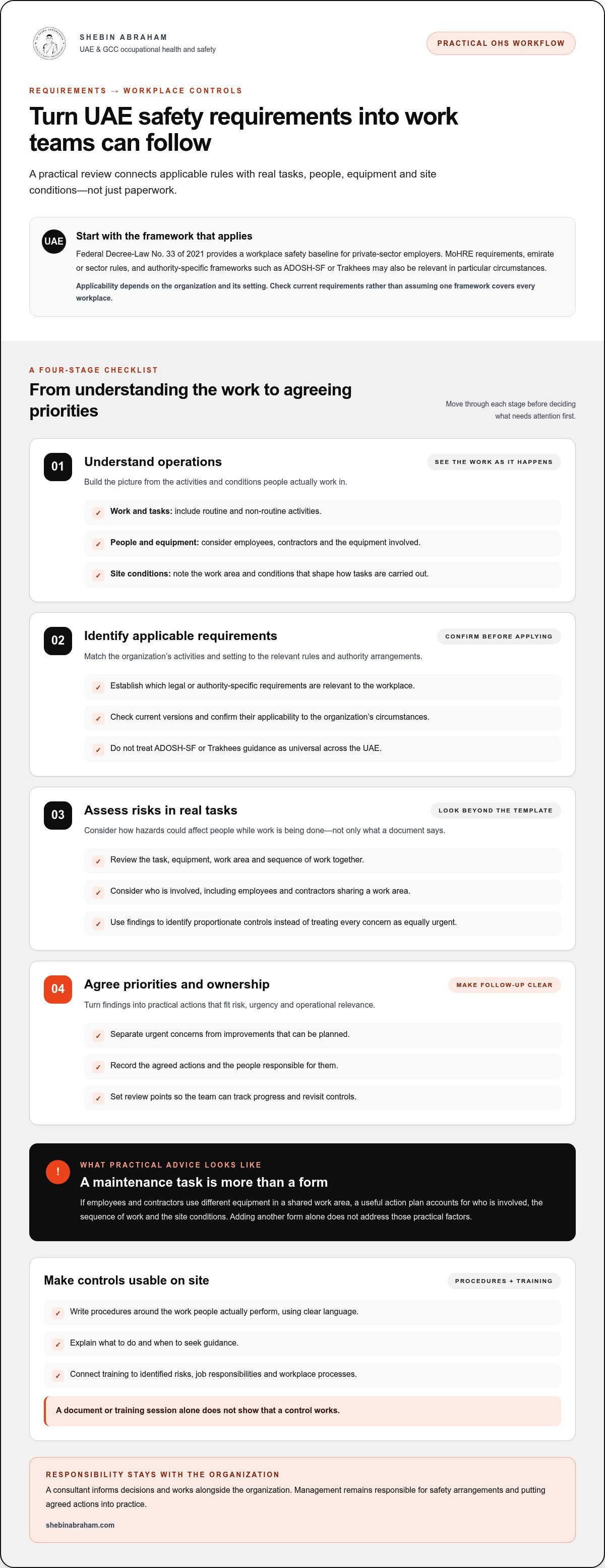
An occupational health and safety consultant UAE organizations engage should connect the applicable framework to their actual activities instead of relying on generic templates. A practical process can move through four steps:
- Understand operations: Review the work, people, contractors, equipment, and site conditions involved.
- Identify applicable requirements: Establish which rules or authority-specific frameworks are relevant, and check their current versions and applicability.
- Assess risks: Consider how hazards could affect people during real tasks, including routine and non-routine work.
- Agree priorities: Set proportionate actions based on risk, urgency, and operational relevance, with clear ownership for follow-up.
From regulatory review to a prioritized action plan
Start with the organization’s activities and existing safety arrangements, such as procedures, risk assessments, and training records. Compare these with applicable requirements and with what happens in practice. Then rank findings so the team can distinguish urgent concerns from improvements that can be planned. Advice relating to frameworks such as ADOSH-SF or Trakhees must reflect the organization’s circumstances and current requirements, rather than being treated as universal across the UAE.
For example, a maintenance task may involve employees and contractors using different equipment in a shared work area. A useful action plan considers who is involved, the sequence of work, and the site conditions. Simply adding another form to the file won’t address those practical factors.
Making procedures and training useful on site
Procedures should describe the work people actually perform, use clear language, and explain what to do and when to seek guidance. Training is most useful when it reflects identified risks, job responsibilities, and workplace processes. A document or training session alone doesn’t show that a control works.
Record agreed actions, responsible people, and review points. Teams can then track progress and revisit controls after changes to tasks, equipment, or conditions, or when experience shows an arrangement needs adjustment. The organization retains responsibility for decisions and implementation; an adviser helps make the route clearer.
Risk assessment identifies what needs attention; practical controls guide the work; follow-up review checks whether those controls still work. For collaborative OHS guidance grounded in workplace realities, explore freelance HSE consulting support.
When should a UAE organization use an OHS consultant?
Bring in an OHS consultant when your team needs focused expertise, additional capacity, or a clear view of what to address next. A consultant can assess, advise, and help shape an action plan, but cannot take over the employer’s responsibility for managing workplace safety. Internal leaders still make decisions, assign resources, and ensure agreed controls are put into practice.
External support doesn’t mean in-house staff lack competence. A fresh perspective can complement their operational knowledge, especially when workloads increase, work changes, or specialist requirements need closer attention. An occupational health and safety consultant UAE organizations engage can provide a structured review while working collaboratively with the people who know the work.
| Situation | Useful support | Intended outcome |
|---|---|---|
| A specific concern or recurring finding | Focused review of the relevant task, procedure, or control | Clear, prioritized corrective actions |
| Changing operations or a new project | Ongoing advisory support as activities and risks develop | Safety arrangements that keep pace with the work |
| A question about an authority-specific framework | Regulatory guidance tailored to verified applicability | Better understanding of relevant requirements and practical next steps |
Is external OHS advice useful when a company already has safety staff?
Yes. An adviser can add capacity during a busy period, bring specialist insight to a defined issue, or help organize a review without displacing internal expertise. For example, safety staff may want support when a project introduces unfamiliar work, findings keep recurring despite corrective actions, or a framework-specific question needs careful interpretation. Internal personnel contribute knowledge of processes and people; the consultant helps them examine the issue from another perspective and agree practical next steps.
When is regulatory-specific consulting relevant?
Specific guidance matters when an organization’s entity, activities, or site may fall under a particular framework. ADOSH-SF advice is relevant where its requirements apply. Trakhees OHS advisory is relevant to operations governed by that framework. Neither should be treated as a universal requirement for every UAE workplace.
Applicability depends on the organization’s circumstances and current authority requirements. A useful review clarifies the relevant framework before recommending actions, then connects the advice to the work and existing safety arrangements. This helps prevent a generic template from being mistaken for a site-specific solution, while keeping accountability with the organization.
What to prepare before working with an occupational health and safety consultant
A focused engagement starts with a clear picture of the work and the concern you want to address. You don’t need to create a perfect document pack first. Gather what’s available, note any gaps, and identify the people who can explain how work is actually done. This helps an occupational health and safety consultant UAE organizations engage tailor advice to operational realities instead of relying on generic templates.
Which information helps an adviser understand your workplace?
Prepare a concise overview of your activities, work locations, workforce roles, contractors, equipment, and higher-risk tasks. Include recent operational changes, incidents, recurring concerns, and upcoming compliance milestones. Existing records are useful context, even if they’re incomplete or organized differently across departments.
- Available risk assessments and relevant safety procedures
- Training records and information about workforce roles
- Relevant authority correspondence or previous review findings
- Details of decision-makers, site contacts, workforce groups, and operational constraints
These materials help the adviser understand not only what the organization has documented, but also where teams need clarity or practical support. Be specific about immediate concerns. An example, such as a procedure that workers interpret differently, can help focus the discussion.
How should the engagement and follow-up be structured?
Agree on the purpose and scope at the outset. Clarify who will provide operational information, who can make decisions, how findings will be discussed, and what practical outputs the engagement should produce. Set expectations for communication and follow-up as well. The organization retains responsibility for its safety decisions and actions; the adviser provides support within the agreed scope.
Involve relevant managers and workers when discussing findings. Their experience can reveal whether a proposed control fits the task, whether instructions are understood, and what may prevent an action from being completed. Keep the agreed actions visible after the review.
- Record each action, its owner, and a suitable target date.
- Note what evidence will show that the action is complete.
- Set a review point to consider whether the control works as intended.
This follow-through helps turn advice into sustained practice. It also gives the team a way to identify lessons and improvements as operations change, rather than treating a report as the end of the process.
Prepare the information you have and define the question you need answered. Learn more about freelance HSE consulting shaped around your organization’s operations.
How Shebin Abraham supports occupational health and safety across the UAE
Shebin Abraham is an independent QHSE and occupational health and safety consultant with over 20 years of experience across the UAE and GCC. He works collaboratively with organizations to connect safety advice with workplace realities, helping teams focus on risks, practical controls, and applicable requirements. For employers seeking an occupational health and safety consultant across the UAE, the value is experienced guidance shaped around the organization rather than a generic set of documents.
Support can be scoped to a specific concern or broader advisory needs. Freelance HSE and OHS consulting helps organizations review safety arrangements, clarify priorities, and strengthen how teams apply procedures in daily work. Customized training and professional mentorship can complement this work by helping employees and safety practitioners understand their roles and put relevant practices into action. These services support capability-building, not standalone certification.
Tailored OHS and regulatory advisory
Regulatory guidance should start with the organization’s activities, risks, and applicable requirements. Where ADOSH-SF applies, advisory support can address relevant documentation, compliance assessments, and implementation planning. The aim is to help teams understand what needs attention and how requirements relate to their operations, not to promise authority approval or certification.
For operations governed by Trakhees requirements, OHS consulting provides guidance on relevant procedures, submissions, and compliance inspections. The useful question is not simply whether a document exists, but whether arrangements suit the work and can be followed consistently. Current requirements and their applicability need to be considered in context.
As an individual adviser, Shebin works alongside organizational teams, bringing their site knowledge together with more than two decades of regional QHSE and OHS experience. That collaborative approach keeps recommendations connected to the people, tasks, and operational conditions they are meant to support.
Practical next steps for UAE employers
Before discussing support, outline your activities, the operational context, and the safety challenge you want to address. You might need help understanding applicable requirements, strengthening an existing procedure, or building confidence in how teams carry out a task. Clear priorities make it easier to define a useful scope and practical outputs.
Every organization’s needs differ. A focused conversation can establish the relevant context, objectives, responsibilities, and suitable consulting support. Your organization retains ownership of its safety decisions and implementation; advisory support helps your team move forward with greater clarity.
To discuss your objectives and operational needs, Discuss your OHS consulting needs.
Make your next safety decision with confidence
Effective OHS consulting helps turn applicable requirements into practical workplace controls, while keeping your organization’s safety responsibilities with management. The right support begins with your operational reality: the work being done, the risks people face, and the actions your team can carry forward.
An occupational health and safety consultant UAE organizations rely on should offer clear, relevant advice, not paperwork disconnected from daily tasks. Shebin Abraham brings over 20 years of UAE and GCC QHSE and OHS experience, with specialized advisory covering ADOSH-SF and Trakhees OHS requirements where applicable. His collaborative approach helps teams understand priorities and connect regulatory guidance with workable arrangements.
Start with the challenge you want to address and the context your adviser needs to understand. A focused conversation can help shape the right scope of support for your organization. Discuss your OHS consulting needs and take a practical next step toward a safer, more consistent workplace.
Frequently Asked Questions
What does an occupational health and safety consultant do in the UAE?
An occupational health and safety consultant UAE employers engage can help identify hazards, assess risks, prioritize controls, and review safety procedures and records. The adviser can also help translate applicable requirements into practical guidance for workers and supervisors. For example, a task procedure may need clearer steps or responsibilities. Consulting supports organizational decisions and implementation; management retains responsibility for workplace safety and maintaining its arrangements.
Is an OHS consultant mandatory for every UAE company?
No, not every UAE company is required to hire an external OHS consultant. Specific requirements depend on the organization’s activities and applicable rules. For example, industrial establishments and construction employers with 100 or more workers are required to appoint a qualified OHS officer. That’s distinct from hiring a consultant. Check current requirements and their applicability to your organization rather than assuming one rule covers every UAE workplace.
Can an OHS consultant guarantee workplace compliance?
No consultant can guarantee workplace compliance. An adviser can interpret applicable requirements, identify gaps, recommend controls, and support documentation or implementation, but the organization must act on that guidance. Management remains responsible for decisions, resources, supervision, and maintaining safety arrangements. Treat consulting findings as a basis for action, then track completion and review whether controls remain suitable as work, equipment, or site conditions change.
When should a business hire an occupational health and safety consultant?
Consider engaging an occupational health and safety consultant UAE businesses can work with when they need a focused risk review, additional advisory capacity, or guidance on a relevant regulatory framework. Triggers may include a new project, changing tasks, recurring safety findings, or uncertainty about existing procedures. External advice can complement in-house staff by adding a structured review or specialist perspective without replacing their operational knowledge or the employer’s responsibilities.
Can an OHS consultant help with ADOSH-SF requirements?
Yes, an OHS consultant can provide ADOSH-SF advisory where the framework applies to an organization. Support may include guidance on relevant documentation, compliance assessment, and implementation planning. The adviser can help connect requirements with workplace procedures and controls, but consulting does not guarantee authority approval or issue accredited certification. Applicability and current requirements should be considered for the entity and its operations before deciding what actions are needed.
What does a Trakhees OHS consultant help with?
A Trakhees OHS consultant provides advisory support for operations governed by the applicable Trakhees framework. Depending on the organization’s needs, guidance may cover relevant safety procedures, required submissions, and preparation for compliance inspections. The aim is to help teams understand applicable expectations and connect them to practical workplace arrangements. Trakhees requirements aren’t universal across the UAE, so confirm their current applicability to the specific entity and activity.
What information should I prepare before speaking with an OHS consultant?
Prepare a short overview of your activities, work locations, workforce roles, contractors, equipment, and higher-risk tasks. Gather available risk assessments, procedures, training records, and relevant authority correspondence. Note recent changes, incidents, recurring concerns, and upcoming compliance milestones. Identify decision-makers and site contacts who can explain how work is done. You don’t need a perfect document pack; existing records and a clearly stated concern help focus the discussion.
