

The cost of a workplace injury in UAE can include medical treatment, continued wages, and compensation for disability or death. According to the Ministry of Human Resources and Emiratisation (MOHRE), an employee receiving treatment for a work injury is entitled to full pay for up to six months, followed by half pay for an additional six months if treatment continues. Employers must cover the full cost of medical treatment until the employee recovers or a disability is confirmed.
For employers, financial impact is only part of the responsibility. Clear reporting, accurate records, and effective safety controls help protect workers and support a well-managed response when an injury occurs.
This article explains how medical expenses, continued wages, and wage-loss benefits contribute to the overall cost, and how disability and death benefits are calculated under UAE rules. It also covers the factors that can affect the total, helping you understand employer obligations and plan a responsible response.
Key Takeaways
- Work-injury costs can include medical treatment and wage continuation, not just the immediate expenses of an accident.
- Disability benefits depend on the degree of disability and the employee’s basic salary.
- Compensation for a work-related death is payable to the employee’s family, alongside other accrued entitlements.
- Understand how insurance coverage, incident reporting and safety controls fit into an employer’s responsibilities.
- Written by Shebin Abraham (IDIP NEBOSH, CertIOSH, MIIRSM), ADOSH-SF Senior OHS Practitioner with 21 years of OHS experience.
Medical costs and wage continuation
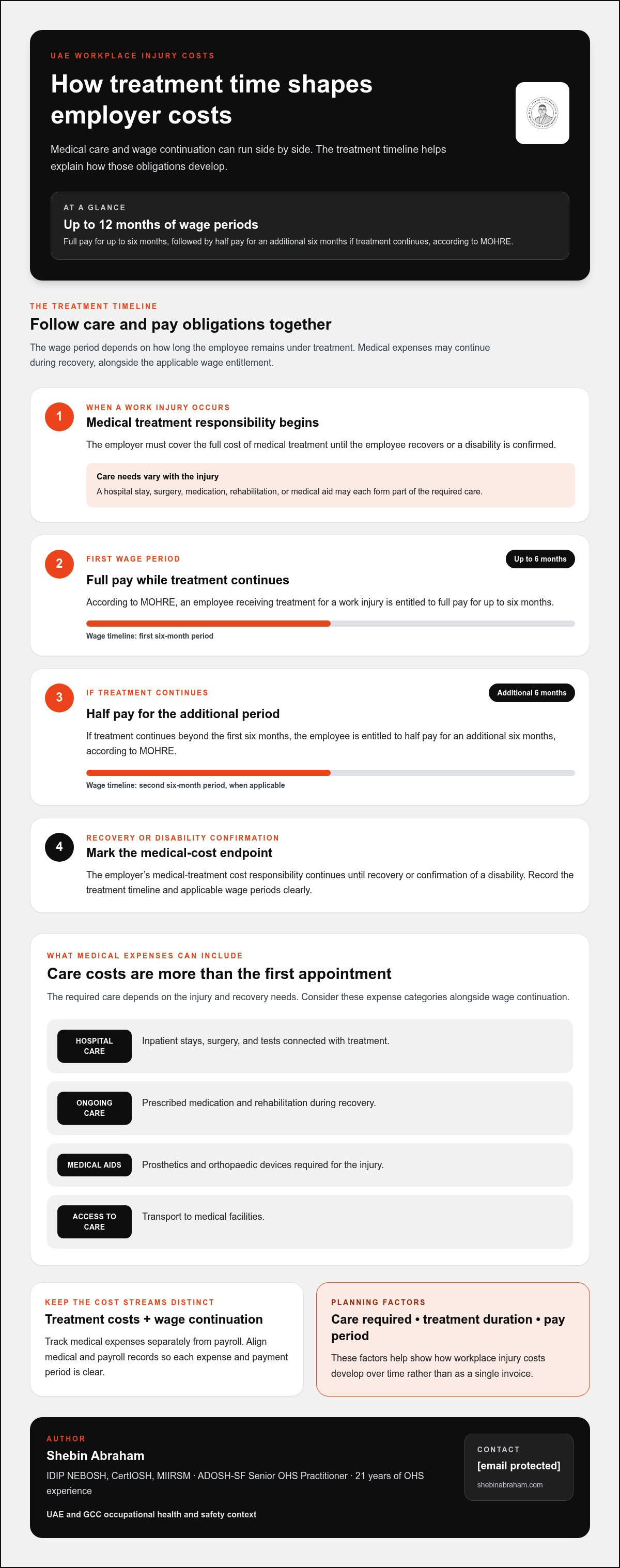
A work injury can create two immediate employer costs: treatment and continued wages. In the UAE, the employer must cover medical treatment until the employee recovers or a disability is confirmed. The medical bill can therefore continue as care progresses, rather than ending after the first appointment. Treatment duration also matters because wage entitlements depend on how long the employee remains under treatment.
According to the Ministry of Human Resources and Emiratisation (MOHRE), an employee receiving treatment for a work injury is entitled to full pay for up to six months. If treatment continues beyond that period, the employee is entitled to half pay for an additional six months, according to MOHRE. Together, these wage periods can extend to 12 months. For an employer, the wage obligation therefore continues alongside the costs of care.
Medical expenses can include hospital stays, surgery, tests, medication, rehabilitation, prosthetics, orthopaedic devices, and transport to medical facilities. The required care depends on the injury and recovery needs. A hospital stay or surgery may involve different costs from medication or rehabilitation, while a prosthetic or orthopaedic device may be part of longer-term care.
- Hospital care: inpatient stays, surgery, and tests connected with treatment.
- Ongoing care: prescribed medication and rehabilitation during recovery.
- Medical aids: prosthetics and orthopaedic devices required for the injury.
- Access to treatment: transport to medical facilities.
Consider these expenses alongside the employee’s pay entitlement. For example, an employee who remains in treatment beyond the first six months may still need medical care while moving from full pay to half pay. The treatment timeline therefore affects both wage costs and the period during which medical expenses continue. Recovery or confirmation of a disability marks an important point in the employer’s medical-cost responsibility.
To assess costs, separate treatment expenses from wage continuation, then map both against the treatment timeline. Keep medical and payroll records aligned so each expense and payment period is clear. This shows how the cost of a workplace injury develops over time, rather than presenting it as a single invoice. The main factors are the care required, treatment duration, and applicable pay period.
Medical expenses, wage loss, disability and death benefits
Beyond treatment and wages, a work injury may lead to temporary wage-loss benefits, disability compensation, or death benefits. The type and amount depend on the injury’s consequences and the employee’s basic salary.
Medical Expense Benefits
Medical-expense benefits cover treatment and related care arising from a work injury. Costs may extend beyond an initial hospital visit to include rehabilitation and medical aids. UAE work-injury expenses can include hospital stays, surgery, tests, medication, prosthetics, orthopaedic devices, rehabilitation, and transport to medical facilities. Identifying these categories helps employers distinguish direct treatment costs from wage-loss and compensation obligations.
For example, an injury requiring surgery may also involve follow-up tests and rehabilitation. Another injury may require medication, transport to a medical facility, or an orthopaedic device. The relevant expenses depend on the care the injury requires. Basic Workmen’s Compensation cover also lists repatriation expenses, which are distinct from transport to medical facilities.
Temporary total disability cover can provide wage-loss benefits while an employee is on sick leave. It addresses income loss while the employee cannot work and treatment and recovery continue. Keep this distinct from medical expenses: one relates to treatment, the other to lost earnings. Reviewing both gives a clearer picture of the financial impact.
Disability and Death Benefits
Disability and death benefits provide compensation when a work injury causes permanent impairment or death. Permanent total disability, permanent partial disability, and death have different calculation methods. In the UAE, a permanent-disability lump sum depends on the assessed degree of disability and the employee’s salary, as determined by a medical committee.
For permanent total disability, compensation equals 24 months of basic salary, subject to a minimum of د.إ 18,000 and a maximum of د.إ 200,000. For permanent partial disability, the applicable schedule’s disability percentage is multiplied by basic wage for 24 months, within the same minimum and maximum. The assessment therefore affects the payable amount.
For a work-related death or occupational illness, the family is entitled to compensation equal to 24 months of the employee’s basic salary, within the د.إ 18,000-200,000 range, according to the Ministry of Human Resources and Emiratisation (MOHRE). The family is also entitled to end-of-service benefits and other accrued entitlements. Cabinet Resolution No. 33 of 2022 specifies compensation amounts payable to dependents.
Separate records for medical expenses, wage loss, and compensation can clarify how each benefit applies. For practical workplace injury risk guidance, see workplace OHS guidance.
Does UAE law require employers to carry workplace injury insurance?
Yes. Workmen’s compensation insurance is mandatory for all UAE private-sector employers under Federal Decree-Law No. 33 of 2021, which came into force in February 2022. The requirement applies even when an employer has just one employee, so there is no minimum headcount threshold. Insurance is part of managing workplace injury liabilities, not an optional benefit reserved for larger companies.
One incident can create several financial obligations at once, including treatment expenses, wage continuation, disability compensation, or death benefits. Workmen’s Compensation insurance covers specified work-related benefits, subject to the policy terms. Employers should understand what their policy covers and how its conditions apply to their workforce and activities.
Coverage depends on the insured workforce and the work performed. Premiums are typically based on payroll, headcount, and activity or industry risk classification. Accurate declarations help align the policy with actual operations. If payroll or workforce numbers change, update those details rather than relying on figures from an earlier policy period.
- Payroll: the declared wages help determine the insured exposure.
- Headcount: the policy information should reflect the people employed.
- Activity and risk classification: the nature of the work affects how exposure is assessed.
Employment arrangements also matter. Coverage for contractors and subcontractors depends on the policy and the employment or contractual arrangement. Distinguish direct employees from contract workers when reviewing coverage. A contractor’s presence on a site does not, by itself, establish which policy responds to an injury. The written insurance terms and working arrangement determine the answer.
Free-zone employers should check which labour requirements apply to their operations. Domestic workers fall under a separate legal framework, with dedicated insurance products for their coverage. Workmen’s Compensation coverage in the UAE is also described within UAE Federal Labor Law and Shariah Law frameworks. Account for these distinctions when identifying the applicable employment category.
Review three items together: the employee register, current payroll declaration, and policy description of covered activities. Compare them with actual staffing and work arrangements, including contractor relationships. This makes gaps and outdated declarations easier to spot before a claim arises. Insurance supports financial planning, while accurate records clarify which people and activities the cover addresses.
What fines or penalties can UAE employers face for workplace safety violations?
UAE federal penalties for health and safety breaches range from د.إ 5,000 to د.إ 1,000,000. The applicable amount depends on the breach and circumstances. A workplace injury can bring medical, wage, and compensation costs, but those costs are distinct from regulatory penalties. Employers should assess both exposures rather than treating a fine as the only financial consequence of a safety failure.
The potential total can rise when a breach affects several employees. UAE health and safety breach fines can be multiplied by the number of affected employees, up to a maximum of د.إ 10,000,000. This means the number of people exposed or affected can influence the overall penalty. The stated ceiling is a maximum, not an automatic fine for every incident or breach.
For example, a safety violation affecting multiple workers may create greater penalty exposure than a similar breach affecting one worker. The exact amount depends on the breach and the affected workforce. Record which workers faced exposure, the hazard involved, and the corrective action taken. Accurate records help explain the scope of an event and the response.
Practical safety controls can help meet obligations and prevent avoidable exposure. UAE employers must provide workers with appropriate personal protective equipment at no cost. PPE should match the work hazard, and supervisors should ensure workers can access and use it. Records of issue and replacement can help demonstrate how the employer managed this control.
- Identify the hazard: record the task, location, and people exposed.
- Apply controls: provide appropriate PPE without charging workers.
- Document follow-up: record corrective action and subsequent review.
These actions help document how the employer addressed a breach. They do not erase an established violation or guarantee a lower penalty. Their value is operational: they help management identify gaps, assign responsibility, and track whether controls are working. For example, repeated reports of missing PPE may point to a supply or supervision issue that needs correction.
Keep penalty exposure separate from insurance and injury-benefit calculations. Workmen’s Compensation addresses specified injury-related benefits, while health and safety fines relate to violations. When reviewing an incident, consider both tracks: the worker’s treatment and entitlements, and the safety conditions regulators may assess. The fine range and employee-based multiplier make prevention, suitable PPE, and accurate incident records important to financial risk management.
Occupational injury
A workplace injury can trigger immediate care, reporting, documentation, and compensation responsibilities in the UAE. The employer’s response affects the worker’s welfare and the records used to assess the incident. Prompt action also helps preserve a clear account of what happened, where it occurred, and which work activity was involved.
Arrange immediate medical attention for an injured employee, then document the incident and witnesses where possible. Record the time, location, task, hazard, and people present. For example, record a fall during maintenance alongside the work conditions and any witness accounts. These details help distinguish the event from later recollections and support the employer’s incident review.
Reporting timelines depend on the type of notification. Employers must report a work-related injury or occupational illness to the Ministry of Human Resources and Emiratisation within 48 hours. An accident resulting in injury or death must also be reported to MOHRE and local police within 24 hours. These requirements address different reporting descriptions, so employers should account for both when responding to an incident.
Compensation timing is another important part of the response. Employers must pay work-injury compensation within 10 days of receiving the medical report confirming the injury or disability. A clear record of when the report arrives helps track this deadline. Keep the medical report, incident record, and payment information together, so the sequence of events can be followed.
Some journeys can qualify as work injuries. An accident while commuting to or from work qualifies if there is no interruption or deviation from the usual route. An accident during the direct usual commute may meet this condition, while a deviation changes the circumstances. Record the route and journey details when reviewing a commuting incident.
Article 38 of the UAE labour law identifies circumstances in which workers forfeit compensation rights. These include deliberate self-injury, intoxication, certain safety-rule violations, wilful misconduct, or refusing medical examination or prescribed treatment without serious reason. Employers should document relevant facts carefully rather than treating an allegation as an established circumstance. The facts and applicable conditions matter.
For employers, the total impact can include care costs, wage obligations, compensation, and reporting duties. Workmen’s Compensation cover generally applies to work-related injury or illness, subject to policy terms, and basic cover applies while an employee is on duty. Clear incident records help connect the event with the work activity and support the claim process.
Review your reporting and incident documentation arrangements so teams can respond promptly. Strengthen your occupational injury response with practical workplace safety oversight.
Compensation is based on a medical report confirming the injury or disability. The employer must pay within 10 days of receiving that report, so keep the medical report and incident records together.
Shebin Abraham: OHS Services
Shebin Abraham’s OHS Services help employers strengthen workplace safety governance and address compliance needs related to injury prevention and response. Turn to this support for practical HSE oversight or guidance aligned with operational requirements, including ADOSH-SF or Trakhees compliance.
Available support includes a Freelance HSE Service, Freelance ADOSH-SF OHS consulting, and OHS Freelancer Trakhees Consulting. Shebin Abraham is an ADOSH-SF Senior OHS Practitioner with IDIP NEBOSH, CertIOSH, and MIIRSM credentials, and 21 years of OHS experience.
Discuss your workplace safety needs with Shebin Abraham to explore OHS support for your operations.
Build a stronger approach to workplace safety
Use an injury-cost review as a starting point for stronger workplace governance. Bring responsibilities, insurance information, incident records, and preventive controls together in a process your teams can follow. Understanding the cost of a workplace injury in the UAE is not only about accounting for what happened. It can also reveal where clearer oversight and better preparation belong in your safety system.
Shebin Abraham’s OHS support helps organisations address workplace health and safety compliance through a practical, collaborative approach. Consider professional guidance when reviewing current arrangements or strengthening safety oversight for your operations.
Contact Shebin Abraham for guidance and take a considered next step toward a safer, more prepared workplace.
Frequently Asked Questions
What does a workplace injury cost an employer in the UAE?
There is no single total: an employer’s exposure can include treatment, wages during recovery, compensation, insurance costs, and penalties for safety breaches. The final amount depends on the care required, recovery period, disability outcome, and incident circumstances. For example, an injury requiring extended rehabilitation may involve different costs from one requiring limited treatment. Assess each expense separately to understand the overall financial impact.
How are medical expenses for work injuries covered under UAE law?
The employer must cover treatment costs for a work injury until the employee recovers or a disability is confirmed. This may involve more than an initial appointment. Keep treatment invoices, medical reports, and payment details together, and link them to the incident record. This helps distinguish costs related to the work injury from unrelated medical spending when reviewing the claim.
What compensation is payable for temporary disability after a workplace injury in the UAE?
Temporary total disability cover can provide wage-loss benefits while an employee is on sick leave. Separately, the Ministry of Human Resources and Emiratisation (MOHRE) states that an employee receiving work-injury treatment receives full pay for up to six months, then half pay for an additional six months if treatment continues. These are distinct considerations: one addresses wage loss through cover, while the other concerns continued wages.
How is permanent disability compensation calculated in the UAE?
Permanent disability compensation is based on the disability degree and the employee’s basic wage. For permanent partial disability, the applicable schedule’s disability percentage is multiplied by basic wage for 24 months, subject to a minimum of د.إ 18,000 and maximum of د.إ 200,000. Permanent total disability compensation is 24 months of basic salary within the same range. A medical committee assesses the disability.
What is the death benefit for a fatal workplace accident in the UAE?
The family is entitled to compensation equal to 24 months of the employee’s basic salary, within the د.إ 18,000-200,000 range, according to the Ministry of Human Resources and Emiratisation (MOHRE). The family is also entitled to end-of-service benefits and other accrued entitlements. Keep employment and salary records accessible, as basic salary is central to calculating the statutory death compensation.
Who pays wages during recovery from a workplace injury in the UAE?
The employer is responsible for the wage continuation required during work-injury treatment. According to the Ministry of Human Resources and Emiratisation (MOHRE), the employee receives full pay for up to six months, followed by half pay for an additional six months if treatment continues. Keep payroll records aligned with medical updates so the applicable payment phase and treatment period are clear.


