
Good HSE mentorship can turn technical knowledge into confident, practical judgement. Safety mentorship for HSE professionals pairs a less experienced practitioner with a seasoned colleague for workplace learning, guidance and useful feedback. A successful programme typically lasts 6-12 months and involves mentors with at least 5 years of experience.
Experience matters, but it is not the only benefit of safety mentorship for HSE professionals. A trusted mentor can help you work through real safety challenges, strengthen communication and leadership skills, and build confidence in your decisions. For organisations, a well-structured mentoring relationship can support consistent safety practices and professional development.
This article explains how mentorship works, who can benefit, what to look for in an effective EHS mentor, and how to give feedback that helps someone grow. It’s written by Shebin Abraham, IDIP NEBOSH, CertIOSH, MIIRSM, an ADOSH-SF Senior OHS Practitioner with 21 years of OHS experience in the UAE and GCC.
Key Takeaways
- Set a clear purpose for mentoring, such as strengthening practical judgement, leadership or professional confidence.
- Agree on expectations early so mentees know how to prepare, ask questions and follow through on development goals.
- Use workplace examples to help new hires recognise hazards, practise safe procedures and understand documentation.
- Choose a mentor who combines relevant HSE experience with patience, integrity and the ability to listen.
- Give feedback that is timely, specific and respectful, then agree on a practical next step together.
What Is a Safety Mentorship Program?
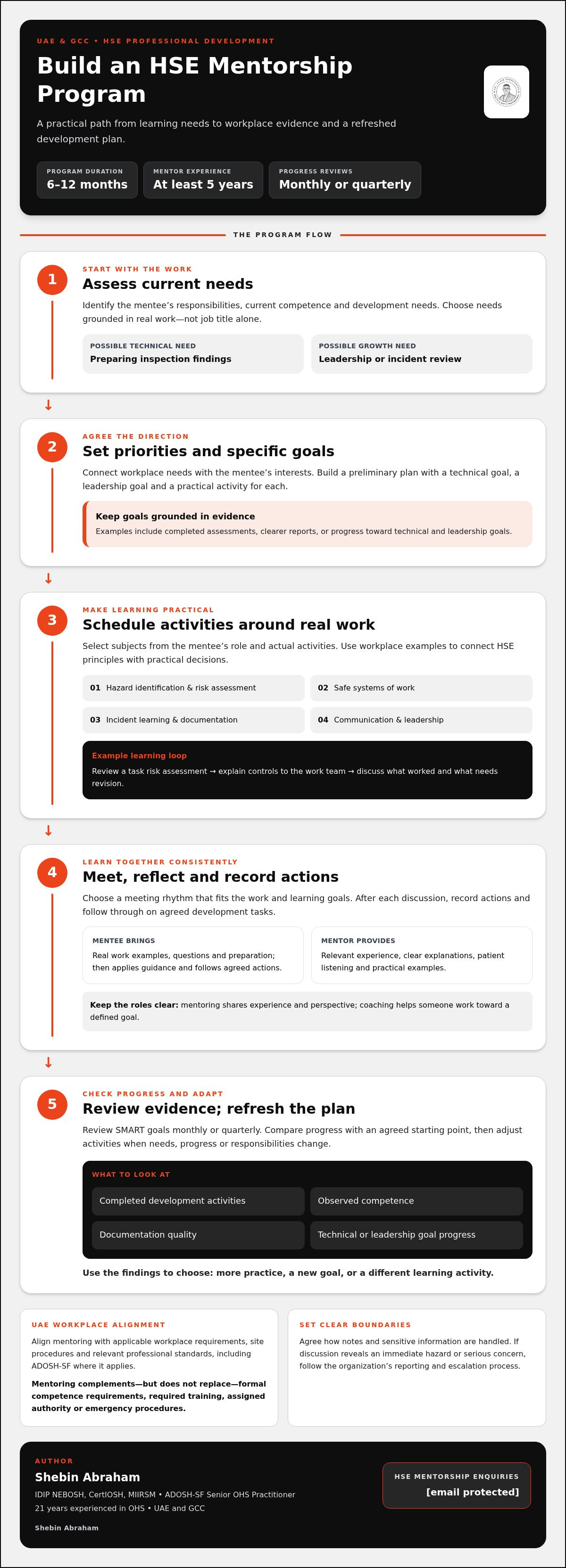
A safety mentorship program links an experienced HSE practitioner with a colleague seeking practical learning and career development. In the UAE, align mentoring with applicable workplace requirements, site procedures and relevant professional standards, including ADOSH-SF where it applies; mentoring complements, but does not replace, formal competence requirements.
HSE Professional Development
Mentors help employees connect HSE principles with decisions made during inspections, risk assessments and incident reviews. A mentee might review a task risk assessment with a mentor, explain the controls to the work team, then discuss what worked and what needs revision. These activities make learning practical and reveal gaps that formal training alone may not address.
Good mentoring also develops judgement, communication and ethical leadership. A mentor can identify obstacles, such as limited site exposure or difficulty presenting findings, and help the mentee choose a manageable response. For example, they could practise explaining an inspection finding before the mentee presents it to a supervisor.
Career Planning and Growth
Career planning turns broad ambitions into practical options and steps. The mentee can identify a current strength, such as inspection practice, and a development need, such as incident investigation or team communication. Together, they can compare potential next roles with the responsibilities and capabilities those roles require.
Choose goals that connect workplace needs with the mentee’s interests. A preliminary plan might include a technical goal, a leadership goal and a practical activity for each. Review progress against evidence, such as completed assessments or clearer reports, and revise the plan when operational demands or career priorities change.
Program Topics and Structure
Useful topics include hazard identification, risk assessment, safe systems of work, incident learning, documentation, communication and leadership. Select subjects from the mentee’s role and actual work activities. The program’s cost depends on delivery format, mentor expertise, scope and duration; the price is provided after a quote request.
Build the program in clear steps: assess the employee’s current needs, agree on development priorities, set specific goals, schedule learning activities and review progress. Distinguish mentoring, which shares experience and perspective, from coaching, which helps someone work toward a defined goal. Then address obstacles and turn the agreed direction into an action plan.
Program Duration and Outcomes
An EHS mentorship program can run for 6 to 12 months, with mentors who have at least 5 years of experience. Set a meeting rhythm that fits the work and learning goals, then record actions after each discussion. Review SMART goals monthly or quarterly, adjusting activities when the mentee’s progress or responsibilities change.
Measure outcomes against an agreed starting point. Track completed development activities, observed competence, documentation quality and progress toward technical or leadership goals. For example, compare an early inspection report with a later one for clearer hazard descriptions and more practical controls. Use the findings to decide whether the plan needs more practice, a new goal or a different learning activity.
Mentee eligibility and responsibilities
HSE mentorship works best when a mentee has a clear learning need and can apply guidance in their role. Match eligibility to the employee’s responsibilities, current competence and development goals, rather than job title alone. A new practitioner might need help preparing inspection findings, while an experienced coordinator may want to strengthen leadership or incident review skills.
Mentees have an active role. They should arrive prepared, bring real work examples, ask questions and follow agreed actions. After discussing a risk assessment, for example, the mentee could revise a section and return with questions about the controls. Managers can help by allowing time for learning activities and linking goals to workplace priorities.
Mentors should have relevant HSE experience and explain decisions clearly. Their responsibilities include listening, sharing practical examples, setting appropriate boundaries and helping the mentee think through options. A capable mentor does not simply provide answers. They might ask the mentee to identify hazards in a work area, explain the chosen controls, and reflect together on what could be improved.
Mentoring should also address emergency preparedness and response. Use the organization’s established emergency arrangements as the reference point, then discuss how the mentee’s role fits within them. A practical session could examine how to raise an alarm, communicate a hazard and follow site instructions during an incident. Mentoring supports learning, but does not replace required training, assigned authority or emergency procedures.
Confidentiality needs clear boundaries from the start. Agree what discussion notes may contain, who can access them and how sensitive employee or incident information will be handled. Mentors and mentees should avoid sharing identifiable details beyond those who need them for the work. If a conversation reveals an immediate hazard or serious concern, follow the organization’s reporting and escalation process rather than treating it as a private mentoring matter.
Consider the work environment when matching people. A mentor from a different function may offer useful perspective, but should understand the mentee’s activities well enough to provide relevant guidance. Managers can support the arrangement by clarifying time expectations and protecting space for meetings without directing every conversation. This balance helps the mentee speak openly while keeping development connected to workplace needs.
For a practical next step, identify one development need, one suitable mentor and one workplace activity where the mentee can practise. If your team needs additional perspective on workplace controls, explore practical HSE support alongside its internal mentoring arrangements.
Mentoring new hires in workplace safety
A new hire needs more than an induction checklist to apply health and safety practices confidently. A workplace mentor can demonstrate procedures, observe the employee performing them, then discuss what went well and what needs correction. During the first 30 days on the job, new hires are most at risk for injuries. Use that period to reinforce safe habits through practical, supervised learning.
Start with the employee’s actual tasks. A mentor can demonstrate safe equipment use, explain the relevant procedure and ask a new hire to describe key hazards before starting work. During a site walk, for example, the pair could identify a slippery floor, damaged equipment or improper waste disposal. The mentee can then explain which controls apply and how to report an unsafe condition.
Small, repeated interactions help build a workplace safety culture. Invite new employees to ask questions during routine activities, not only formal training. If a worker is unsure how to handle a task, the mentor can pause the activity, review the safe method and explain when to seek further guidance. This reinforces that raising concerns is part of responsible work.
Mentors should also show how health and safety connects with communication and documentation. Ask a new hire to practise describing a hazard, recording an observation or explaining a control to a colleague. Review the work together and correct omissions promptly. Mentorship can reinforce accurate records and hazard communication, helping new employees understand why both matter in daily operations.
Pandemic-related risks can change how teams work, communicate and share spaces. Use a task-based discussion to identify current concerns, then explain the workplace’s applicable procedures for hygiene, shared equipment and reporting health concerns. For example, a mentor can discuss how to communicate a changed work arrangement or revised site instruction. Keep the conversation aligned with the organization’s current controls.
Effective mentoring also involves listening. Ask the new hire what feels unclear, then use a real task to explore the gap. The mentor can share experience without encouraging shortcuts or replacing approved procedures. EHS mentees are twice as likely to stay in their roles, and supportive guidance can help employees feel connected to their teams. That relationship can strengthen safety culture while supporting professional growth.
Close each practical session with one action: repeat a procedure, clarify a reporting step or review a hazard-control example. Record the learning point and revisit it during the next suitable work activity. This simple cycle helps new hires make safe practice part of their role, rather than treating safety as separate from the work itself.
Choosing effective EHS mentors
Choose a mentor whose knowledge matches the mentee’s work, not simply the most senior person available. For a construction practitioner, relevant experience might include task risk assessments, contractor coordination and site inspections. In the UAE, consider whether the mentor understands the systems and procedures used at the workplace, including applicable ADOSH-SF or Trakhees requirements.
Technical ability matters, but so does the ability to teach. A strong mentor explains why a control matters, invites questions and adapts guidance to the mentee’s level. For example, they might ask the mentee to explain a hazard before discussing possible controls. This reveals the mentee’s reasoning and gives the mentor a clear starting point.
Assess practical qualities during a short introductory conversation. Look for a mentor who can:
- Give direct, respectful guidance without taking over the mentee’s decisions.
- Listen carefully and ask focused questions about actual work.
- Explain procedures through examples, not unexplained jargon.
- Protect sensitive information and follow workplace reporting arrangements.
- Make time for agreed activities and follow through on commitments.
Match expectations before pairing people. Define the mentee’s development objective, the mentor’s role and how progress will be discussed. If the mentee wants to build confidence in incident reviews, agree to examine a completed, appropriately anonymised case. The mentor can guide the analysis while allowing the mentee to identify contributing factors and propose improvements.
Consider independence and workplace relationships, too. A direct line manager may know the employee’s tasks well, but the reporting relationship can make candid discussion harder. If that is a concern, choose a suitable experienced colleague outside the reporting line. Clarify how mentoring conversations differ from performance reviews, while preserving the organization’s normal process for escalating hazards.
Finally, check that the mentor welcomes the responsibility and can support the agreed subject. A specialist in occupational hygiene may not be the best match for a mentee focused on contractor controls. If the need spans several areas, identify a primary mentor and arrange focused input from relevant colleagues. Review the match through practical examples: can the mentee apply the guidance, explain decisions and identify when further direction is needed?
The workshop teaches participants to give effective feedback while maintaining trust. That emphasis is useful when choosing a mentor: feedback should help the mentee think through work and next steps, rather than leave them unsure whether questions are welcome. In an introductory discussion, notice whether the prospective mentor can be clear about what needs attention while keeping the exchange respectful. The mentee should have room to explain their reasoning and ask for clarification.
Agree on how feedback will be shared during mentoring, so both people understand that honest discussion is part of the arrangement. A mentor can invite the mentee to reflect on what went well, what remains uncertain and what they might try next. This keeps feedback connected to learning while giving the mentee a chance to respond and build confidence in applying guidance.
Communication and feedback skills
Trust makes mentoring conversations useful. The mentor needs to listen closely, ask clear questions and respond without embarrassment or blame. If a mentee misses a hazard in a work area, for example, ask what they observed and how they assessed the risk before addressing the gap. This keeps the discussion focused on the work and makes the mentor’s expertise easier to apply.
Give feedback soon after the activity, while details remain clear. Describe the specific behaviour, explain its effect and agree on a practical next step. Instead of saying, “Your inspection was weak,” identify the missed hazard, explain why it matters and ask the mentee to revise the finding. Specific feedback gives the learner something concrete to practise.
Balance correction with recognition. If a mentee communicates a control clearly during a toolbox talk, name the effective action and explain how it helped the team understand the task. Then identify one opportunity to improve, such as checking whether workers can describe the control in their own words. Honest, respectful feedback can build confidence without hiding a performance gap.
Use questions to encourage reflection rather than provide every answer. After reviewing an incident, ask the mentee to identify contributing factors, evidence and possible preventive measures. The mentor can add occupational health or safety expertise where the analysis needs more depth. This exchange develops independent judgement and shows when a decision needs escalation through workplace procedures.
Listen for barriers behind a performance issue. A mentee who struggles to complete an assessment may need clearer instructions, access to relevant information or more practice with the task. Ask what made the work difficult, then agree on support and a review point. Keep the conversation about observable work, not assumptions about motivation or ability.
Mentoring and coaching can work together, but serve different purposes. A mentor may share lessons from a similar operational challenge, while a coach helps the mentee define a goal and consider options. For instance, the mentor can describe how a clear handover prevented confusion, then ask the mentee to plan improvements for their next shift handover.
Close each discussion with a brief recap: the feedback, the action and how progress will be recognised. Record development points appropriately, while protecting sensitive information and following workplace reporting processes. Consistent communication helps mentors and mentees maintain trust, address concerns early and turn learning into practical change.
Strengthen your team’s mentoring conversations with practical HSE guidance tailored to workplace needs.
Shebin Abraham: OHS Services
Shebin Abraham provides OHS support for UAE organizations that need practical guidance alongside internal HSE development. Services include Freelance HSE Service, Freelance ADOSH-SF OHS consulting and OHS Freelancer Trakhees Consulting. These services can help teams strengthen workplace safety processes and address applicable compliance requirements.
Shebin Abraham is an IDIP NEBOSH, CertIOSH, MIIRSM professional and ADOSH-SF Senior OHS Practitioner, with 21 years of OHS experience. His advisory work can help organizations connect safety management priorities with day-to-day operational needs, while internal mentors continue supporting employees’ professional growth.
For OHS guidance relevant to your workplace, contact Shebin Abraham or visit shebinabraham.com.
Put professional growth into practice
Connect development with a real workplace priority. Choose an HSE challenge your team is addressing, then identify what employees need to learn, practise or communicate more confidently. A focused starting point gives mentoring a clear purpose and helps managers make space for learning alongside operational responsibilities. Review changes in practice and use those observations to shape future development.
When your organization needs an external OHS perspective alongside internal mentoring, Shebin Abraham’s OHS Services can support workplace safety priorities. Safety mentorship for HSE professionals is most valuable when learning stays connected to the decisions that protect people and strengthen daily operations. Share your team’s needs and priorities with Shebin Abraham to discuss a practical way forward.
Discuss your HSE development needs with Shebin Abraham, and take the next step toward a more capable, confident safety team.
Frequently Asked Questions
How will I benefit?
You can gain a clearer understanding of how to apply HSE knowledge to complex workplace decisions. A mentor might help you prepare for a challenging discussion with operations, explain a control in practical terms or decide when an uncertain issue needs escalation. You can also explore career direction, such as deepening risk assessment expertise or moving toward a leadership role.
What is safety mentorship for HSE professionals?
Safety mentorship for HSE professionals is a purposeful development relationship that helps practitioners build judgement and capability through discussion of real work. The pair agrees on what the mentee wants to develop, how they will work together and what boundaries apply. Unlike induction, mentorship continues beyond initial orientation and can address professional challenges as responsibilities evolve.
What skills and qualifications should an HSE mentor have?
An HSE mentor should bring relevant occupational safety experience, sound judgement and the ability to explain decisions clearly. Qualifications such as NEBOSH or IOSH credentials may demonstrate formal learning, but the match should also reflect the mentee’s work and development needs. Look for active listening, discretion and a willingness to distinguish personal experience from workplace procedures or established technical requirements.
How to find a safety mentor for an HSE career?
Start by writing down the capability you want to develop, such as presenting risk findings or preparing for a move into leadership. Then identify experienced colleagues whose work gives them relevant insight, including people outside your immediate reporting line. Discuss expectations and learning goals before agreeing to a match. A clear purpose helps both people decide whether the relationship is a good fit.
What is the difference between HSE mentoring, coaching, and training?
Mentoring draws on an experienced practitioner’s perspective to support broader professional development. Coaching helps someone work toward a defined goal through questions, reflection and agreed actions. Training teaches specific knowledge or procedures, often through a planned course or practical exercise. For example, training can introduce a reporting system, coaching can help improve report delivery, and mentoring can explore longer-term career development.


