

Yes. A customized HSE training workshop in the UAE can support workforce development by connecting safety learning to the hazards, roles and procedures employees encounter at work. Courses can combine lectures, case studies, exercises and tutorials with private study and work assignments, helping participants build practical knowledge alongside core concepts.
Organisations need training that speaks to their workforce and the risks people manage every day. This article explains how tailored workshops can build safety awareness, support hazard identification and address different industry needs across the UAE. It also outlines what to consider when shaping the content, learning activities and follow-up for a team.
Written by Shebin Abraham (IDIP NEBOSH, CertIOSH, MIIRSM), an ADOSH-SF Senior OHS Practitioner with 21 years of experience in occupational health and safety, this guidance connects workforce learning with the practical responsibility of protecting people at work.
Key Takeaways
- Start workshop planning with a needs assessment that identifies workforce roles, existing knowledge gaps and the hazards employees face.
- Use hazard identification and risk assessment to shape practical training around real tasks, safe controls and clear responsibilities.
- Adapt examples and learning activities to each industry and workforce so employees can apply the guidance in their own work settings.
- Choose workshop content and delivery methods that support participation, understanding and follow-through on the job.
- Use OHS consulting when your organisation needs guidance connecting workforce development with its operational and compliance needs across Dubai and the UAE.
Can organisations use Health, Safety & Environment HSE training courses in Dubai to support workforce development?
Yes. HSE training can build workforce knowledge when its content reflects employees’ roles, hazards and learning needs. A customized HSE training workshop in Dubai can also connect course learning with practical workplace decisions.
Training Needs and Course Design
Begin with a training needs assessment: identify job roles, tasks, existing knowledge and workplace hazards. Then set learning objectives that address those needs, rather than choosing a course title alone. Supervisors, for example, may need practice assessing hazards, while employees need clear guidance on task-specific controls. Compare training options by reviewing trainer experience, course content, accreditation and past-student feedback. These factors help determine whether the learning supports workforce development and a stronger safety culture.
Custom Content and Learning Materials
Course design can combine lectures, case studies, exercises and tutorials with private study and work assignments. Ask how each activity supports the objectives and whether examples reflect participants’ work. Slides, audio, video, projectors and lecture notes can support instruction. Custom content should explain relevant procedures and hazards in accessible language. Review reference materials before delivery so terminology, examples and activities fit the workforce and strengthen practical understanding.
Accreditation and Regulatory Coverage
Recognition depends on the qualification and course, so compare the specific awarding or approving body rather than assuming every provider has the same status. The HSE certification program described for Dubai is approved by the Ministry of Education Dubai. For management-system learning, ISO 45001 is the occupational health and safety management systems standard, according to the International Organization for Standardization. Training content should be mapped to applicable UAE and Dubai requirements, sector risks and workplace procedures, without treating a general course as a substitute for site-specific instruction.
Participants, Prerequisites, and Assessment
Confirm participant numbers, entry requirements, assessment methods and certificate terms before registration; these depend on the course. A provider should explain whether learning is assessed through exercises, assignments, examinations or a project. Some HSE courses include a significant project or dissertation, while successful participants receive a Certificate of Completion. The OSHA General Industry course described for Dubai is a 30-hour training course. Workshop duration depends on its scope; onsite delivery can help connect learning to the work setting. Most institutes in Dubai offer online registration, and course fees depend on duration, content and delivery format.
Workplace hazard identification and risk assessment
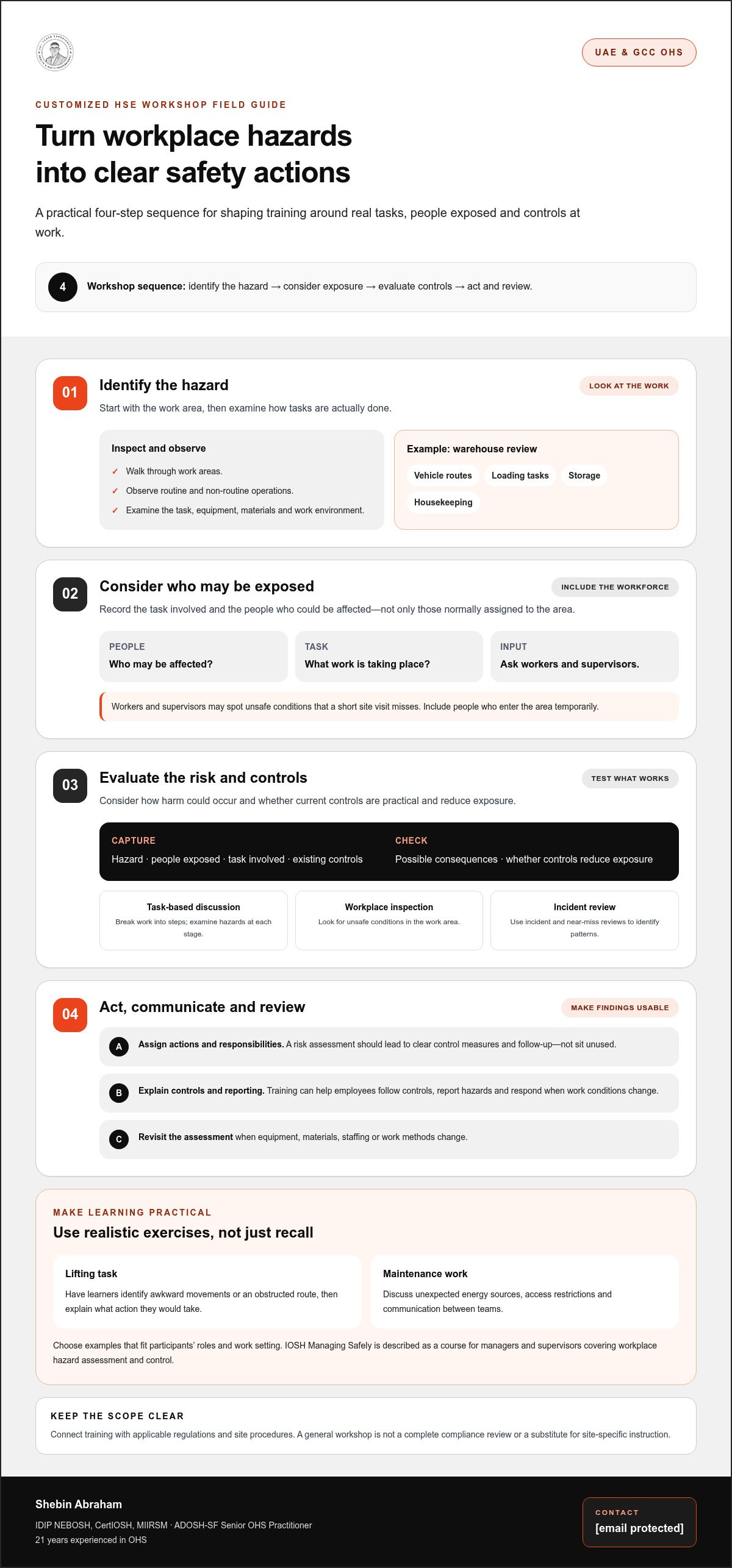
Effective workplace training helps employees recognise hazards before they lead to harm. Start with a walk-through of work areas, then observe routine and non-routine operations. A warehouse review, for example, can examine vehicle routes, loading tasks, storage and housekeeping. Speak with workers and supervisors too, as they may identify unsafe conditions a short site visit misses.
Record each hazard alongside the people exposed, the task involved and existing controls. Then assess how harm could occur and whether the controls are practical. A risk assessment should lead to clear actions, assigned responsibilities and follow-up, not sit unused. Training can strengthen knowledge and skills by showing employees how to report hazards, follow controls and respond when work conditions change.
Use a consistent sequence during a workshop:
- Identify: inspect the task, equipment, materials and work environment.
- Consider exposure: note who may be affected, including workers who enter the area temporarily.
- Evaluate: consider possible consequences and whether existing controls reduce exposure.
- Act and review: assign control measures, explain them to the team and revisit the assessment after changes.
Hazard recognition becomes more useful when learners practise with realistic examples. Ask a group to review a lifting task, identify awkward movements or an obstructed route, and explain what action they would take. For maintenance work, participants can discuss unexpected energy sources, access restrictions and communication between teams. These exercises test whether workers can apply procedures, not simply recall terms.
Risk assessment techniques should fit the work being reviewed. A task-based discussion can break an activity into steps and examine hazards at each stage. A workplace inspection can reveal unsafe conditions, while incident and near-miss reviews can highlight patterns that need attention. IOSH Managing Safely is described as a course for managers and supervisors covering workplace hazard assessment and control. Its subject matter can help structure relevant learning for those roles.
Keep the assessment connected to applicable regulations and site procedures, without presenting a generic workshop as a complete compliance review. Training should explain the controls workers must follow and how to raise concerns through workplace reporting channels. Revisit the assessment when equipment, materials, staffing or work methods change. For organisations refining this process, workplace risk assessment support can help connect hazard findings with focused workforce learning.
Customized HSE training for different industries and workforces
Dubai organisations work across construction, logistics, facilities management, hospitality and office environments. A useful HSE workshop reflects the tasks people perform, not simply their industry label. Construction workers may need practical learning around site access, lifting activities and coordination between trades. Corporate office teams may focus on workstation arrangements, emergency procedures and reporting concerns. These examples help make training relevant without treating every workplace as identical.
Start by grouping audiences according to their responsibilities. Employees need clear instructions for their own tasks, while supervisors need practice communicating controls and responding to concerns. Leadership teams need to understand how decisions about staffing, schedules and work methods can affect safety. Contractors and temporary workers may also need site-specific orientation before joining operations. These distinctions help shape course content that supports compliance and day-to-day understanding.
Industry examples should reflect actual work processes. In a warehouse, a scenario might follow goods from receiving to storage and dispatch, identifying where teams need to coordinate. In hospitality, a workshop can use a kitchen or housekeeping task to discuss safe work practices and reporting routes. Construction participants can review how site teams share information when work areas or task sequences change. Trainers can adapt these examples to the workplace and participants’ knowledge and skills.
- For employees: practise recognising relevant procedures and communicating hazards through workplace channels.
- For supervisors: work through a team scenario, clarify responsibilities and discuss how to reinforce safe practices.
- For leadership: examine how operational decisions shape the resources and expectations supporting safety.
- For mixed groups: use a shared case study, then discuss how responsibilities differ by role.
Language, literacy and prior experience also shape course design. Use familiar terms, visual explanations and demonstrations where they make procedures easier to understand. A new worker may benefit from a guided task walkthrough, while an experienced supervisor may gain more from discussing a complex operational scenario. Ask participants to explain a control in their own words to reveal whether the message is clear and usable.
Effective customized HSE training connects individual actions with corporate processes and leadership oversight. Record the learning objectives, audience, examples and assessment approach, then review whether the content still reflects current operations. When teams, equipment or work methods change, refresh the relevant materials. This makes training a practical part of workforce development, rather than a detached classroom exercise.
HSE training and consulting across Dubai and the UAE
Organisations can connect safety training with occupational health and safety consulting across Dubai and the wider UAE. The right approach links workforce learning to operations, applicable requirements and management-system goals.
Training and Consulting Coverage
Training can build employee understanding, while consulting helps connect that learning with workplace procedures and governance. A team might need instruction on reporting hazards, for example, while managers review how reports inform operational controls. Consider how a program addresses both employee capability and the processes supporting health and safety. This keeps learning relevant to daily work.
Management-system courses can provide a broader framework. ISO 45001 is the occupational health and safety management systems standard, according to the International Organization for Standardization. ISO 14001 is the environmental management systems standard, according to the International Organization for Standardization. These references can help organisations distinguish occupational safety learning from environmental management content when planning programs.
Providers Offering Tailored Training
Dubai providers offering tailored health, safety and environment training include course providers and qualified consultants who adapt learning to an organisation’s needs. Compare accreditation, trainer experience, course content and past-student feedback. Also review whether the proposed program reflects your sector, workforce roles and operational context. Internationally recognised certificate examples include NEBOSH, IOSH and OSHA, but the qualification should match the intended learning outcome.
Ask for a clear explanation of the course structure, learning activities and assessment method. A program using lectures, case studies, exercises and assignments may suit a broader qualification, while a focused workshop can address a specific workplace learning need. A certificate course and tailored in-house learning may serve different objectives. Ensure participants understand what each program covers before enrolment.
For organisations operating across the UAE, align training with the relevant workplace procedures and oversight arrangements. A Dubai team working on a site governed by specific client or authority requirements may need different examples from employees in an office or service setting. Use those operational distinctions to shape scenarios, terminology and learning objectives. This helps participants connect general safety principles with the decisions they make at work.
Consulting can also help turn training findings into practical improvements. Recurring questions during a workshop, for example, may point to unclear procedures, gaps in role understanding or a need to refresh learning materials. Record these themes, assign follow-up actions and review whether employees can apply the guidance. Training and advisory support work best when learning connects to operational practice, management oversight and ongoing occupational health and safety development.
What customized HSE training workshops are available in Dubai?
Organisations can choose between focused workplace workshops and broader qualification-based training. A customized HSE training workshop in Dubai can centre on a defined learning need, while established courses provide structured subject pathways. The right option depends on participants’ roles, work activities and intended learning outcomes.
Examples of available course topics include occupational safety, environmental management and food safety. The International Organization for Standardization identifies ISO 45001 as the occupational health and safety management systems standard. Its course subject may suit teams learning about management systems and safety responsibilities. ISO 14001, also identified by the International Organization for Standardization, concerns environmental management systems. It can guide learning about environmental management processes.
- Hazard control: IOSH Managing Safely is described as a course for managers and supervisors, covering workplace hazard assessment and control.
- General industry safety: the OSHA General Industry course described for Dubai is a 30-hour training course.
- Food safety: HACCP training covers analysis and control of biological, chemical and physical hazards, making its subject relevant to food industry personnel.
- Foundational qualification: the NEBOSH International General Certificate is described as a foundational course focused on global standards and management systems.
These options serve different purposes. A supervisor may need structured learning about assessing and controlling hazards, while a food team may require attention to HACCP hazard analysis. A workforce seeking foundational knowledge may consider a qualification pathway. For a workplace-specific workshop, designers can build activities around the organisation’s procedures, roles and tasks while keeping the learning objective clear.
Before selecting a format, define what participants should know or do after training. Then compare course content with that outcome. Decide whether the aim is general knowledge, understanding a management system or addressing a particular work activity. A workshop can use case studies, exercises or assignments to help participants apply concepts. For example, a team can discuss how a hazard is identified, controlled and reported in its own process.
Course materials and assessment should match the selected pathway. A formal course may include a project or dissertation, while a focused workshop may use practical exercises to assess understanding. Successful participants in HSE training courses receive a Certificate of Completion, according to the Dubai course descriptions. Choose based on learning needs and workplace relevance, not the course title alone. Discuss tailored workshop requirements for your team’s operational context.
Shebin Abraham: OHS Services
Shebin Abraham’s OHS Services can help organisations connect workplace safety priorities with practical occupational health and safety guidance. Turn to his Freelance HSE Service when your team needs support reviewing operational risks and strengthening its HSE approach. His Freelance ADOSH-SF OHS consulting and OHS Freelancer Trakhees Consulting address organisations’ needs relating to those frameworks.
Shebin Abraham holds IDIP NEBOSH, CertIOSH and MIIRSM credentials and is an ADOSH-SF Senior OHS Practitioner. He brings 21 years of OHS experience to his work with organisations in the UAE and GCC. His guidance can help clarify training priorities and connect them with wider OHS considerations. Contact Shebin Abraham to discuss your organisation’s needs, or visit shebinabraham.com.
Turn safety priorities into practical learning
Choose an operational priority and decide what employees should be able to do differently afterward. A focused starting point, such as improving hazard reporting or clarifying task responsibilities, gives your team a practical basis for shaping a customized HSE training workshop in Dubai. Keep the outcome specific, then connect workshop activities to the work people actually perform.
Consider how learning will continue after the session. Supervisors can reinforce key messages during routine discussions, while managers review whether procedures and training remain aligned as operations change. This makes workforce development an ongoing responsibility, not a one-time event. Shebin Abraham’s OHS Services, Freelance HSE Service and Freelance ADOSH-SF OHS consulting support organisations seeking occupational health and safety guidance.
For a considered next step, contact Shebin Abraham about HSE training and share the workplace priorities your team wants to address. With a clear purpose and practical follow-through, your organisation can keep building a stronger, more engaged approach to safety.
Frequently Asked Questions
What is HSE training?
HSE training develops employees’ understanding of health, safety and environmental responsibilities at work. It can help people recognise hazards, follow workplace procedures and report concerns through appropriate channels. A workshop might use a site scenario to practise identifying a risk and explaining the next action. Subject matter and activities should reflect participants’ roles, work environment and operational priorities.
Do you offer customized HSE training programs for companies?
Yes. Shebin Abraham provides customized health and safety training workshops for organisations, alongside OHS and freelance HSE services. A company can outline its workforce needs, operational context and intended learning outcomes to shape a relevant program. A session for new employees may focus on understanding site procedures, while a leadership group may examine how safety responsibilities are communicated and supported.
How can I customize an HSE workshop for my industry, workforce, and site risks?
Begin by defining the audience and the workplace decision the training should improve. Share relevant procedures, task descriptions and recurring employee questions, then group participants by responsibility where useful. A workshop for maintenance staff, for example, could use a work-order scenario to discuss communication and safe planning. Ask the trainer to connect exercises with your work context and explain how understanding will be assessed.
What topics and course formats can a customized HSE workshop cover?
A tailored workshop can cover hazard reporting, safe work procedures, incident learning or environmental responsibilities, depending on the organisation’s needs. Formats may include focused discussion, case-based exercises, practical demonstrations or a structured course. A maintenance team could analyse a task scenario, while managers review how safety information reaches workers. Choose the format according to the objective, audience and workplace setting.
How much does customized HSE training cost in Dubai, and what affects pricing?
The price depends on the case and is provided after a quote request. Key cost factors include the workshop’s scope, content development, delivery format, location requirements and assessment approach. A focused session using existing materials differs from a program requiring tailored scenarios and extensive preparation. When requesting a quote, share the intended audience, learning objectives and operational context so the proposed scope reflects your training needs.
What risks can customized HSE training help reduce, and how is its effectiveness measured?
Relevant training can help workers recognise unsafe conditions, understand procedures and communicate concerns, supporting better control of workplace risks. Measure learning through practical exercises, participant explanations or scenario-based questions. After delivery, managers can review whether employees apply the intended procedure during routine work and whether recurring questions remain. These indicators help identify where refresher learning or clearer workplace guidance may be useful.
How do I book a customized HSE training workshop in Dubai?
Contact Shebin Abraham with a brief outline of your organisation, intended participants and workplace learning need. Include relevant procedures or example tasks where they clarify the context. Then discuss the workshop’s objectives, proposed content, format and assessment approach before agreeing on the scope. This preparation helps ensure the training plan addresses a defined workforce need rather than relying on a generic course description.


