

A compliant Trakhees food and health safety plan should set out practical hygiene, sanitation, food handling and storage controls for the work being done. Trakhees’s Health Manufacturing & Logistics program discusses requirements consistent with MOH and Dubai Municipality requirements. The key is to turn relevant expectations into procedures staff can follow each day.
A plan can become paperwork if it is disconnected from daily work. Clear routines help teams protect people and keep operations orderly. This guide explains how to compare your HSE management system with hygiene and food safety controls, identify gaps and turn them into practical actions.
Review personal hygiene, cleaning and sanitation, food handling, storage, staff awareness and records. A focused gap analysis shows where current arrangements align and where procedures, responsibilities or evidence need attention.
Key Takeaways
- Compare your current hygiene and sanitation procedures with the controls needed for safe handling and storage, then record any gaps clearly.
- Identify which activities and establishment types are relevant to your operation before shaping a food safety plan around day-to-day work.
- Build the plan around practical procedures, staff awareness, assigned responsibilities and controlled supporting documents.
- Review the plan when work practices, processes or identified risks change, and keep revisions traceable.
- Written by Shebin Abraham, IDIP NEBOSH, CertIOSH, MIIRSM, an ADOSH-SF Senior OHS Practitioner with 21 years of OHS experience.
Hygiene, sanitation, handling and storage awareness
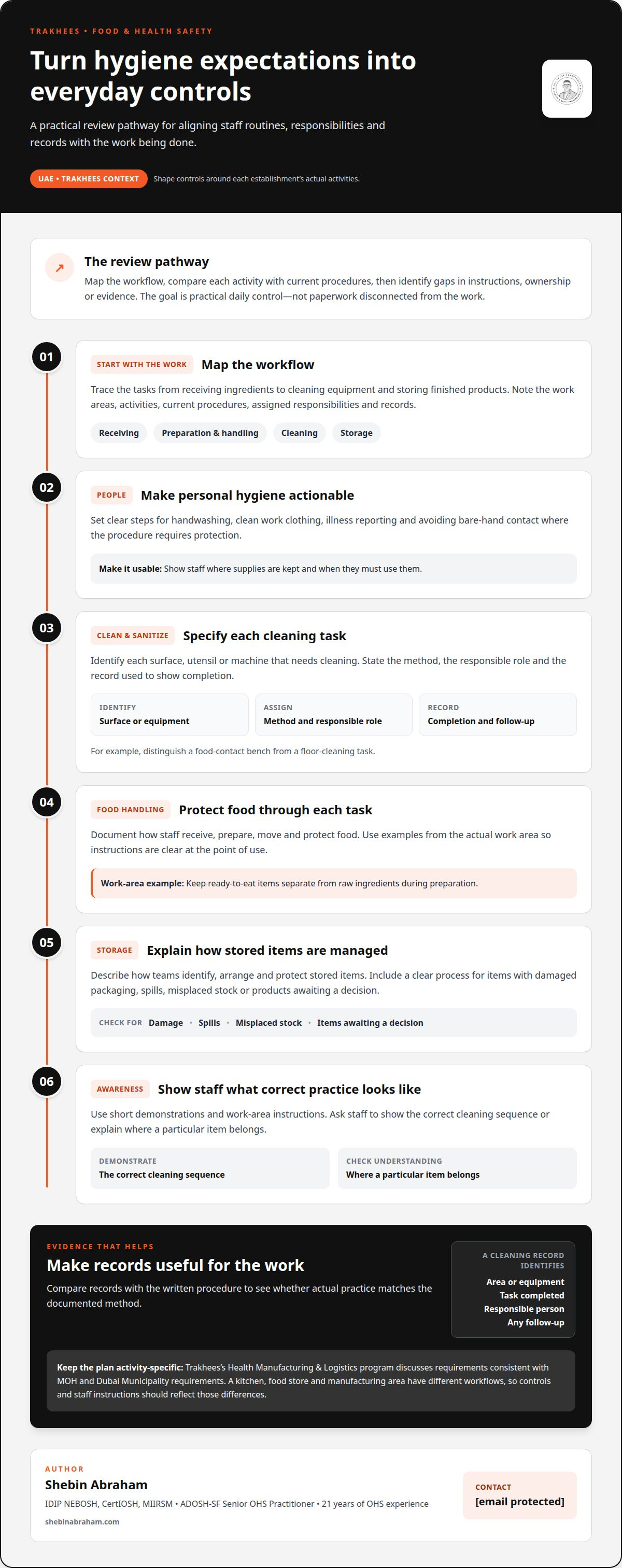
A useful Trakhees food and health safety plan turns hygiene expectations into tasks staff can follow on every shift. Map the work, from receiving ingredients to cleaning equipment and storing finished products. Compare each task with current procedures, assigned responsibilities and records. The goal is to identify practical gaps, not add another document to a folder.
Trakhees’s Health Manufacturing & Logistics program discusses requirements consistent with MOH and Dubai Municipality requirements. Use this alignment as a reference when reviewing procedures, while keeping instructions relevant to the establishment’s activities. A kitchen, food store and manufacturing area have different workflows, so their controls and staff instructions should reflect those differences.
- Personal hygiene: Set clear steps for handwashing, clean work clothing, illness reporting and avoiding bare-hand contact where the procedure requires protection. Show staff where supplies are kept and when they must use them.
- Sanitation: Identify each surface, utensil or machine that needs cleaning. State the cleaning method, responsible role and record used to show completion. For example, separate a food-contact bench from a floor-cleaning task.
- Safe handling: Document how staff receive, prepare, move and protect food. Use examples from the work area, such as keeping ready-to-eat items separate from raw ingredients during preparation.
- Storage: Explain how teams identify, arrange and protect stored items. Include a clear process for damaged packaging, spills, misplaced stock and products awaiting a decision.
- Awareness: Use short demonstrations and work-area instructions. Ask staff to show the correct cleaning sequence or explain where a particular item belongs.
Keep records useful. A cleaning record should identify the area or equipment, the task completed, the responsible person and any follow-up. A storage check should help staff spot misplaced or damaged goods, rather than simply record that shelves were inspected. Compare records with the written procedure to see whether actual practice matches the documented method.
What are the Trakhees food safety plan fees and processing times? Accreditation program registration should be completed at least 5 working days before the program, while plan review timing depends on submission completeness, scope and any revisions.
For personal care context, Trakhees’s Q1 2026 campaign covered 356 establishments and recorded a 94.11% compliance rate. That campaign concerned personal care establishments, so treat it as inspection context, not as a food-sector compliance statistic. Use activity-specific procedures and records to make hygiene controls visible in daily work.
Which businesses need a Trakhees food safety plan?
Start with two details: where the establishment operates and what its licensed activity involves. A food-related business label alone doesn’t explain which controls apply. Map the actual work, then compare it with Trakhees requirements relevant to that site and activity. A restaurant kitchen, food store and production area each handle different tasks.
Businesses that prepare, handle, store or manufacture food should assess whether their operations fall within Trakhees jurisdiction. Consider both the activity on the licence and the work carried out each day. A business might store packaged products, prepare meals or manufacture goods. Each workflow raises different hygiene and storage questions.
The program provides relevant context for businesses assessing health-related manufacturing or logistics activities, but it does not mean every food business follows an identical plan. Consider the licensed scope and actual processes before deciding which documentation fits.
- Food preparation: Map receiving, preparation, cooking or assembly, cleaning, and service. A café preparing meals needs procedures that reflect its own work areas.
- Food storage: Review how products arrive, move, remain protected, and leave the premises. A distribution store handling packaged stock has different daily steps from a restaurant kitchen.
- Food manufacturing: Identify each stage from incoming materials through production and finished-product storage. Use the workflow to assign responsibilities and supporting records.
- Health establishments: Check whether the licensed activity is a personal-care or other health establishment rather than food handling. Trakhees’s Q1 2026 campaign covered beauty centres and men’s and women’s salons, illustrating that health-establishment oversight also covers activities outside food businesses.
Use a simple applicability review. Record the establishment’s location, licensed activity, work areas, products handled and tasks performed. Then identify which steps involve food, hygiene, sanitation or storage. Compare those steps with existing procedures and flag any process without a clear owner or record. This creates a reasoned basis for determining whether the current management system needs food-specific controls.
For businesses with several sites, assess each location separately. A central office may not handle food, while a warehouse stores food products. Keep the site and activity distinction clear to prevent a generic plan from overlooking differences between a preparation area, a store and a logistics operation.
Shebin Abraham, IDIP NEBOSH, CertIOSH, MIIRSM, is an ADOSH-SF Senior OHS Practitioner with 21 years of OHS experience.
What are Trakhees requirements for food safety plans?
Separate documented authority requirements from the practical controls your operation needs. Use relevant requirements to guide a project-specific review instead of assuming every establishment needs identical wording or procedures.
Connect applicable expectations with actual activities. Map receiving, preparation, production, storage and dispatch, then identify the controls and records for each step. This makes the plan usable by staff and helps managers compare documented arrangements with the work performed.
Build the assessment around clear elements:
- Scope: Describe the site, activities and areas covered. Separate food-related operations from unrelated office or support functions.
- Responsibilities: Assign ownership for carrying out controls, maintaining records and escalating issues. Name roles, not only departments.
- Procedures: Link each relevant activity to a documented method. A receiving procedure, for instance, should explain how staff handle an identified concern.
- Records: Identify the evidence that demonstrates procedures are followed. Use forms or logs that show the activity, responsible role and required follow-up.
- Review: Set a process for checking whether documented controls still match current operations. A changed workflow should trigger a review of affected procedures.
Compare the plan with your existing HSE management system. Create a cross-reference showing each relevant control, its current document, responsible owner and revision. Flag gaps where an activity has no procedure, a procedure lacks an owner, or a record cannot demonstrate completion. This creates a clear audit trail.
Keep food-specific controls distinct from broader workplace safety arrangements. An equipment maintenance procedure may support safe operations, but it does not automatically explain how a food-related process is controlled. Link documents where they overlap while preserving the purpose of each instruction.
Use UAE-relevant requirements as your reference point. OSHA is a United States agency, so its guidance is not a substitute for applying Trakhees requirements relevant to a UAE project. A foreign template may help organize information, but adapt its terminology and assumptions carefully.
Test the draft against a real work sequence. Ask a supervisor to trace a product from receipt through its next handling stage using the plan and its records. Turn unclear responsibilities, missing document references and impractical instructions into specific actions in the gap register. This makes a broad comparison actionable without presenting a generic template as an official Trakhees form.
Any unclear handoff should be resolved before the plan is finalized, including who escalates an incident and how that action is recorded. In Trakhees jurisdictional areas, certain workplace accidents and incidents require immediate notification within 24 hours of occurrence. Workplace injuries that leave a person unable to work or perform normal active duties for more than 3 days are also listed among injuries requiring notification. Keep these reporting responsibilities distinct from food-control records while linking them where relevant.
How do I prepare and submit a food safety plan to Trakhees?
Prepare the plan around the establishment’s activities and organize its supporting documents for review. A Trakhees food and health safety plan should connect each relevant process with its control, owner and evidence. Record the site, licensed activity, work areas and food-related tasks to keep the scope focused on the operation being assessed.
- Map the workflow. Trace the work from receiving through handling, storage, production or service. For example, show where a product enters, which team handles it, and where it is stored or prepared.
- Review existing documents. Compare current procedures, records and responsibilities with each workflow step. Note the document title, identifier, owner and revision in a controlled register.
- Record gaps and actions. Identify steps without a clear instruction, assigned role or supporting record. Give each action an owner and a practical completion point, then track its status.
- Involve operational staff. Ask supervisors and employees who perform the work to review the procedures. Their input can reveal differences between written instructions and actual tasks.
- Assemble the submission pack. Arrange the plan and relevant supporting documents in a clear sequence. Use consistent titles and revisions so a reviewer can trace each reference.
Keep the plan distinct from task-level risk assessments. In UAE construction projects, an HSE plan sets out project-wide safety arrangements, while a risk assessment examines hazards and controls for a defined activity. Food-related documents also have their own purpose. Use the HSE system as a framework, but make food processes and their evidence easy to identify.
Before submission, check traceability. Select a workflow step, such as receiving an item, and follow its control through the procedure, assigned role and record. Correct broken references, outdated revisions and unclear ownership. A well-maintained document register makes follow-up easier if Trakhees requests clarification or revised material.
Submit through the process applicable to the establishment and activity, using the required document format and supporting records. Keep the submitted version, revision details and correspondence together. If feedback identifies a gap, log the requested change, update the affected document and record the new revision.
Use relevant requirements to align the plan while ensuring documents describe the site’s actual work. A final review with the people responsible for operations helps confirm that each instruction is practical and can be evidenced.
How often must a Trakhees food safety plan be reviewed or renewed
Set a review schedule in your management system and review the plan whenever a relevant operational change occurs. Do not assume a fixed renewal interval without an applicable Trakhees requirement. Set review timing according to the establishment’s activities, documented controls and changes that could affect food handling or storage.
Distinguish scheduled reviews from reviews triggered by a change. A scheduled review checks whether the plan still describes the operation. A trigger-based review starts when an event changes the work, such as a new process, a changed layout or a revised responsibility. Record the reason for each review to keep the decision trail clear.
Use practical triggers, including:
- Changed activities: Review affected sections before adding food preparation to a site that previously only stored packaged products.
- Altered premises: Reassess procedures when equipment or work areas move, since the documented workflow may no longer match the floor plan.
- Revised responsibilities: Update assigned roles when the person responsible for a procedure or record changes.
- Audit or inspection findings: Link each relevant finding to an action, revised document and closure record.
- Recurring issues: Examine the related procedure when repeated record entries show the same problem, such as incomplete cleaning documentation.
For every review, compare the plan with current operations. Select a process, such as receiving or storage, and trace it through the instruction, responsible role and supporting record. Check that document titles, identifiers and revisions match the controlled register. If the process has changed, record the required update and its owner.
Keep review evidence concise. A review log can record the date, scope, participants, documents examined, identified changes and resulting actions. It helps managers distinguish a full plan revision from a review that found no changes necessary. It also prevents an outdated copy staying in use after a revised procedure takes effect.
Formal renewal is separate from keeping controls accurate. Follow the applicable Trakhees process for any renewal or resubmission and retain the submitted version with related correspondence. Maintain an internal schedule for periodic reviews and updates prompted by events. Set the review interval to suit the pace of change in the business, not an assumed universal period.
For a gap analysis, compare your review log and revision register with the current plan. Arrange Trakhees OHS consulting to help assess document control, review triggers and alignment with your HSE management system.
Shebin Abraham: OHS Services
Shebin Abraham provides OHS Freelancer Trakhees Consulting to help organizations assess gaps between existing HSE arrangements and Trakhees requirements. Turn to this support when your team needs a structured review of procedures, responsibilities, document control or corrective actions for its food safety plan.
Shebin Abraham is an ADOSH-SF Senior OHS Practitioner with IDIP NEBOSH, CertIOSH and MIIRSM credentials, and 21 years of OHS experience. His advisory approach focuses on making compliance arrangements clear, traceable and relevant to the work being performed. This can help teams organize their review findings and identify practical next steps within their management system.
Contact Shebin Abraham to discuss your Trakhees OHS consulting needs.
Make Your Next Review Count
A plan becomes more useful when reviews lead to clear ownership and visible progress. Choose a gap that affects daily work, assign responsibility for addressing it and record how the change will be reflected in the management system. This gives your Trakhees food and health safety plan a practical role beyond document submission, connecting safe working habits with accountable oversight.
Keep communication between operations and safety personnel active. The people doing the work can identify where procedures need clearer instructions or better document control. A focused review also helps managers decide which improvements to prioritize.
For support aligning your HSE arrangements with Trakhees expectations, contact Shebin Abraham to discuss your plan. A thoughtful next step can make compliance work clearer for the people responsible for putting it into practice.
Frequently Asked Questions
What is a Trakhees food safety plan in Dubai?
A Trakhees food and health safety plan describes how a food-related business manages relevant hygiene and safety controls. It should fit the establishment’s activities rather than copy a generic template. A food store and a meal-preparation area, for example, have different workflows to document.
What documents are required for Trakhees food safety plan approval?
Prepare a document package that explains the site’s activities and how its controls are managed. Supporting material can include the plan, relevant operating procedures, staff responsibility records, monitoring forms and a controlled document register. Link each record to the procedure it supports, such as a cleaning record to a cleaning procedure. Organize documents by title and revision, and keep references consistent throughout the package.
What food safety standards and HACCP rules does Trakhees require?
Identify applicable food safety controls based on the establishment’s activity and documented processes. HACCP is a food safety framework, but it should not be described as a specific Trakhees rule or certification requirement unless it applies to the operation’s governing requirements.
What are Trakhees requirements for food handlers and Person in Charge certification?
Give food handlers clear, role-specific instructions for their tasks, such as receiving, preparation, cleaning or storage. Link training evidence to relevant duties and use demonstrations to check whether staff can follow procedures. Trakhees lists health-establishment courses for salon and laundry activities, but those course names do not establish food-handler or Person in Charge certification requirements for food businesses.
What inspections, violations, and penalties apply to Trakhees food businesses?
Inspection scope and any enforcement action depend on the activity and applicable requirements. Trakhees’s Q1 2026 inspection campaign described in this article covered personal care establishments, so its findings shouldn’t be treated as food-business inspection results. For a food operation, keep current procedures and records accessible, document any identified issue, and track corrective action through closure. Don’t assume a penalty amount or violation category applies without an applicable basis.
What are the Trakhees food safety plan fees and processing times?
Plan review timing depends on submission completeness, scope and any revisions.


