

The cost of an OHS consultant in the UAE depends on your organization’s needs, operational risks, and the level and duration of support required. There is no single fee for every assignment. Shebin Abraham’s consultancy fees are based on the agreed scope, complexity, and delivery requirements.
Look beyond the fee: a consultant’s qualifications, relevant sector experience, and practical approach all matter when workplace safety and business continuity are at stake. This article explains what affects consultancy costs, how to assess a consultant’s credentials and experience, and how OHS services can support your workplace, including advice on ADOSH-SF and Trakhees requirements.
Written by Shebin Abraham, IDIP NEBOSH, CertIOSH, MIIRSM, an ADOSH-SF Senior OHS Practitioner with 21 years of experience in OHS, this guide focuses on practical, human-centred advice for workplaces in the UAE and GCC.
Key Takeaways
- Assess a consultant’s qualifications and relevant UAE regulatory experience alongside their formal credentials.
- Look for an implementation approach that turns findings into practical improvements for your workplace.
- Understand how a gap analysis and risk assessment can help identify priorities and guide OHS planning.
- Match the consultancy service to your workplace needs, including relevant ADOSH-SF or Trakhees requirements.
- Compare providers by the scope of support and their experience, not cost alone.
Consultant qualifications and practitioner registration
Choose a consultant whose qualifications match your workplace risks, sector, and applicable UAE requirements. A certificate demonstrates formal learning; practical experience shows how that knowledge can be applied to real operations.
For work on the UAE mainland, OHS consultancy may require clearance or registration with the Ministry of Human Resources and Emiratisation (MOHRE). Check whether the consultant’s registration or clearance applies to the work in scope. Recognized qualifications such as NEBOSH, IOSH, or equivalent credentials can demonstrate professional knowledge, but the appropriate level depends on the assignment.
When choosing and verifying an OHS consultant in Dubai, Abu Dhabi, or another emirate, review the qualification level, awarding body, relevant sector experience, and applicable registration. Ask how the consultant will apply those credentials to your workplace and its governing requirements.
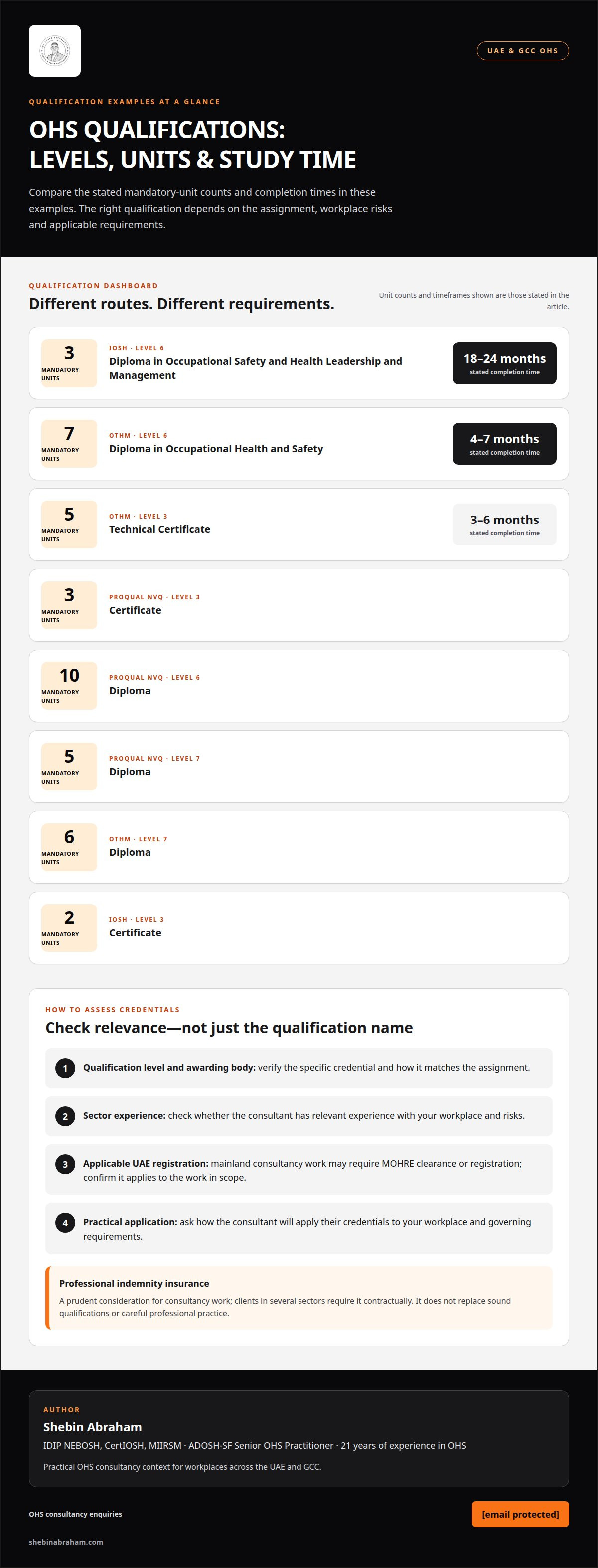
IOSH, OTHM, and ProQual NVQ qualifications cover different levels and learning routes. For example, the IOSH Level 6 Diploma in Occupational Safety and Health Leadership and Management has 3 mandatory units and a stated completion time of 18 to 24 months. The OTHM Level 6 Diploma in Occupational Health and Safety has 7 mandatory units and a stated completion time of 4 to 7 months.
- The OTHM Level 3 Technical Certificate has 5 mandatory units and a stated completion time of 3 to 6 months.
- The ProQual NVQ Level 3 Certificate has 3 mandatory units; its Level 6 Diploma has 10.
- The ProQual NVQ Level 7 Diploma has 5 mandatory units; the OTHM Level 7 Diploma has 6.
- The IOSH Level 3 Certificate has 2 mandatory units.
These examples help distinguish OHS diplomas from shorter certificates. International qualifications can demonstrate structured learning, while national requirements and workplace practices determine how that knowledge is applied. Highfield qualifications may also appear in a consultant’s profile; assess the specific qualification, level, and relevance rather than relying on the awarding-body name alone. In Sharjah or another emirate, sector-specific requirements can influence which credentials matter most.
Professional indemnity insurance is a prudent consideration for consultancy work, and clients in several sectors require it contractually. Ask how the consultant’s cover relates to the scope of advice, reports, and implementation support. Insurance does not replace sound qualifications or careful professional practice.
Failure to meet applicable UAE workplace safety requirements can lead to regulatory consequences, disrupt operations, and undermine workforce confidence. Specific penalties depend on the applicable requirement and circumstances. Unresolved hazards may also affect continuity, project delivery, and contractual relationships.
Consultant experience and implementation approach
Experience matters most when it helps translate occupational health and safety requirements into workable routines. A consultant familiar with construction, for example, can consider contractor coordination, changing work areas, and site activities. In an office, the practical priorities may differ. Relevant experience connects advice to the actual workplace, rather than relying on a generic template.
Look for an approach that starts with understanding your operations. The consultant can review work activities, existing procedures, incident records, and management responsibilities. Discussions with supervisors and workers help reveal how tasks happen in practice. This context can show whether a written policy has a gap or whether an existing control needs clearer implementation.
The next step is to turn findings into an ordered plan. Each recommendation should identify the issue, proposed control, responsible role, and method for tracking progress. For example, if a site procedure no longer reflects a changing construction activity, the consultant can help align the documented process with the work being done.
A management system also needs to function beyond the initial review. ISO 45001:2018 is an international occupational health and safety management system standard, according to the International Organization for Standardization. Its features include a risk-based approach, leadership and worker participation, integration with other management systems, and continuous improvement. These elements provide a useful frame for considering implementation.
Experience across industries helps a consultant recognize that one solution will not suit every operation. Construction, logistics, and office-based work involve different tasks and exposures. A practical adviser adapts the process to the workplace, considers relevant environmental interfaces, and explains why a control suits the activity. This makes guidance easier for managers and teams to apply.
Implementation also depends on communication. The consultant should explain findings clearly, discuss operational constraints with relevant staff, and distinguish urgent corrective actions from longer-term improvements. A supervisor, for example, needs to understand not only what a procedure says, but how it applies to the shift’s assigned tasks and oversight.
Training should support the work system, not sit apart from it. NEBOSH knowledge can strengthen professional understanding, while suitable safety training helps workers understand procedures relevant to their roles. A consultant can connect training topics to observed work practices and help management plan how understanding and implementation will be reviewed.
Finally, assess the consultant’s method by reviewing the assignment’s outputs and follow-through. A coherent process links workplace review, prioritized recommendations, assigned responsibilities, and progress checks. This sequence helps turn advice into active safety management, keeping occupational health and safety part of daily operations rather than a document filed away after completion.
Gap analysis and risk assessment
A gap analysis compares current workplace arrangements with applicable regulatory and organizational requirements. In the UAE, it should take account of the relevant authority and operating context rather than treating every site alike. For example, a consultant can compare existing procedures, training records, and inspection findings with the requirements governing a specific operation.
Risk assessment examines work activities and how people could be harmed. The consultant reviews actual operations, observes tasks, and speaks with workers and supervisors. In a warehouse, for instance, an assessment may examine vehicle movements, pedestrian routes, and how work instructions are used during active shifts.
Useful findings connect each gap or hazard to a clear decision. The consultant records what was observed, which people or tasks are affected, and what controls are already in place. This helps distinguish a missing procedure from one that exists but is not followed consistently.
- Set the scope: identify the site, work areas, activities, and relevant regulatory framework.
- Gather evidence: review procedures, records, inspections, and incident information.
- Assess exposure: observe tasks and discuss practical conditions with workers.
- Prioritize action: connect each finding to a suitable control, owner, and review method.
Prioritization should reflect the seriousness of potential harm and the effectiveness of existing controls. A leading indicator, such as repeated inspection findings, can reveal a weakness before an injury occurs. Incident information adds context, but a low incident count alone does not show that every hazard is adequately controlled.
Regulatory mapping depends on the workplace. The consultant identifies the applicable authority and requirements, then compares them with operational evidence. Dubai Municipality and Abu Dhabi Occupational Safety and Health Center are among the UAE authorities identified in occupational safety matters. A project operating under a particular jurisdiction may need a tailored review of its applicable rules.
Assessment results should prompt action, not simply produce a report. The consultant can group findings by operational priority, explain why each control matters, and identify where management decisions or worker input are needed. For example, a change to a work process may call for updated instructions and relevant safety training.
Courses can address identified skills gaps, but training alone cannot fix every weakness. If an assessment finds unclear responsibilities, management arrangements may also need revision. A useful review links occupational health risks, regulatory gaps, controls, and follow-up in one practical workplace plan.
HSE consultancy services in the UAE
OHS consultancy services in the UAE can connect workplace safety arrangements with daily operations. The scope should reflect the work, applicable authority, and support your organization needs.
HSE Consultancy Offerings
Consultancy may include reviewing safety management arrangements, conducting audits, identifying gaps, and advising on practical improvements. An audit, for example, can assess whether written procedures match workers’ tasks. The consultant can explain the findings and help management prioritize follow-up actions.
Some assignments focus on a management system. ISO 45001:2018 is an international occupational health and safety management system standard, according to the International Organization for Standardization. Consultancy can support system development or review, including attention to risk-based planning, leadership, worker participation, and continual improvement. This support is distinct from issuing certification.
Other work may focus on safety compliance within a specific jurisdiction or operating context. Dubai Municipality and Abu Dhabi Occupational Safety and Health Center are among the UAE authorities relevant to workplace safety requirements. Advice for an organization operating under the Abu Dhabi framework, for example, should reflect its context and applicable requirements.
Consider the assignment’s outputs as well as its title. A useful scope identifies the sites or activities to be reviewed, the records or processes involved, and how recommendations will be reported. Clear deliverables connect audits and advice to management decisions instead of leaving findings as disconnected observations.
Sector and Hazard Specialization
Construction, manufacturing, logistics, and office-based workplaces face different safety considerations. Construction sites may involve changing work areas and contractor coordination. Logistics operations may need close attention to vehicle and pedestrian interactions. Relevant hazards depend on the tasks, equipment, layout, and organization of work.
Specialized OHS consulting should account for these differences. When reviewing a construction project, a consultant can consider how site activities and responsibilities change as work progresses. In a warehouse, the review may focus on interactions among workers, vehicles, and storage areas. These examples show why advice should reflect actual operations, not just a sector label.
Environmental and occupational health considerations can also overlap with workplace safety. The consultant can examine how a process, work area, or management procedure affects people and operational controls. For organizations using an integrated management system, the review can consider how health, safety, and environmental processes relate while keeping their distinct purposes clear.
Choose a scope that specifies the work activities and locations under review. A single-site audit, for example, may differ from support covering several operating locations or contractors. The consultant should explain how findings will be organized, how safety compliance concerns will be raised, and how recommendations can strengthen workplace safety culture.
Which UAE companies provide OHS consulting, and how do their services compare?
UAE organizations can engage independent practitioners, specialist consultancies, or providers that combine advisory work with safety training. The right fit depends on the scope, relevant regulatory knowledge, and how closely the support needs to connect with daily operations.
Compare the work delivered, not just provider labels. One assignment may need a focused compliance review; another may require ongoing guidance across several activities. A project involving ADOSH-SF requirements needs relevant framework knowledge, while Trakhees-related work calls for familiarity with that authority’s OHS requirements.
Different delivery models suit different needs. An independent consultant can provide direct, focused advice for a defined assignment. A larger consultancy may offer a broader team or multiple disciplines. A training-led provider may focus on courses, while an embedded practitioner may support ongoing workplace processes. These are service models, not measures of quality in themselves.
Use the following comparison points to clarify what each proposal covers:
- Scope: Identify sites, activities, deliverables, and applicable requirements.
- Practitioner: Match qualifications and experience to the work and sector.
- Method: Understand how reviews, recommendations, and follow-up are handled.
- Continuity: Determine whether the need is a defined review or ongoing support.
- Training: Establish whether safety training is relevant to the assignment.
Provider experience should relate to your operating context. A construction project, for example, may need advice that accounts for changing site activities and contractor interfaces. If you need Trakhees-related support, prioritize experience relevant to those requirements rather than relying on a general safety profile alone.
Compare proposals for clarity. A useful proposal explains the work included, intended outputs, the consultant’s role, and how findings will inform decisions. If two proposals use similar labels, compare their actual deliverables. An audit, a gap review, and ongoing advisory support are different scopes, even when each concerns workplace safety.
Training and certification also need careful distinction. A provider may deliver courses or advise on a management system, but certification issuance is a separate activity. For example, ISO 45001:2018 is an international occupational health and safety management system standard, according to the International Organization for Standardization. Clarify whether a proposal concerns advisory support or certification.
For a defined UAE requirement or practical review, discuss your OHS consulting needs and the scope of support that fits your workplace.
Shebin Abraham
Shebin Abraham provides practical OHS guidance to organizations assessing consultancy needs, workplace risks, or UAE compliance requirements. His services include OHS Services and Freelance HSE Service, with specialist consulting aligned with ADOSH-SF and Trakhees requirements.
As an ADOSH-SF Senior OHS Practitioner with 21 years of OHS experience, Shebin Abraham holds IDIP NEBOSH, CertIOSH, and MIIRSM credentials. This experience supports a grounded approach to reviewing workplace needs and shaping relevant advice for organizations in the UAE and GCC.
Consider reaching out when you need professional input to clarify OHS priorities or support a compliance assignment. Contact Shebin Abraham to discuss your workplace needs.
Turn your OHS priorities into a practical next step
Choose a scope that reflects the work your organization needs, rather than treating consultancy as a one-size-fits-all purchase. A clear discussion of your operational priorities can help shape relevant OHS support and make the next steps easier to define. The cost depends on the case and is given after a quote request, with scope, complexity, and delivery requirements shaping the fee.
For organizations seeking an OHS consultant in the UAE, Shebin Abraham offers OHS Services, Freelance HSE Service, and Freelance ADOSH-SF OHS consulting. These services support workplaces seeking practical advice and guidance on applicable requirements, connecting professional input with organizational needs and operating context.
Start by outlining the workplace concern, the relevant site or activity, and the kind of support you need. That gives the discussion a useful direction without committing your organization to a predetermined solution. Contact Shebin Abraham about OHS consultancy to discuss a suitable next step for your workplace.
Frequently Asked Questions
How much does an HSE consultant cost?
The fee depends on the assignment’s scope, complexity, duration, and required outputs. A focused review of one process differs from support across multiple sites or ongoing operational needs. Existing documentation, applicable requirements, site access, and follow-up can also affect the work involved. Define the intended outcome first, such as an audit report or support implementing corrective actions.
Do I need to comply with ADOSH or OSHJ?
Apply the occupational safety framework relevant to your organization’s jurisdiction and activities. ADOSH-SF requirements apply to entities within the Abu Dhabi framework; other UAE workplaces may fall under different authority or free-zone requirements. The acronym OSHJ alone does not establish which framework applies. Clarify the scheme and governing authority for the workplace, then scope advice against those requirements rather than treating ADOSH-SF and OSHJ as interchangeable.
What does a health and safety consultant do in the UAE?
A health and safety consultant helps an organization address workplace risks and strengthen its safety arrangements. After a change in equipment or work processes, for example, the consultant can review how that change affects existing procedures and staff responsibilities. Work may include audits, risk assessments, compliance advice, or management-system support. The deliverable should match the organization’s need, whether a defined review or continuing guidance.
What does an occupational health and safety (OHS) consultant do in the UAE?
An OHS consultant focuses on preventing work-related harm and supporting effective occupational health and safety arrangements. This may involve examining how tasks affect workers, identifying gaps in controls, and advising managers on practical improvements. A review, for example, can consider whether a process change creates new exposures or training needs. The consultant provides advice and implementation support so the organization can make informed decisions about its operations.
Which UAE regulations and standards apply to workplace health and safety?
Requirements depend on the workplace’s jurisdiction, sector, and activities. Federal Law No. 8 of 1980 and subsequent ministerial resolutions are cited as requiring UAE employers to meet workplace safety standards. Relevant authorities include MOHRE, Dubai Municipality, and Abu Dhabi Occupational Safety and Health Center. Free-zone rules may also matter, including those relevant to DIFC, JAFZA, or ADGM. ISO 45001:2018 is an international management-system standard, not a UAE law.
What qualifications and accreditations should an OHS consultant in the UAE have?
Look for relevant occupational safety qualifications, such as NEBOSH, IOSH, NVQ, or OTHM credentials, suited to the assignment. Review the exact qualification level and awarding body, then consider sector experience and knowledge of the applicable UAE framework. For work requiring practitioner registration or clearance, assess whether the consultant meets that requirement. Professional indemnity insurance may also matter, particularly where a client contract requires it.
How much does an OHS consultant cost in the UAE?
There is no single fee for every OHS assignment. The scope, operational risks, number of activities or locations, reporting requirements, and follow-up needs determine the consultancy effort. A document review, for instance, involves different work from an on-site assessment followed by implementation support. Describe the outcome your organization needs and its operating context to define an appropriate scope and fee.
What steps does an OHS consultant take during an audit, risk assessment, or safety management system setup?
An OHS consultant typically defines the scope, reviews relevant workplace information, and examines activities or management arrangements. The consultant records findings, assesses risks or system gaps, and develops recommendations suited to the assignment. An audit may result in a findings report; management-system support may include documentation and implementation guidance. Follow-up can help management track whether agreed actions have been addressed.


