

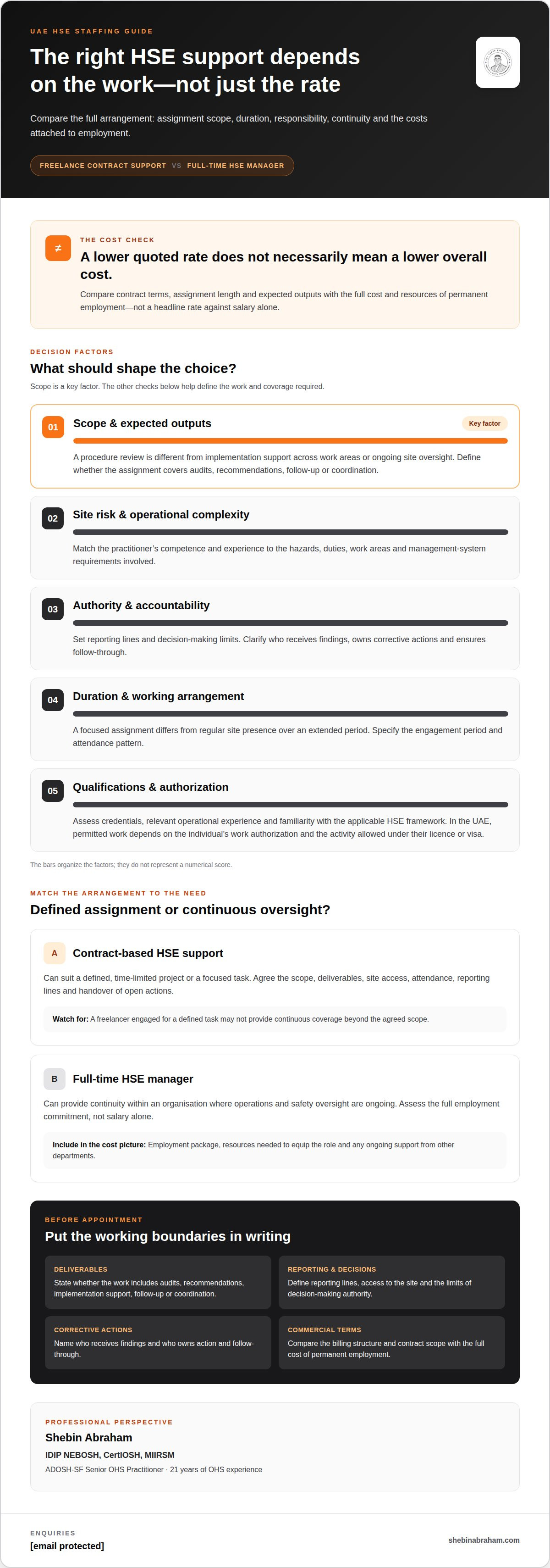
A lower quoted rate does not necessarily mean a lower overall cost. The freelance HSE vs full-time HSE manager decision depends on how long you need the role, the work involved, its authority and who is accountable for ongoing safety management.
It is understandable to focus first on rates when planning a project budget. A fair comparison also considers contract terms and whether your organisation needs focused support for a defined period or continuous oversight within its operations.
This article explains how to weigh those factors in the UAE, including project duration, authority and accountability, so you can choose a role that fits the work rather than relying on the rate alone. It draws on the practical perspective of Shebin Abraham, an ADOSH-SF Senior OHS Practitioner with 21 years of OHS experience, holding IDIP NEBOSH, CertIOSH and MIIRSM credentials.
Key Takeaways
- Compare the full cost of each arrangement, not just the quoted rate. Contract terms and the length of the assignment can change which option makes sense.
- Match the role to the work: time-limited project needs may suit contract support, while ongoing operations may call for continuous oversight.
- Clarify authority and operational accountability so safety decisions have clear ownership and follow-through.
- Assess staffing needs in light of project duration, risk profile and the scope of HSE responsibilities.
- Build a full-time employment cost picture by considering the wider obligations and costs involved, not salary alone.
Consultant rates and factors affecting compensation
In the UAE, HSE compensation depends on the assignment’s scope, duration and level of responsibility. Compare the work and expected outputs, not just the quoted rate.
Compensation Factors
HSE consulting fees reflect the expertise, time and responsibilities required for a defined assignment. A short advisory engagement and sustained site oversight involve different workloads and deliverables.
Scope is a key factor. Reviewing a procedure differs from supporting implementation across several work areas. Site risk, operational complexity and reporting requirements also affect the work involved. A contract should state whether it covers audits, recommendations, follow-up or ongoing coordination.
Duration and working arrangements also shape a proposal. A project requiring concentrated support differs from one needing regular site presence over an extended period. Compare the deliverables and level of responsibility alongside the billing structure, such as a project fee or time-based arrangement.
Qualifications and Certifications
Relevant qualifications and certifications demonstrate a practitioner’s training and professional grounding. Employers should match a person’s competence to the project’s hazards, duties and management-system requirements.
According to International Organization for Standardization, ISO 45001 is the international standard for occupational health and safety management systems. Its relevance depends on the work: a role supporting an ISO 45001 system needs familiarity with its requirements, while operational experience helps translate documented controls into site practice.
UAE qualification expectations depend on the employer, role and project framework. Match the candidate’s credentials and experience to the assigned responsibilities rather than treating one certificate as proof of competence for every site.
Whether a freelance HSE consultant can serve multiple UAE companies depends on the person’s work authorization and the activity permitted under their licence or visa. The arrangement must authorize the work and client relationship involved. Requirements depend on the individual’s status and setup.
Assess a candidate against the actual scope before appointment. Review relevant qualifications, experience with comparable operations, familiarity with the applicable HSE framework and ability to produce the required reports or recommendations. Then define deliverables, site access, reporting lines and decision-making limits in writing.
- Scope: distinguish document review from implementation support or ongoing site oversight.
- Risk: consider the hazards and operational complexity the consultant must address.
- Accountability: clarify who receives findings and who owns corrective actions.
- Duration: match the engagement period and attendance pattern to project needs.
For example, a contractor needing a focused review of safety procedures may require a different level of input from a site seeking continuing operational support. Use that distinction to compare proposals fairly, without assuming a lower rate means equivalent coverage.
Shebin Abraham, IDIP NEBOSH, CertIOSH, MIIRSM, is an ADOSH-SF Senior OHS Practitioner with 21 years of OHS experience. His professional perspective underscores a practical point: qualifications, applicable authorization and clearly defined responsibilities all matter when selecting HSE support.
Contract-based HSE consulting versus permanent employment
In the UAE, contract-based support suits defined assignments, while permanent employment provides continuity within an organisation. The right structure depends on operational needs, project duration and who will own ongoing safety management.
Full-Time Employer Costs
The total employer cost of a full-time HSE manager includes more than salary. A salary-only comparison can understate the financial commitment of permanent employment.
Budget for the employment package and resources needed to equip the role. The total depends on agreed compensation, employment terms and the organisation’s arrangements. A full-time manager may also need ongoing support from other departments to carry out responsibilities across operations.
Compare this recurring commitment with the defined scope of a contract assignment. Contract-based work on time-limited projects tends to offer HSE professionals more attractive terms than a permanent position. For the employer, however, the relevant comparison is the full cost of employment against the contract’s scope, duration and deliverables, not a salary figure against a headline consulting rate.
For example, a company with continuing site activity may value consistent internal oversight, while a project with a clear end point may need time-limited support. Align the employment arrangement with the work that must continue after the initial assignment.
Freelance Consulting Risks
The main risks of freelance HSE consulting arise when scope, availability and accountability are unclear. Recommendations need assigned owners and follow-through to become effective workplace controls.
A freelancer engaged for a defined task may not provide continuous coverage beyond the agreed scope. If the project needs regular site presence or ongoing coordination, specify attendance, deliverables, reporting lines and the handover of open actions in the contract. Otherwise, gaps can emerge between a review and operational follow-up.
Can freelance HSE consultants legally serve multiple UAE companies, and what licence or visa is required? They can serve multiple companies only when their work authorization and permitted activity allow it. The applicable licence or visa depends on the individual’s status and work setup.
Contract-based support can be practical when responsibilities are clearly bounded. Interim HSE managers take full operational responsibility for a project’s safety management for the duration of the contract. Written authority, escalation routes and responsibility for corrective actions are therefore essential parts of the engagement.
Use the site’s staffing needs as a decision point. An HSE manager is recommended when a site has more than 20 workers, has a high-risk profile, or the client contract explicitly requires one. Where those conditions apply, define how the role interacts with supervisors and project leadership.
For a defined project scope, contract-based HSE support can help establish clear deliverables and accountability from the outset.
HSE manager authority and operational accountability
An HSE manager’s effectiveness depends on clear authority, defined responsibilities and reliable communication. In UAE operations, distinguish technical advice from decisions that managers and supervisors must own.
An HSE manager may oversee professionals working across quality, hygiene, health, safety and environmental functions. That remit connects several disciplines, but it does not make every operational decision the manager’s alone. For example, an HSE team may assess a safety finding, while the department controlling the affected process takes corrective action. Name each owner in reporting lines and action records.
Operational accountability means responsibility for managing safety activities within an agreed role and authority. Interim HSE managers take full operational responsibility for a project’s safety management during their contract. The contract should explain the project scope, reporting relationships and decisions the manager can make. Site leadership also needs to know how instructions are communicated and escalated.
Authority must work in practice. When an HSE manager identifies a non-conformity, the next steps include recording the finding, notifying the responsible department and tracking corrective action. The manager works with their team and other departments to address and resolve non-conformities. For example, a repeated failure to follow a site procedure needs a named action owner, due date and evidence of closure.
Clear accountability prevents findings from staying in reports without operational follow-through. A useful responsibility matrix identifies who detects a hazard, evaluates its significance, approves corrective work and confirms completion. Keep assignments consistent across site procedures, meeting records and escalation routes. When several departments share a control, record the lead owner and each supporting function.
What UAE laws require companies to appoint an HSE officer or manager? Assess appointment requirements against the rules governing the relevant emirate, sector and project, along with applicable client or contract conditions. A role title alone does not establish the required appointment for every UAE workplace.
Before assigning authority, define the operating boundaries in writing. Specify whether the manager can make recommendations, direct internal follow-up or make project safety decisions. Link each responsibility to an escalation route, such as reporting an unresolved finding to project leadership. This gives workers and department heads a clear path when an issue remains open.
For example, a construction project may involve site leadership, technical teams and several departments. Set out who receives inspection findings, allocates resources for corrective action and records closure. Review these arrangements when the scope changes or a project phase ends. Clear delegation supports consistent oversight while keeping operational responsibilities visible to those delivering the work.
Project duration and staffing needs
Project duration helps determine whether HSE support should be continuous or tied to defined work. Map the project phases, site activity and required coverage before choosing a staffing arrangement.
A short, clearly bounded assignment may need focused support during planning, mobilisation or a specific review. For example, a consultant could assess procedures before a contractor begins site work, then provide findings for the project team to address. Define the start point, deliverables and closeout responsibilities so the engagement has a clear purpose.
Long-running operations create different needs. Ongoing work can require repeated site engagement, regular reporting and follow-up as activities change. A permanent manager can provide continuity within the organisation, while contract-based support can cover a defined period or workload. The choice depends on whether HSE tasks continue between project milestones or rise mainly during particular phases.
Workload also changes over a project’s life. Mobilisation may involve coordinating procedures and communicating expectations; active work may demand frequent field engagement; closeout may require documenting outstanding actions. Map these demands against the project schedule. If activity peaks are predictable, align support with those periods and assign internal owners for work outside them.
Staffing decisions should reflect the site’s workforce and risk profile, not duration alone. An HSE manager is recommended when a site has more than 20 workers, has a high-risk profile, or the client contract explicitly requires one. These criteria can make dedicated oversight relevant even for a time-limited project.
Urgent mobilisation can affect the decision, too. An HSE manager can be deployed to a project site within 48 hours in an urgent situation. That timing may matter when an unexpected project need arises, but the employer still needs to define the required authority, assignment scope and reporting line. Availability alone does not establish what work the role will cover.
Plan continuity before an engagement ends. Record open findings, responsible owners, due actions and key site documents in a handover. For example, a departing consultant should leave the project team able to track unresolved corrective actions without relying on informal conversations. If the project continues, decide who will monitor those actions after the assignment ends.
Use a simple staffing review at each major project phase: identify the work ahead, estimate the HSE presence required and confirm who owns ongoing follow-up. If the scope expands or site risks change, revisit the arrangement. This ties staffing to actual project conditions and keeps safety responsibilities visible as work progresses.
What are the total employer costs of hiring a full-time HSE manager in the UAE?
In the UAE, the total employer cost is broader than an HSE manager’s salary. Build the budget around the agreed employment package, role requirements and resources needed for the work. This is more useful than treating salary as the complete cost.
Start with the compensation stated in the employment offer. Add any employer-paid benefits or allowances included in that package. Terms vary between employers, so use the actual proposed arrangement rather than a generic market estimate. For example, compare offers by listing salary and each additional package component separately.
Next, consider the cost of bringing the employee into the role. Recruitment, onboarding and role-specific training can all require organisational resources. The amount depends on the hiring process and the manager’s responsibilities. A position covering several operational areas may need a different induction plan from one focused on a defined site or project.
Work equipment and access also belong in the budget. Identify what the HSE manager needs to carry out the agreed duties, such as access to reporting systems, site facilities and relevant work tools. Separate one-time setup costs from recurring operational support to make the internal budget easier to review as the role develops.
Coverage during absence is another practical consideration. If safety oversight must continue while the manager is away, identify who will handle inspections, report urgent findings and track open actions. The arrangement could involve existing personnel or additional support, depending on the organisation’s structure. Include this coverage model in the cost comparison rather than assuming the role operates without interruption.
Also account for management time. A full-time HSE manager works with other departments to address non-conformities, and those teams may need time to provide information, approve actions or implement controls. For example, changing a work procedure in response to a finding can involve both HSE and the department responsible for that process.
To estimate the complete commitment, group costs into clear categories:
- Employment package: salary and agreed employer-paid benefits or allowances.
- Hiring and setup: recruitment, onboarding and role-specific training.
- Tools and access: work equipment, systems and site resources.
- Continuity: coverage and handover arrangements for ongoing HSE tasks.
- Internal coordination: time needed from departments supporting corrective actions.
Then compare the total with the work expected across the project or organisation. A permanent appointment may fit sustained operational needs; a time-limited assignment may fit a bounded scope. Use the same deliverables and coverage assumptions in both comparisons to make the decision meaningful.
Shebin Abraham: OHS Freelancer Trakhees Consulting
Shebin Abraham’s OHS Freelancer Trakhees Consulting supports projects with Trakhees OHS compliance requirements. It can help connect the staffing decision to your project’s consulting needs, defined responsibilities and required scope.
For broader workplace health and safety needs, Shebin Abraham provides OHS Services and Freelance HSE Service. Freelance ADOSH-SF OHS consulting supports work involving ADOSH-SF standards. The right option depends on the framework and responsibilities your project needs addressed.
Share the project context, applicable requirements and support needed to discuss a suitable approach. Contact Shebin Abraham to talk through your OHS consulting needs.
Set Your HSE Support Up for What Comes Next
Base the next decision on the work ahead, not just the position title. Identify who needs to act on HSE findings, how decisions will move through the organisation and what continuity the project requires. These choices turn the freelance HSE vs full-time HSE manager comparison into a practical staffing decision.
Agree on the role’s purpose before work begins. A clear brief can set expectations for scope, reporting relationships, decision-making authority and handover. It also gives the organisation a basis for reviewing whether its HSE arrangements still fit as operations or project needs change.
For a UAE organisation considering its next step, a conversation can connect project requirements with relevant OHS support. Share the context and responsibilities you need covered.
Contact Shebin Abraham to discuss your needs and move forward with a clearer plan for HSE support.
Frequently Asked Questions
When do you need which role?
The freelance HSE vs full-time HSE manager decision depends on whether the need is project-based or ongoing. A company preparing a defined deliverable may need time-limited expertise, while a business maintaining safety systems across daily operations may need a permanent manager. For example, targeted support with a safety-system review differs from coordinating routine HSE responsibilities as work priorities change.
What does a freelance HSE consultant do compared with a full-time HSE manager?
A freelance consultant typically delivers agreed HSE advice or project work, while a full-time manager is employed within the organisation and supports its continuing HSE activities. A consultant’s outputs might include a risk assessment or safety-system documentation. A full-time manager may coordinate internal processes that keep procedures current and help teams apply them during regular operations.
What are the typical freelance HSE consultant rates in the UAE?
There is no single typical rate for every UAE assignment. The fee depends on the consultant’s experience, scope, project duration, site attendance, risk profile and required deliverables. For Shebin Abraham’s services, pricing depends on the case and is provided after a quote request. A focused document review and sustained site support involve different levels of work, so compare proposals against the same scope.
When is it better to hire a freelance HSE consultant versus a full-time HSE manager?
Use the freelance HSE vs full-time HSE manager comparison to match the arrangement to the work. A freelance consultant may suit a bounded need, such as preparing specific HSE documentation or supporting a project phase. A full-time manager may fit an organisation needing a continuing internal role across changing operations. Consider whether HSE work is occasional and deliverable-based or a recurring responsibility requiring ongoing coordination.


