

Construction safety compliance is about more than keeping documents in order. A safety compliance consultant for construction in the UAE helps turn applicable requirements into practical HSE systems, risk assessments and site protections suited to the realities of a project.
Construction teams need procedures and controls that work on site, not just on paper. This article explains how consultants support regulatory compliance, implement HSE management systems, assess risks and protect workers while accounting for UAE and emirate-specific requirements.
It also outlines when specialist support can help and what to expect from construction health and safety consultancy. The article draws on the experience of Shebin Abraham, IDIP NEBOSH, CertIOSH, MIIRSM, an ADOSH-SF Senior OHS Practitioner with 21 years of experience in OHS and more than 20 years serving clients in the UAE and GCC.
Key Takeaways
- Understand how UAE and emirate-level requirements shape contractor compliance and the role of local authority rules.
- Learn how a practical HSE management system connects project risks, procedures, responsibilities and ongoing oversight.
- Recognize the workplace controls that help protect construction teams and support environmental care on site.
- See how consultants contribute through risk assessment, compliance guidance and construction health and safety oversight.
- Identify when specialist ADOSH-SF or Trakhees OHS consulting can help align site practices with applicable requirements.
Accreditation and local authority regulations
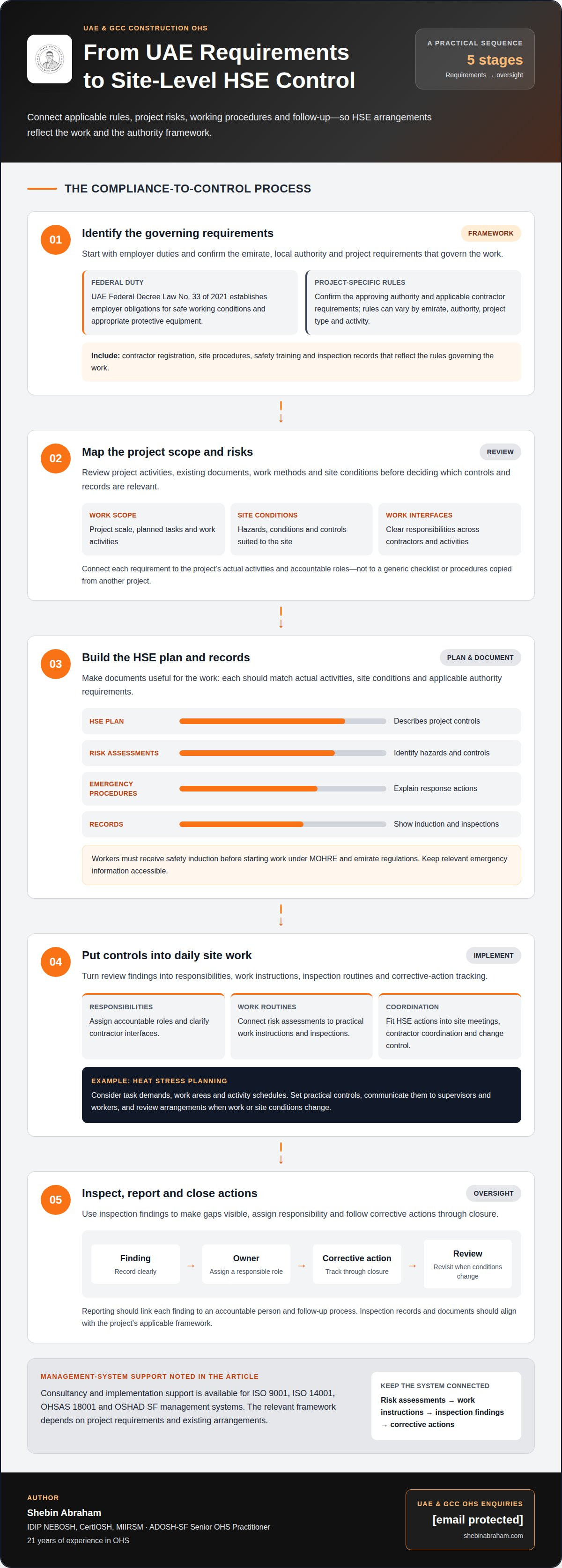
UAE construction compliance combines federal employer duties with requirements set by the relevant emirate and project authority. Contractor registration, site procedures, safety training and inspection records should reflect the rules that govern the work.
UAE Regulatory Compliance
UAE Federal Decree Law No. 33 of 2021 establishes employer obligations to provide safe working conditions and appropriate protective equipment. Construction workers must receive safety induction before starting work under MOHRE and emirate regulations. A compliance review connects these duties to project procedures, assigned responsibilities, equipment controls and records showing that workers received relevant instruction.
When comparing consultants, look for a clear method to map applicable regulations, review project documents and record inspection findings. Ask how recommendations connect requirements to site activities and accountable roles. A suitable consultant explains how each control fits the project’s authority framework, hazards and work scope instead of relying on a generic checklist.
Emirate and Project Requirements
Requirements can vary by emirate, local authority, project type and work activity. Identify the project’s approving authority and applicable contractor requirements before finalizing compliance arrangements. The project’s scale, site conditions and planned tasks also determine which controls and records are relevant.
Assess how a consultant adapts their review to the governing framework and project scope. For example, a project with several contractors needs clear responsibilities across work interfaces. Advice should reflect those responsibilities and applicable authority requirements, not copy procedures from a different project or jurisdiction.
Required Safety Documents and Plans
Construction sites need documented emergency procedures and records showing how risks and controls are managed. These may include the project HSE plan, risk assessments, safety induction records and inspection findings. Each document should reflect actual work activities, site conditions and applicable authority requirements.
Organize records by purpose: plans describe controls, assessments identify hazards, and records demonstrate implementation. Emergency procedures should explain response actions, with relevant information kept accessible. Induction records should show that workers received site-specific guidance before starting their assigned tasks.
Regulatory breaches can also have licensing consequences under applicable rules. A compliance review should record each finding, assign an accountable role and track corrective actions through closure. This creates a clear oversight record and helps managers address gaps systematically. Useful reporting makes findings understandable and links each action to a responsible person and follow-up process.
Requirements vary across emirates and project authorities, so a national checklist cannot replace a project-specific review. A consultant should identify the relevant framework, explain how it applies and align documents and inspections accordingly. This helps construction teams maintain consistent oversight while meeting the requirements that govern their work.
HSE management contract development and implementation
Effective HSE management turns project risks and applicable requirements into assigned responsibilities, working procedures and follow-up. Start by defining the project scope, work activities, governing framework and support needed.
To engage a construction safety consultant in the UAE, define the project’s HSE needs, agree on scope and deliverables, and establish reporting and review arrangements. Choose support that connects management-system documents with site implementation and project conditions.
HSE Management Implementation
Implementation can begin with a review of project activities, existing procedures and risk controls. The consultant can turn findings into assigned responsibilities, work instructions, inspection routines and corrective-action tracking. Agree how HSE actions fit site meetings, contractor coordination and change control. This helps teams respond when work methods or site conditions change.
Heat stress planning should reflect the worksite and its conditions. Consider task demands, work areas and activity schedules, then set practical controls and communicate them to supervisors and workers. Procedures should also explain where relevant supplies are kept, how they are accessed and who maintains them. Review the arrangements when work or site conditions change.
HSE Management Systems
Management systems give teams a consistent way to plan, implement and review HSE controls. Consultancy and implementation support is available for ISO 9001, ISO 14001, OHSAS 18001 and OSHAD SF management systems. The relevant framework depends on project requirements and the organization’s existing arrangements. Procedures should connect responsibilities, risk controls, records and performance review.
For a construction site, system documents need to guide real decisions. Risk assessments should inform work instructions, and inspection findings should lead to corrective actions. The consultant’s scope should explain how documents will be developed, applied and reviewed with project teams. This keeps management-system work connected to daily operations instead of isolated paperwork.
Contract development should clarify the working relationship before implementation begins. Set out the project scope, site interfaces, reporting route, expected deliverables and review process. Identify who supplies project information and who receives findings. Agree how urgent hazards are escalated and how corrective actions are recorded. These details help integrate HSE consultancy and management with construction schedules and contractor coordination.
A sound approach also plans for change. Changes to scope, sequencing, subcontractor activities or site conditions can affect risk controls. Schedule reviews around significant project changes, document decisions and communicate revised controls to affected teams. Include national requirements and applicable local authority expectations alongside the project’s changing operational needs.
For project teams that need practical support translating HSE requirements into site arrangements, Freelance HSE support can provide a relevant next step.
Workplace safety and environmental protection
Construction safety depends on controls matched to each task, location and exposure. Assess work at height, moving equipment, scaffolding, emergency access and environmental hazards together. This joined-up review shows how one activity can affect workers, nearby trades and the surrounding area. A signed procedure matters only if workers can apply it during the task.
For work at heights exceeding 1.8 meters, fall protection systems are required in the UAE. The assessment should identify suitable protection, safe access and how the system will be used. For scaffolding, UAE construction requirements specify compliance with British Standard BS 1139 or European Norm EN 12811. Inspection should assess the scaffold’s condition and safe use before work proceeds, and after changes that could affect it.
Emergency arrangements need to work with the actual site layout. UAE workplace safety regulations require documented emergency procedures, unobstructed access routes and clearly marked emergency exits at construction sites. Trace routes from active work areas to exits, then check whether stored materials or temporary barriers obstruct access. Workers need to know the response steps for their area, not just where a plan is filed.
Equipment inspections should assess condition, function and suitability for the task. Safety inspections examine, test and assess equipment and systems, including mandatory and non-mandatory items. A useful record identifies the item, findings, corrective action and closure status. For example, a damaged access component should prompt a clear decision about use, repair or removal, rather than an undocumented verbal warning.
- Work at height: connect the risk assessment with fall protection, access and task controls.
- Scaffolding: assess compliance with BS 1139 or EN 12811 and record inspection outcomes.
- Emergency readiness: keep procedures documented, routes clear and exits marked.
- Equipment: record inspection findings and track corrective actions to closure.
Include environmental protection in the site review. Map activities that could cause spills, dust, noise or unmanaged waste, then assign controls and responsible roles. Identify where materials are handled and stored, how waste is separated, and how spills would be contained. Controls should reflect actual construction activities and site conditions, not generic statements in a plan.
Certification and operational protection serve different purposes. A certificate does not replace site-level controls, worker instruction or inspection records. A Dubai court ordered AED 4 million compensation for a worker paralyzed by falling glass panels during inadequate rigging operations, as reported by Gulf News. The case underscores why lifting plans, rigging controls and competent oversight must connect directly to the work being performed.
Environmental controls are stronger when they are built into the safety system and checked against the work taking place. Esimaje has more than 6 years of progressive experience developing, implementing, and auditing OHS management systems. Billy holds a construction health and safety qualification referencing OSHA standard 29 CFR 1926.
The consultancy supports transitions from ISO 14001:2004 to ISO 14001:2015, helping align environmental management with site controls for waste, dust and spill prevention. Connecting these responsibilities with inspections and corrective-action records can make environmental performance part of routine site oversight, rather than a separate document exercise.
Construction health and safety consultancy
Construction health and safety consultancy connects UAE regulatory obligations with decisions made during planning, procurement and site delivery. Its value is making safety standards usable across project teams, not simply recording them in a manual.
Consultant Responsibilities
UAE Federal and emirate-specific health and safety laws apply to businesses operating in the country. A consultant can interpret applicable requirements for a construction project, identify gaps and turn findings into assigned actions. For example, a review can trace how a site procedure reaches supervisors, subcontractors and the workers doing the task.
Look for a defined process covering advice, inspection findings, reporting and follow-up. The consultant should explain technical issues in language project leaders and workers can use. Each finding needs an owner, a suitable corrective action and recorded close-out, rather than an unresolved note.
Construction Safety Consultancy Scope
The scope may include planning reviews, workplace inspections, risk-control advice, HSE documentation and management-system support. Set its boundaries according to the project phase, activities and authority requirements. A consultant can help coordinate these elements, while project managers retain their operational responsibilities and decision-making.
Define deliverables around the project’s actual needs. For example, a team changing work sequencing may need a focused review of revised activities and their interfaces. A project with recurring findings may benefit from trend analysis and follow-up. Specific outputs make it easier to connect consultancy work with project management.
Effective consultancy can also strengthen safety culture through everyday leadership. Review whether supervisors discuss hazards before work, workers can raise concerns, and managers respond to reported issues. These observations show whether written standards influence site behaviour. A toolbox discussion about a changing task, for example, can reveal where instructions need clearer ownership or communication.
Approved documents should support decisions, not replace them. A consultant can help teams align procedures, work planning and supervision, then review how those arrangements function on site. Certification is separate from consultancy support: advice can assist a management system, but does not itself issue accredited ISO certification.
Assess the value of the work by connecting each recommendation to a project risk, responsible role and follow-up method. Useful reporting distinguishes urgent site concerns from longer-term system improvements, helping managers act in the right order. Repeated observations about a work interface, for example, may call for coordination between teams rather than another standalone document.
The practical takeaway is clear: strong construction health and safety consultancy helps people apply requirements consistently. It connects UAE legal frameworks, project controls and leadership actions, keeping worker wellbeing central to delivery. Advice is most useful when it visibly changes how work is planned, supervised and reviewed.
Construction safety compliance consultant roles in UAE
A construction safety compliance consultant turns applicable requirements into coordinated project actions. In the UAE, the role connects regulatory interpretation, project planning and day-to-day HSE oversight, keeping worker protection central to delivery.
The consultant’s work starts with understanding the project: its activities, authority framework, workforce arrangements and existing safety controls. UAE Federal and emirate-specific health and safety laws apply to businesses operating in the country. The consultant can map relevant requirements against project arrangements, identify gaps and explain what needs attention. This gives managers a clearer basis for assigning responsibilities and tracking actions.
Typical responsibilities include:
- Reviewing project arrangements: examine HSE procedures, task planning and responsibilities against the project scope.
- Assessing risks: connect hazards to practical controls, work methods and the people responsible for applying them.
- Supporting site oversight: record observations, prioritize findings and follow corrective actions through closure.
- Advising project teams: explain requirements to managers and supervisors in terms they can use in planning and coordination.
These activities work best as a connected process. If a site observation identifies an unsafe work interface, for example, the consultant can document the issue, clarify its risk and recommend coordinated action. The project team then assigns an owner, communicates the control and records follow-up. This gives managers evidence of how the issue moved from identification to resolution.
A consultant also helps make HSE information useful to people in different project roles. Project managers may need a clear summary of outstanding actions, while supervisors need practical direction for the next shift. Workers need instructions that relate directly to their tasks. Tailored communication supports consistent implementation without treating every audience as if it has the same role.
Define the consultant’s scope around the project’s actual needs. Agree which sites or activities are covered, what reporting includes, how observations are escalated and how actions are reviewed. A project with multiple contractors, for example, may need clear interfaces between reporting lines and site coordination. A written scope helps prevent responsibilities from falling between teams.
Shebin Abraham’s Freelance HSE Service provides construction teams with professional HSE support shaped around workplace compliance needs. If your project needs help clarifying the consulting scope or coordinating HSE oversight, discuss construction HSE support as a practical next step.
Shebin Abraham
Shebin Abraham helps construction teams in the UAE strengthen OHS compliance and connect safety requirements with practical site arrangements. His support is relevant when a project needs HSE guidance, workplace risk reviews or advice aligned with ADOSH-SF or Trakhees requirements.
Shebin is an ADOSH-SF Senior OHS Practitioner with IDIP NEBOSH, CertIOSH and MIIRSM credentials, and 21 years of experience in OHS. Through OHS Services and Freelance HSE Service, he works with teams to address compliance needs and improve how health and safety practices are applied on site.
For project-specific OHS or HSE support, contact Shebin Abraham to discuss your construction safety needs.
Build the next step into your project plan
Make safety compliance part of how your construction project is planned and managed, not a separate task left until problems arise. A safety compliance consultant for construction in the UAE can help turn project requirements into practical HSE actions and clearer oversight.
Shebin Abraham provides OHS Services, Freelance HSE Service and Freelance ADOSH-SF OHS consulting. This support can help your project address workplace health and safety requirements and align its approach with ADOSH-SF. Start with a focused conversation about your project needs and the support that would be useful.
Contact Shebin Abraham to discuss your needs. A clear conversation can help your team move forward with practical attention to compliance and the people on site.
Frequently Asked Questions
What UAE laws and regulations govern construction health and safety?
Construction health and safety in the UAE is governed by federal employer duties alongside applicable emirate and authority requirements. UAE Federal Decree Law No. 33 of 2021 establishes obligations concerning safe working conditions and appropriate protective equipment. Contractor registration and classification requirements may also apply under relevant rules. Project procedures should reflect the framework that governs the site, its activities and the responsible authority.
Which UAE authorities oversee construction safety compliance across the emirates?
Oversight depends on the project’s location, sector and authority jurisdiction. MOHRE provides the federal employment framework, while emirate-level bodies and project authorities may set additional requirements. ADOSH-SF and Trakhees OHS frameworks apply to projects within their respective scopes. A project-specific review can identify the relevant authority, applicable rules and approval processes, including how requirements intersect when multiple contractors or work activities are involved.
What qualifications and certifications should a UAE construction safety consultant have?
Look for relevant occupational health and safety qualifications, practical construction experience and working knowledge of the applicable UAE framework. Credentials such as NEBOSH qualifications and professional memberships demonstrate formal preparation, but do not replace sound site judgment. Consider how the consultant applies their expertise to reviewing risk assessments, explaining findings to supervisors and supporting corrective-action follow-up on active projects.
What are the penalties for construction safety violations in the UAE?
Consequences depend on the violation and the rules governing the project. Relevant contractor violations under Dubai Law No. 7 of 2025 can result in license suspension for up to one year. Other consequences depend on the specific breach and applicable requirements, so one penalty should not be assumed for every case. Clear findings, assigned corrective actions and documented follow-up help project managers address compliance gaps.


