

Contractor safety compliance is tested on site, not just in a policy file. A safety consultant for contractors in the UAE can help identify workplace risks, prepare safety reports and plans, and assess whether day-to-day practices align with applicable requirements. Federal Decree-Law No. 33 of 2021 establishes the fundamental duty of every employer in the UAE to provide a safe and secure working environment.
That responsibility can feel especially demanding when contractors must coordinate people, work activities and client expectations across multiple locations. A safety consultant for contractors UAE businesses rely on can bring practical structure to compliance, including reviews aligned with ISO, ADNOC and ADOSH requirements, and independent assessments that identify gaps and guide improvements.
This article explains how consulting support can address operational needs across the UAE, what a contractor audit may cover, and how the right advice connects documented systems with safer work in practice.
Key Takeaways
- Contractor safety obligations apply across the UAE, while the relevant local framework can shape how compliance is implemented on site.
- Audits aligned with ISO, ADNOC and ADOSH can help identify gaps between documented procedures and work practices.
- Independent assessments offer a structured way to examine hazards, records and safety controls, then prioritize practical improvements.
- Consultant support can be tailored to the contractor’s activities, project requirements and locations across the UAE.
- Shebin Abraham, IDIP NEBOSH, CertIOSH, MIIRSM, ADOSH-SF Senior OHS Practitioner, brings 21 years of OHS experience to his advisory work.
UAE regulatory compliance and international standards
Contractor compliance in the UAE combines federal duties with emirate-specific frameworks and project requirements. An effective safety system translates those requirements into site controls, worker guidance and documented assessments.
Federal Decree-Law No. 33 of 2021 establishes every UAE employer’s fundamental duty to provide a safe and secure working environment. Ministerial Resolution No. 32 of 1982 sets out protective measures for employers against occupational hazards. For contractors, these requirements make hazard identification, safe work procedures and suitable workplace controls essential parts of safety management.
Requirements also depend on where and in which sector the work takes place. Abu Dhabi’s EHSMS Regulatory Framework requires entities in its jurisdiction to develop, implement and continuously improve an EHS management system. Dubai Municipality’s Code of Construction Safety Practice sets site safety standards in Dubai. These frameworks shape contractors’ documentation, site practices and ongoing assessments.
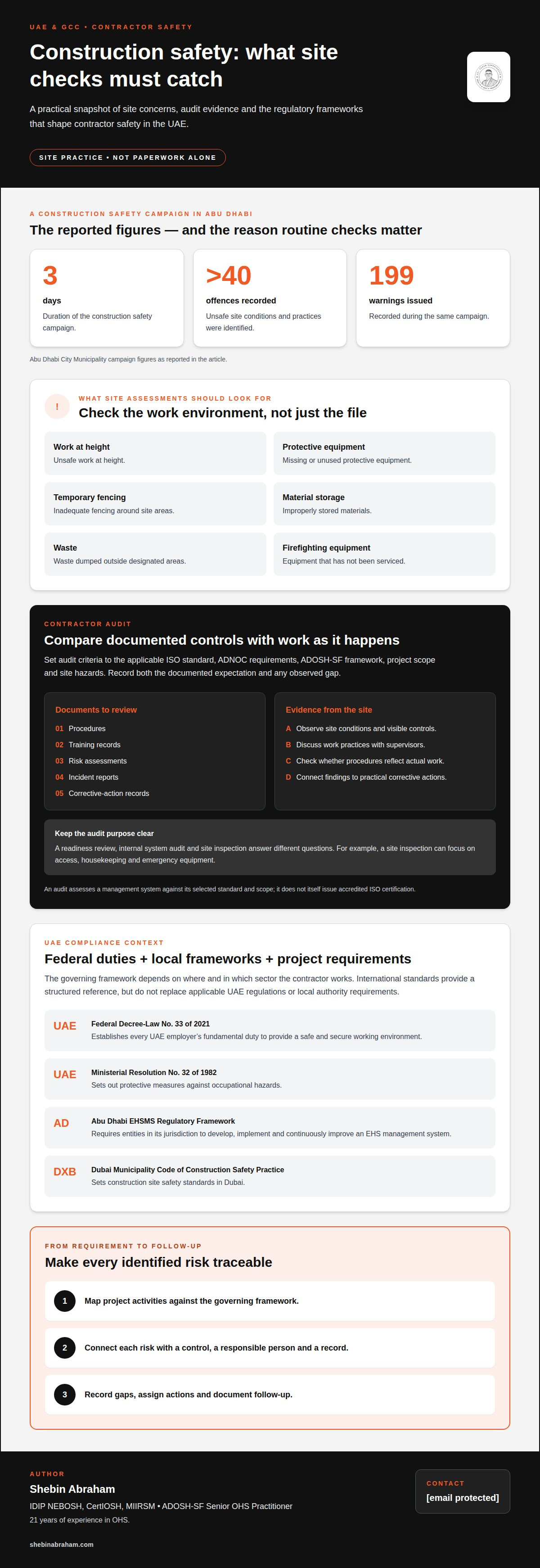
International standards provide a structured reference for managing safety, but they do not replace applicable UAE regulations or local authority requirements. Start by mapping each project’s activities against its governing framework. Then connect every identified risk with a control, a responsible person and a record. For example, a construction site assessment should consider work at height, protective equipment, temporary fencing and material storage.
Consultant Qualifications and Approvals
The relevant qualifications and approvals depend on the consultant’s assigned scope, sector and governing framework. Match OHS credentials and experience to the work, such as management system development, site assessments or compliance guidance. Consider formal approval requirements within the applicable authority or project framework. This helps distinguish professional competence from permission to undertake a particular appointment.
Authority Requirements and Violation Risks
MoHRE provides the federal employment context, while Abu Dhabi’s EHSMS framework and Dubai Municipality’s construction safety code illustrate emirate-level requirements. Abu Dhabi City Municipality identified unsafe work at height, missing protective equipment and inadequate fencing during a construction safety campaign. Contractors may face warnings and recorded offences: the three-day campaign recorded more than 40 offences and issued 199 warnings. These examples show why site assessments must address actual practices, not paperwork alone.
Safety systems are most effective when findings lead to assigned actions. A consultant can review procedures, observe site conditions and record gaps against relevant regulations and standards. The assessment should identify each risk, the required control and how follow-up will be documented. This helps contractors address hazards before they contribute to incidents and supports continuous improvement within the applicable UAE framework.
Employers in the UAE must provide a safe and appropriate working environment under regulations set out by the Ministry of Human Resources and Emiratisation (MoHRE). Abu Dhabi City Municipality has called on contractors to follow applicable health and safety standards to protect construction workers. It identified unsafe work at height, failure to use protective equipment, inadequate temporary fencing, improper material storage, waste dumped outside designated areas and unserviced firefighting equipment as site concerns. These examples show why routine checks should cover worker protection, site boundaries, materials, waste and firefighting equipment.
Auditing aligned with ISO, ADNOC, and ADOSH
An effective contractor audit compares documented safety management with work as it happens. Set its criteria according to the applicable ISO standard, ADNOC requirements, ADOSH-SF framework, project scope and site hazards. The result should show how controls work in practice, not merely confirm that forms are complete.
Start by defining the audit’s purpose. A readiness review, internal system audit and site inspection answer different questions. A readiness review can check whether records and responsibilities are organized for a client assessment. A site inspection can focus on visible controls, including access, housekeeping and emergency equipment. A clear scope keeps findings relevant to the contractor’s work.
An audit may include procedures, training records, risk assessments, incident reports and corrective-action records. Site observations and discussions with supervisors help establish whether documents reflect actual work. If a procedure describes a control that workers do not follow, for example, record both the documented expectation and the observed gap.
Contractors choose a health and safety consultant by matching relevant UAE framework experience to their sector, project and audit purpose. Look for an approach that explains its criteria, evidence and findings clearly, then connects each gap to a practical corrective action. For ADNOC-related readiness, ADNOC HSE Prequalification Support can address the prequalification aspect.
Treat ISO alignment as a structured assessment of a management system against the selected standard and scope. An audit can examine how the organization identifies hazards, assigns responsibilities, controls operational risks and reviews performance. It does not itself issue accredited ISO certification. Findings should distinguish system-level weaknesses from individual site issues so actions address the underlying cause.
For ADNOC and ADOSH-SF work, use the relevant project or framework criteria rather than assuming one checklist suits every contractor. Map evidence to the stated requirements, record non-conformities and identify who owns each follow-up action. This tailored approach shows the value of audits: they connect safety management expectations with workplace practice.
- Define scope: identify the work, site and framework being assessed.
- Gather evidence: review records, observe work and discuss controls with relevant staff.
- Report findings: describe evidence, gaps, risks and corrective actions.
- Follow up: track agreed actions and assess whether controls are working.
Include emergency arrangements in the audit when they fall within the agreed scope. Review the relevant procedures, assigned roles and supporting records, then compare them with site arrangements. A clear report gives contractor management a practical basis for prioritizing improvements and strengthening ongoing compliance.
Independent and impartial safety assessments
An independent assessment gives contractor management a separate view of how work is controlled. The assessor compares site conditions, task documents and worker practices, then records evidence and practical corrective actions. On a construction site, this can reveal a gap between a written control and the way a task is actually performed.
UAE construction risk assessments and method statements should reflect the work, its hazards and applicable project or authority requirements. A useful assessment identifies task steps, potential harm, existing controls and additional measures. The method statement explains the safe work sequence, responsibilities and relevant emergency arrangements. The required format depends on the governing framework and project conditions.
For an impartial review, define the scope before visiting the site. Identify the contractor’s activities, work areas and records to examine, then compare the evidence with actual conditions. For example, an assessment of material handling can consider routes, storage, access and worker practices. Distinguish observed facts from recommendations so each finding is clear and actionable.
Site risk assessment and management should link hazards to controls and accountable follow-up. An assessor can review the risk register, task assessments, method statements, inspection records and corrective-action log. At the work area, observations may cover access, housekeeping, equipment condition and protective measures. Focus the assessment on the task being performed rather than relying on a generic checklist.
Health and safety risk assessments also benefit from input from workers and supervisors. A brief discussion about a task can clarify how it is performed, where conditions change and which controls are practical. The assessor documents the evidence and provides guidance to support the contractor’s safety system. This brings operational knowledge into the review without transferring management’s responsibility for decisions and follow-up.
Fire risk assessments should examine relevant ignition sources, combustible materials, escape routes and firefighting provisions. On a construction site, changing work areas or stored materials can affect the assessment, so observations should reflect current conditions. The report can state the concern and its location, identify the control needing attention and name the action owner. Recommendations should match the hazards found.
Documents and inspections vary by scope, but a contractor assessment may include:
- Task risk assessments and method statements for work under review.
- Site inspection records, hazard reports and corrective-action tracking.
- Training or competency records relevant to the assessed activity.
- Emergency procedures and fire-safety inspection evidence within scope.
After the visit, group findings by risk and required action. A clear report states what was observed, the supporting evidence and how management can track resolution. Make recommendations specific: name the work area or document, describe the control gap and assign a responsible role. This gives contractors a practical basis for improving site conditions and checking whether corrective measures work.
Consultant support across the UAE
Contractors operating across the UAE need support that accounts for each project’s location, activity and governing framework. Abu Dhabi’s EHSMS Regulatory Framework and Dubai Municipality’s Code of Construction Safety Practice show why one generic compliance file may not suit every site. A consultant can map applicable requirements, identify procedures that need tailoring and help teams implement controls consistently.
For projects in different emirates, begin with a location-based review. Record each site’s activities, client requirements, applicable authority framework and existing safety documents. Then identify shared controls and location-specific procedures. This clarifies what managers can standardize and what needs separate treatment, while helping prevent outdated documents from following teams between projects.
Practical support connects management procedures with site-level work. A consultant can assist with risk reviews, safety reports and follow-up actions, then help supervisors communicate revised controls. If site observations identify unsafe storage, for example, the report can specify the affected area, required improvement and responsible role. Management can track the action and apply relevant learning to future site reviews.
Safety training can help promote consistent practices across sites. A consultant can train workers and managers in skills that support accident prevention. Training topics should reflect actual tasks and hazards rather than rely on a generic presentation. Crews performing different activities may need different practical guidance, even when they work under the same contractor’s management system.
For UAE-wide operations, reporting arrangements should make findings understandable to both site teams and senior management. A shared report structure can capture the location, activity, observation, risk and corrective action. Project-specific details remain essential: an Abu Dhabi site assessment should reflect its applicable framework, while a Dubai construction review should account for the relevant local code. This balance supports comparison without treating every site as identical.
- Map locations: connect each project with its relevant authority and client requirements.
- Review controls: compare procedures with site activities and inspection findings.
- Support implementation: assign follow-up actions and communicate changes to affected teams.
- Build capability: tailor safety training to workers’ tasks and workplace hazards.
Consulting support can also help contractors prepare for client requirements. Where ADNOC prequalification applies, organize supporting HSE information around the relevant request and identify documentation gaps. Across the UAE, a consistent cycle of reviews, reports, training and follow-up helps teams maintain oversight and keep safety arrangements connected to work on the ground.
What services does a safety consultant provide for contractors in the UAE?
A safety consultant can help contractors turn workplace hazards and applicable requirements into practical controls. Support may cover risk identification, safety reports, advice on safety plans and staff training for emergencies. It is most useful when the scope reflects the contractor’s activities, project expectations and the records needed to manage safety.
Risk identification starts with understanding the work. A consultant can review tasks, observe working conditions and speak with relevant staff to identify hazards. A site review, for example, can examine access routes, material handling and equipment use. The assessment can describe existing controls, note gaps and help management prioritize corrective action.
Safety documentation is a working record, not a substitute for site controls. A consultant can help organize safety plans, inspection findings, risk records and action tracking around the contractor’s operations. Clear reports link each finding to its location, evidence and follow-up responsibility. This structure helps managers see which issues need attention and monitor progress.
Workplace safety training can give workers and managers skills to help prevent accidents. A consultant can tailor guidance to job activities and explain how to respond to relevant hazards. Emergency training can focus on workplace roles and procedures. Training is more useful when it connects directly with workers’ tasks and safety arrangements.
Consulting support can help a contractor understand how its safety arrangements relate to applicable UAE requirements. The consultant reviews the work and relevant documentation, identifies areas needing attention and explains practical steps to improve alignment. In Abu Dhabi, for example, entities within the EHSMS Regulatory Framework must develop, implement and continuously improve an EHS management system. The project and its location therefore shape the advisory scope.
A clearly defined assignment can cover several connected activities:
- Reviewing contractor activities and identifying workplace hazards.
- Preparing safety reports that explain findings and corrective actions.
- Advising on safety plans and practical implementation of controls.
- Providing relevant workplace safety or emergency training.
- Supporting follow-up through documented actions and reviews.
Choose support according to the immediate need. A contractor preparing for a client review may need focused documentation and gap analysis; a team addressing site concerns may benefit from a workplace assessment and targeted guidance. For ongoing operational needs, freelance HSE support can provide practical advice within an agreed scope.
For support that connects contractor activities with OHS guidance and documented follow-up, discuss contractor safety support and identify the work scope, project context and priority concerns.
For a client review, define the assignment around the records and safety arrangements that need attention, then agree how findings and follow-up will be documented. Workplace safety consultants in the UAE can advise on safety plans and help companies work within applicable safety rules. Ensure the advice reflects the contractor’s activities and project expectations, and give recommended actions clear ownership. This keeps support focused on practical controls, relevant guidance and continued review of outstanding issues.
Shebin Abraham
Shebin Abraham provides practical OHS guidance to contractors dealing with compliance questions, audit findings and site safety concerns. His support connects documented requirements with controls suited to project activities and workplace conditions.
As an author, Shebin Abraham holds IDIP NEBOSH, CertIOSH and MIIRSM credentials. He is an ADOSH-SF Senior OHS Practitioner with 21 years of experience in occupational health and safety. His relevant support includes OHS Services, Freelance HSE Service, ADOSH-SF freelance OHS consulting and Trakhees OHS consulting.
Turn to Shebin Abraham when your team needs help understanding applicable requirements, assessing safety arrangements or planning practical improvements. Contact him to discuss your contractor-specific requirements and priorities.
Make your next safety decision practical
Choosing a safety consultant for contractors in the UAE comes down to turning advice into clear ownership. Before your next project review, define the decision you need help with: closing an audit finding, improving a site control or aligning work with a project requirement. A focused discussion can clarify the scope and identify a useful next step for your team.
Bring the operational issue, relevant project context and outcome you are working toward. Shebin Abraham can discuss your safety needs and the appropriate OHS support for your situation. The aim is a clear, practical discussion that keeps worker wellbeing and effective site management in view.
Contact Shebin Abraham to discuss your safety needs and take the next step with confidence.
Frequently Asked Questions
What are UAE occupational health and safety laws and regulations for contractors?
UAE contractors operate under federal workplace safety duties and applicable emirate or project requirements. Federal Decree-Law No. 33 of 2021 establishes the employer’s fundamental duty to provide a safe and secure working environment, while Ministerial Resolution No. 32 of 1982 sets out protective measures against occupational hazards. In practice, a contractor should translate these requirements into task controls, worker instructions and records suited to its activities and applicable framework.
Do UAE construction contractors need a safety consultant or HSE officer?
The cited UAE provisions establish employers’ safety responsibilities, but do not set a universal requirement for every contractor to hire an external consultant. The need for dedicated HSE support depends on project conditions, applicable authority or client requirements, and the contractor’s capacity to manage safety effectively. Specialist advice can help address a framework gap or audit finding, while an HSE officer may support ongoing site-level coordination.


