

Yes, a freelance Trakhees consultant for JAFZA can assist with environmental and occupational health and safety compliance, as well as liaison on applicable requirements. The support can also be relevant to other Trakhees-covered areas, including Dubai Maritime City, Palm Jumeirah and Nakheel developments. The key is understanding which authority requirements apply to the project and its location.
When safety responsibilities, environmental requirements and approval processes overlap, clear coordination matters. A consultant can help organize compliance work, support communication with the relevant authority and keep workplace safety connected to day-to-day operations.
This article explains when Trakhees oversight may apply, what practical consulting support can involve, and how to approach JAFZA projects with a clear view of the work required. The goal is to make compliance easier to manage and support safer, more consistent operations.
Key Takeaways
- A consultant can help organize Trakhees environmental and OHS compliance, prepare submissions, and support liaison with relevant authorities.
- JAFZA is one of several areas where Trakhees requirements may apply; the project’s location and scope determine which approvals are relevant.
- Construction, fit-out, modification, and operational compliance involve distinct requirements, so identify the approval pathway before work begins.
- For Trakhees submissions, consultant and contractor registration and accreditation for the relevant work may matter; assess experience against the project’s specific requirements.
- Shebin Abraham, IDIP NEBOSH, CertIOSH, MIIRSM, is an ADOSH-SF Senior OHS Practitioner with 21 years of OHS experience.
Consultant assistance and government liaison
A Trakhees consultant helps align environmental and safety documents with the project’s jurisdiction and approval pathway. For JAFZA work, that can mean coordinating the right submission before construction, fit-out, or operational activities proceed.
Freelance Consultants and Consultancy Firms
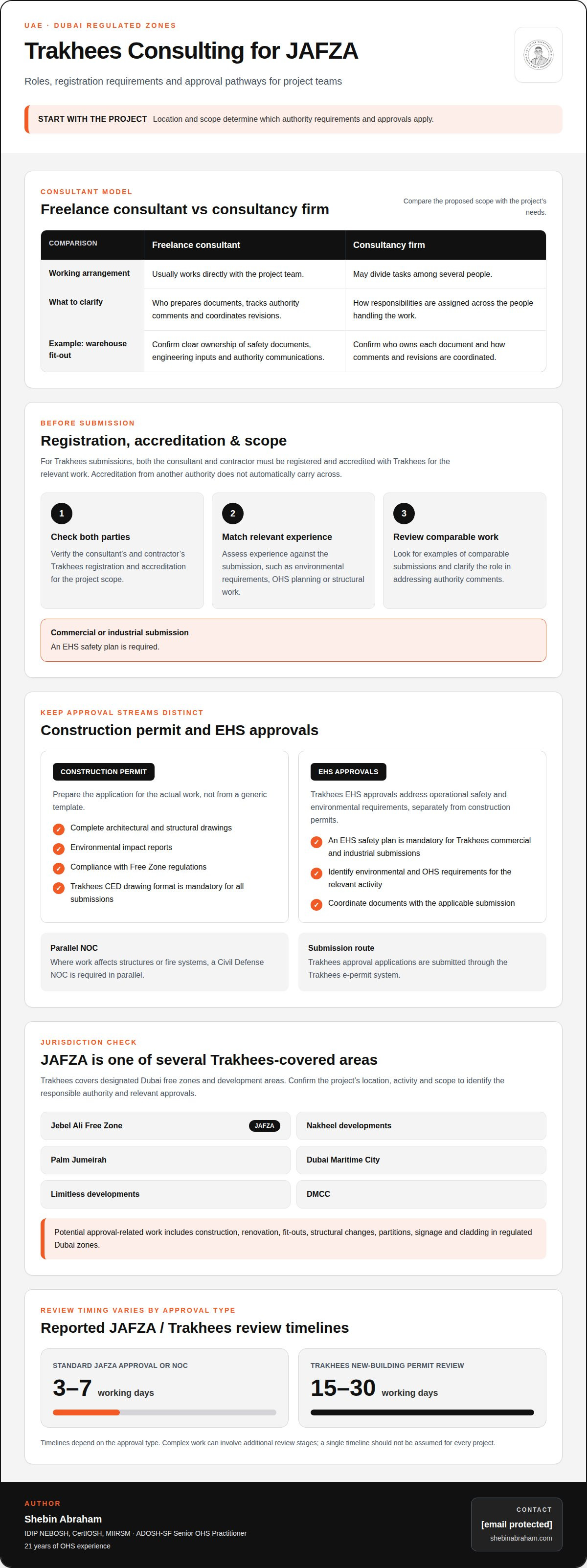
A freelance consultant usually works directly with the project team, while a consultancy firm may divide tasks among several people. Compare the proposed scope with your project’s needs. A warehouse fit-out, for example, may require clear ownership of safety documents, engineering inputs and authority communications. Agree who prepares each document, tracks comments and coordinates revisions before submission.
Qualifications and Required Approvals
For Trakhees submissions, both the consultant and contractor must be registered and accredited with Trakhees for the relevant work. Accreditation from another authority does not automatically carry across. Match the consultant’s experience to the submission, such as environmental requirements, OHS planning, or structural work. A commercial or industrial submission requires an EHS safety plan.
Finding a Qualified Consultant
To assess a consultant for a JAFZA project, review their Trakhees registration and accreditation for the relevant work. Look for examples of comparable submissions and clarify their role in preparing documents and addressing authority comments. Confirm that the contractor’s registration and accreditation also match the project scope before submission.
Begin by defining the proposed work and its location. Trakhees approvals may apply to construction, renovation, fit-outs, structural changes, partitions, signage and cladding in regulated Dubai zones. A consultant can map these activities to the relevant submission and identify where engineering drawings or environmental reports are needed.
Trakhees is the regulatory arm of the Ports, Customs, and Free Zone Corporation. A consultant can support liaison by organizing submission documents, coordinating responses to review comments and keeping the project team aligned on revisions. A warehouse modification, for example, may involve structural details and operational safety information, making consistent document control important.
Prepare the application for the actual work, not from a generic template. Building permit applications require complete architectural and structural drawings, environmental impact reports and compliance with Free Zone regulations. Trakhees CED drawing format is mandatory for all submissions. Where work affects structures or fire systems, a Civil Defense NOC is required in parallel.
Keep approval streams distinct. Trakhees EHS approvals address operational safety and environmental requirements, separately from construction permits. An EHS safety plan is mandatory for Trakhees commercial and industrial submissions. A consultant can coordinate the documents with the relevant submission and help identify gaps before they cause avoidable delays.
Trakhees approval applications are submitted through the Trakhees e-permit system. Before submission, a consultant can organize the required documents, check that drawings use the required format and coordinate applicable NOCs. A structured process helps project teams see which items need attention and supports clear communication with the authority.
JAFZA and other Trakhees-covered areas
Trakhees jurisdiction covers designated Dubai free zones and development areas, not only JAFZA. The project’s location, activity and scope determine which regulatory approvals apply.
Projects in Jebel Ali Free Zone may require Trakhees approvals for construction, fit-out or operational work. Other areas where Trakhees approvals are relevant include Nakheel developments, Palm Jumeirah, Dubai Maritime City, Limitless developments and DMCC. Requirements vary by project, so identify the responsible authority before planning the work.
Before hiring a freelance consultant for a JAFZA project, assess three risks: incorrect assumptions about jurisdiction, gaps in relevant registration or accreditation, and incomplete applications that lead to revisions or delays. Confirm that the proposed scope covers the project location and activity, and clarify the consultant’s role in submissions and authority liaison.
For businesses operating in JAFZA, OECD states that an operating licence is required, and its type depends on the activities the business will carry out. That activity profile also helps frame the operational and environmental requirements relevant to the project. A warehouse operation, for example, may have different needs from an office fit-out or residential development.
Trakhees approval is relevant to construction, modification or fit-out projects in its areas before work starts. A master developer or building management NOC is required where applicable. A fit-out application may involve technical drawings and an on-site evaluation by Trakhees inspectors. Align the scope, drawings and approval route from the outset.
Submission and review timelines depend on the approval type. A standard JAFZA approval or NOC is estimated at 3-7 working days, while Trakhees new-building permit reviews typically take 15-30 working days. Complex work can involve additional review stages, so a single timeline should not be assumed for every project.
Trakhees approval applications are submitted through the Trakhees e-permit system. A practical sequence is to establish the project’s jurisdiction, define the proposed activity, identify required permits and NOCs, then prepare the relevant documents. This helps prevent a mismatch between the planned work and the authority submission.
- Map the site address to the relevant free zone or designated area.
- Match the proposed activity to the required licence and approval pathway.
- Align technical drawings and project scope before submitting the application.
- Plan for inspections and review stages appropriate to the work.
Clear jurisdiction mapping helps JAFZA teams plan environmental and operational compliance alongside project approvals. It also helps ensure the application reflects the actual site, activity and work scope.
Trakhees also oversees construction permits and environmental, health, and safety regulations for projects in free zones, special development areas, and select commercial and residential zones in Dubai. It provides business licensing and company formation services and oversees environmental, health, and safety regulations for businesses under its jurisdiction. JAFZA has hosted more than 7,000 companies, making jurisdiction checks relevant across a broad business community.
Check fees and review periods against the approval sought. Trakhees approval timelines in Dubai typically range from a few days to several weeks.
How can I find a qualified Trakhees consultant for JAFZA?
Start with the project scope, then match the consultant’s Trakhees registration and experience to the work. A JAFZA warehouse fit-out, for example, calls for different evidence than an OHS review of ongoing operations.
Define the work before assessing capability. List the site location, business activity, planned changes and required outcomes. A structural modification may need engineering coordination, while an operational review focuses on workplace safety and environmental controls. A well-defined scope gives the consultant a clear basis for setting out responsibilities and deliverables.
Assess registration and accreditation against the precise work proposed. Trakhees submissions may require consultants and contractors accredited for the relevant work; Dubai Municipality registration does not transfer. Ask for evidence that the consultant’s registration aligns with the submission, and establish who will coordinate any separately appointed contractor.
Assess comparable experience through specific examples, not broad claims. A useful example identifies the work type, the consultant’s responsibilities, the documents coordinated and how authority comments were handled. Experience preparing a commercial EHS safety plan, for instance, is more relevant to an industrial submission than general construction experience alone.
Use a focused scope discussion to assess technical judgment. Ask how the consultant would map the project to its approval route, organize the required documents and manage revisions. A building permit application requires complete architectural and structural drawings, environmental impact reports and compliance with Free Zone regulations. The consultant should explain how these elements apply to the actual work.
Clarify communication arrangements before engagement. Identify who will prepare and review each document, communicate with Trakhees, track application status and coordinate responses. Since applications are submitted through the Trakhees e-permit system, agree who manages submission records and follow-up. Clear ownership helps prevent missed comments and inconsistent document versions.
Compare proposed scopes by substance, not firm size or presentation. A freelance specialist may be directly involved, while a consultancy firm may divide tasks across a team. In either case, make the named professional’s experience, responsibilities and authority liaison role explicit. Projects involving several technical disciplines also need clear coordination among contributors.
- Match registration and accreditation to the specific work.
- Request comparable project examples and defined responsibilities.
- Clarify document ownership, authority liaison, and revision handling.
- Align the proposed scope with the site and activity.
Shebin Abraham, IDIP NEBOSH, CertIOSH, MIIRSM, is an ADOSH-SF Senior OHS Practitioner with 21 years of OHS experience. His perspective reflects the importance of connecting technical compliance decisions with the people working under those systems.
What qualifications and approvals should a Trakhees consultant have?
For Trakhees submissions, registration and accreditation must match the work. Both the consultant and contractor must be registered and accredited with Trakhees for the relevant work. Dubai Municipality registration does not transfer automatically. This matters when selecting support for a JAFZA OHS submission or a project involving construction.
Identify the consultant responsible for your submission, then match their Trakhees registration and accreditation to the scope, such as environmental, health and safety requirements or relevant building submissions. General experience does not replace the required registration for that work. The contractor’s credentials must also align with its assigned role.
Trakhees requires environmental, health and safety clearances and, where applicable, building permits. The clearances depend on the project and its activities. For example, a commercial or industrial submission requires an EHS safety plan. This is separate from a building permit, so establish which approval path covers operational safety and which covers construction.
Trakhees EHS approvals can involve fire safety and risk assessments, occupational health and safety permits, and hazardous-material handling and disposal certifications. These are approval areas, not a universal credential list for every consultant or project. Ask how the consultant’s accreditation and experience fit the specific EHS scope, such as a risk assessment or hazardous-material process.
- Registration: Confirm Trakhees registration for the relevant submission work.
- Accreditation: Match accreditation to the consultant’s defined role and project scope.
- Experience: Review examples relevant to the actual EHS or building approval.
- Coordination: Establish how the consultant and contractor’s respective roles connect.
Keep professional qualifications separate from project approvals. A consultant’s registration does not itself provide the project’s environmental, health and safety clearances or building permit. The consultant supports the application by coordinating documents and requirements relevant to the work. If a project involves building activity and workplace hazards, define both workstreams before preparing submissions.
Ask how the consultant will handle authority comments and document revisions. For example, an EHS safety plan should reflect the commercial or industrial activity described in the submission. If hazardous materials are involved, clarify how they fit the applicable approval scope. Practical examples help assess relevant capability without confusing credentials with approvals.
Before engagement, document the consultant’s responsibilities, the contractor’s responsibilities and the approvals in scope. Confirm that each party’s Trakhees registration and accreditation match its assigned work. This gives the JAFZA project team a clear basis for coordinating submissions and distinguishing professional eligibility from the approvals the project must obtain.
Approval may cover new construction, structural and architectural drawing reviews, renovations, extensions and demolitions in free zones and special development areas. Fit-out approvals can apply to office, retail and commercial works, with on-site evaluations by Trakhees inspectors.
What is the difference between a freelance Trakhees consultant and a consultancy firm?
The main difference is how the work is delivered. A freelance consultant usually works directly with the project team, while a consultancy firm may assign responsibilities across several people. For a JAFZA project, assess the named professional handling the work, not just the business model.
Direct involvement can simplify communication on a defined assignment. One consultant, for example, may coordinate an operational safety review, organize project documents and track authority comments. This can suit a focused scope with clear deliverables. Agree who responds to comments and manages revisions before submission.
A consultancy firm may bring together people in different technical roles. This can help when a project combines engineering drawings, environmental matters and workplace safety planning. Focus on how the roles connect: ask who leads coordination, reviews each document and shares project information among contributors.
Neither arrangement replaces project-specific eligibility. Trakhees submissions may require the consultant and contractor to be registered and accredited for the relevant work. Check the professional responsible for the submission as well as the contractor’s role. A firm’s overall experience alone does not show that the person handling your scope has relevant registration or experience.
Compare the proposed scope in writing. It should identify project activities, documents to coordinate, authority liaison responsibilities and how revisions will be handled. For a warehouse modification, clarify who manages engineering inputs and who coordinates operational safety documents. This helps prevent gaps between technical and OHS workstreams.
- Direct accountability: Identify the person leading your submission and communicating with the project team.
- Specialist coordination: For multi-discipline work, understand how the assigned specialists share documents and decisions.
- Relevant eligibility: Match registration and accreditation to the actual work, not the provider’s general profile.
- Defined deliverables: Record submission tasks, revision handling, and liaison responsibilities in the agreed scope.
For a defined OHS assignment, direct access to one experienced professional may be the priority. A project with structural, environmental and operational components may need coordinated technical input. In either case, assess the named lead, relevant credentials, communication process and fit with the project scope.
Use those criteria to decide which delivery model suits your team. If you’re preparing a JAFZA submission, discuss your Trakhees project requirements and the support needed for its scope.
Shebin Abraham: Freelance HSE Service
Shebin Abraham provides freelance Trakhees OHS consulting for businesses managing workplace safety and compliance requirements across regulatory jurisdictions, including JAFZA. His support helps teams organize OHS work around their project scope and operational needs.
Shebin Abraham holds IDIP NEBOSH, CertIOSH, and MIIRSM credentials and is an ADOSH-SF Senior OHS Practitioner with 21 years of OHS experience. His services include OHS Services, Freelance HSE Service, Freelance ADOSH-SF OHS consulting, and Trakhees consulting. Turn to him when your team needs professional support with Trakhees-related OHS compliance or practical HSE guidance.
Contact Shebin Abraham to discuss the OHS support your operations and projects need.
Set Your Next Compliance Step in Motion
Make the next step a clear project brief. Define the work ahead, the people responsible, and the operational concerns that need attention. That gives a freelance Trakhees consultant in JAFZA a practical starting point for aligning support with your site and business activities.
Compliance is most useful when it informs everyday decisions, not when it remains a document exercise apart from operations. Involve your project team early, especially those responsible for workplace safety and implementation. Their input helps translate requirements into procedures that work for the people doing the job.
If you’re ready to discuss your project’s OHS needs, contact Shebin Abraham for assistance. A focused conversation can help you identify a sensible next step and move forward with greater clarity.
Frequently Asked Questions
Can you help with Trakhees environmental and safety compliance?
Yes. Shebin Abraham provides Trakhees OHS consulting and guides businesses on safety and environmental compliance. For example, an operations team preparing for a process change can use OHS support to identify relevant safety documents and controls. The support is shaped around the activities involved, connecting compliance tasks with practical workplace responsibilities.
What does a freelance Trakhees consultant in JAFZA do?
A freelance Trakhees consultant in JAFZA provides focused advice on a business’s Trakhees-related OHS needs. Support can include organizing compliance documents, understanding relevant safety protocols and preparing for compliance inspections. If a business changes how a work area operates, consulting can help assess the implications for workplace safety procedures and supporting records.
Can a freelance consultant submit Trakhees applications on behalf of a JAFZA company?
A consultant can help prepare and coordinate an application submitted through the Trakhees e-permit system. Shebin Abraham’s Trakhees OHS consulting supports permitting documentation and compliance guidance. For a JAFZA company, clarify who will manage the formal portal submission and provide the required business information. This distinguishes professional document support from the company’s own application responsibilities.


