

Good HSE procedures do more than document rules; they help people carry out work safely and consistently. HSE management procedures development brings together risk assessment procedures, emergency procedures and safe systems of work within a wider management framework. For occupational health and safety, ISO 45001:2018 is the international standard for management systems, according to the International Organization for Standardization.
A framework is useful only when procedures reflect actual work, clarify responsibilities and support compliance instead of sitting unused in a folder. This article explains what an HSE management system includes, how to assign procedure development and how to review and tailor procedures so they work for the people who use them.
Shebin Abraham, IDIP NEBOSH, CertIOSH, MIIRSM, is an ADOSH-SF Senior OHS Practitioner with 21 years of experience in OHS. His experience serving clients across the UAE informs a practical, people-focused approach to workplace health and safety.
Key Takeaways
- Build procedures around the risks, tasks and working conditions they are meant to control.
- Assign development to people with relevant operational knowledge, and involve the workers who will use each procedure.
- Use clear, task-appropriate safe work instructions to support competence, not replace it.
- Manage procedures through review and updates so they remain aligned with changing work and compliance needs.
- Adapt model procedures to local operations, workforce needs and the way work is actually performed.
Allocating procedure development responsibilities
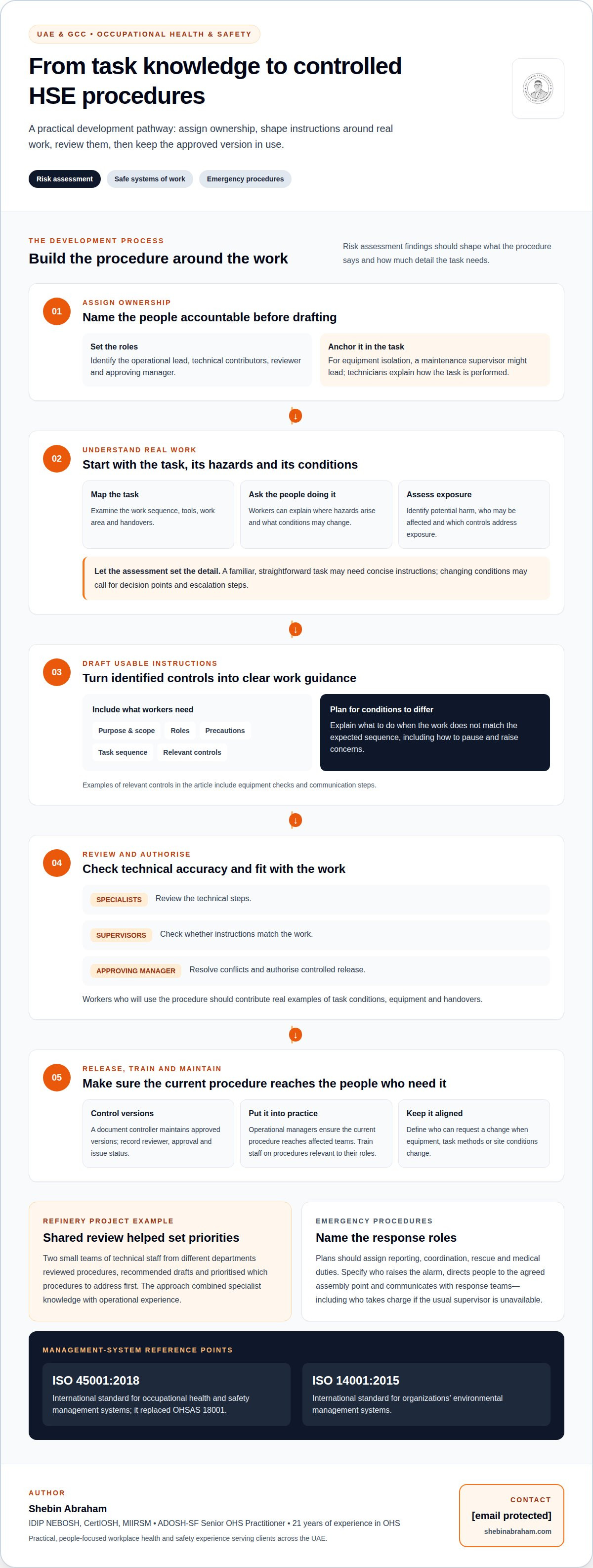
Assign each procedure to an owner who understands the work and its hazards. Before drafting, name the operational lead, technical contributors, reviewer and approving manager. For example, a maintenance supervisor might lead a procedure for equipment isolation, while technicians explain how the task is performed. Clear ownership helps prevent conflicting instructions and gives workers a defined way to raise practical concerns.
In one refinery project, two small teams of technical staff from different departments reviewed procedures and recommended drafts. They also prioritised which procedures to address first. This approach combines specialist knowledge with operational experience, helping an organisation identify existing instructions, find gaps and sequence the work according to operational priorities instead of drafting documents in isolation.
Set responsibilities for every stage, not just the writing. The procedure owner gathers task information and prepares a draft. Subject-matter specialists review technical steps, and supervisors check whether the instructions match the work. The approving manager resolves conflicts and authorises controlled release. Workers who will use the procedure should share examples of real task conditions, equipment and handovers. Senior management coaching can encourage participation and reinforce that procedures are working controls.
Environmental procedures need defined ownership too. ISO 14001:2015 is the international standard for organizations’ environmental management systems, according to the International Organization for Standardization. An organisation can assign environmental specialists to identify relevant operational controls, while department managers explain where those controls apply. For example, a production procedure may need input from the team responsible for managing its environmental aspects.
Emergency response plans need named roles for reporting, coordination, rescue operations and medical duties. Specify who raises the alarm, directs people to the agreed assembly point and communicates with response teams. At sites with several work areas, define how each area reports an incident and who takes charge if the usual supervisor is unavailable. The plan should reflect the site’s hazards, layout and response arrangements.
Keep authority clear and practical. A document controller can maintain approved versions, but operational managers are responsible for ensuring the current procedure reaches affected teams. Define who can request a change when equipment, task methods or site conditions change. Record the reviewer, approval and issue status so workers can distinguish current instructions from superseded drafts.
Connect responsibility with competence. In the refinery project, all staff received training on procedures relevant to their roles. Apply the same principle to procedure development: contributors need enough task knowledge to review their sections, and users need instruction suited to their duties. This makes procedure development a shared operational responsibility, with accountability from the first draft through workplace use.
What is an HSE Management System?
An HSE Management System is an organised framework connecting workplace risks, responsibilities, controls and review. Its procedures explain safe work; common mistakes include weak risk assessment, inadequate instructions and relying on documents alone.
Hazard Identification and Risk Assessment
Hazard identification finds potential sources of harm. Risk assessment considers who may be affected and how controls should address exposure. Together, these findings help procedure writers decide which tasks need documented instructions and what those instructions must control.
Start with the task, not a generic template. For equipment maintenance, examine the work sequence, tools, work area and handovers. Ask the people doing the task where hazards arise and what conditions may change. Their input can identify relevant hazards and link each one to a clearly described control. HSE management procedures development works best when task-level findings shape the instructions.
Risk assessment also helps determine whether a written procedure is an appropriate control and how much detail it needs. A familiar, straightforward task may need concise instructions, while changing conditions may call for decision points and escalation steps. Use the assessment to shape the procedure rather than completing it separately and filing it without changing the work instructions. This connection between assessment and action is central to HSE management procedures development.
Procedure Coverage and Controls
HSE management procedures describe how an organisation manages health, safety and environmental risks through defined work practices. They may cover risk assessment, emergency response and safe systems of work, as well as the controls workers need to perform their assigned tasks.
For each procedure, state its purpose, scope, roles, required precautions and task sequence. Include relevant controls identified through risk assessment, such as equipment checks or communication steps. Explain what to do if conditions differ from the expected sequence, giving workers a clear way to pause and raise concerns.
ISO 45001:2018 is the international standard for occupational health and safety management systems and replaced OHSAS 18001, according to the International Organization for Standardization. Separately, ISO 14001:2015 is the international standard for organizations’ environmental management systems, according to the International Organization for Standardization. These standards provide distinct management-system reference points for workplace health and safety and environmental management.
In the UAE, procedures need to fit the organisation’s operations and work locations. For example, a site procedure for vehicle movement should reflect actual routes, work interfaces and communication arrangements. A copied instruction that ignores those conditions may look complete but fail to guide the people doing the work.
Keep assessment and procedure review connected. When a control changes, the procedure may need revision. If workers say an instruction cannot be followed as written, reassess the task and its controls. This feedback can reveal that a document is unclear or incomplete, or that it is being relied on without adequate supporting measures.
An effective HSE management system makes risk decisions visible in everyday work. Procedures guide action, while supervision, suitable equipment and worker competence support it. Treat each document as one part of the control system, not as proof on its own that a hazard has been managed.
Safe Systems of Work and Safe Operating Procedures
Develop and implement procedures by analysing the task, drafting instructions with users, reviewing controls, approving the document, training relevant workers and managing revisions. Depending on the task, include instructions, checklists, decision aids, diagrams or flow charts, along with operational records showing how required controls are applied.
Safe Work Procedures
A safe system of work sets out an agreed safe way to complete a task, while an operating procedure explains its practical sequence. Both help workers understand expected actions, control points and what to do when conditions change.
Walk through the task with the people who perform it. For equipment maintenance, observe preparation, access, work steps and handover. Ask users where the task varies and which instructions need clarification. Their experience can reveal differences between the written method and actual operating conditions.
Choose a format that suits the task and its consequences. A short checklist may work for routine pre-use checks; a flow chart can guide decisions when a task has different paths. Include details that guide action, using clear language workers can follow at the point of work.
Development and Implementation Steps
Procedure development is a controlled process, taking instructions from task analysis through approval and workplace use. A defined sequence helps ensure an accurate draft does not become an unused document.
First, identify the task and gather existing instructions from operating and support teams. Compare the current method with work as performed, then draft or revise the procedure with users. Discuss proposed changes with relevant managers, resolve operational concerns and approve the final version through the organisation’s document-control process.
Implementation takes more than issuing a file. Introduce the procedure to managers and operating staff, explain actions for each role and provide training suited to workers’ duties. Supervisors can observe whether instructions fit the task and identify improvements. Procedures should support competence, not replace the practical knowledge and ability needed to work safely.
Procedure Documents and Operational Controls
Procedure documents pair usable instructions with supporting tools and records. Their purpose is to guide work and make important control steps visible, not to create paperwork without operational value.
Depending on the task, include step-by-step instructions, checklists, decision aids, diagrams or flow charts. Supporting records may capture completed checks, approvals, training or task handovers when they help demonstrate how the procedure is applied. For example, a maintenance checklist can highlight required inspection points, while a handover record can communicate unfinished work.
Build procedure management into the system, covering selection, development, use, review and updating. Assign an owner, identify the current approved version and remove superseded copies from work areas. Ask workers and supervisors for feedback when instructions are unclear or difficult to follow. Review affected procedures when task methods, equipment or operating conditions change, keeping written guidance aligned with actual work.
A procedure is one part of an effective control arrangement. If human error remains a concern, do not treat written instructions as the only safeguard. Consider whether the task, work environment and equipment also support the safe method. This keeps the document connected to practical controls and the people responsible for using them.
Compliance management and regular review
ISO 45001:2018 is the international standard for occupational health and safety management systems and replaced OHSAS 18001, according to the International Organization for Standardization. ISO 14001:2015 is the international standard for organizations’ environmental management systems, according to the International Organization for Standardization. These standards provide distinct frameworks for managing workplace safety and environmental responsibilities.
Compliance management connects applicable frameworks to how an organisation selects, develops, follows, reviews and updates procedures. In UAE workplaces, controlled documents should align with actual tasks, operational risks and applicable organisational requirements. A procedure register can show each document’s owner, approval status, users and review triggers, helping managers identify what needs attention.
Treat review as a management process, not a date entered once on a document. Set clear triggers for reassessment, such as a changed work method, equipment modification, incident finding or worker feedback. For example, if a maintenance team reports that an instruction no longer matches the equipment layout, the owner can assess the change, consult affected users and update the controlled version.
Manage the full document lifecycle. The procedure owner checks whether instructions remain useful, operational staff review task details and an authorised manager approves revisions. Document control replaces outdated copies in work areas and communicates the current version to affected workers. Training or briefings should explain changes that affect how people do the task, rather than simply announcing a new document number.
Audits and workplace observations can check whether procedures are understood and followed. Reviewers might compare instructions with observed work, examine completed checklists and discuss obstacles with users. If workers repeatedly bypass a step, investigate whether it is unclear, impractical or unsupported by the task design. Record a corrective action, assign an owner and follow up.
Performance measures can reveal patterns, but each needs context. Lost Time Injury Rate, Total Case Incident Rate and Experience Modification Rate are examples of metrics used to track HSE performance. A trend should prompt questions about work activities, reporting and controls. It cannot replace task-level review or prove that a particular procedure is effective.
Use management review to turn findings into decisions. Leaders can consider audit results, incident learning, procedure changes and performance measures together, then set improvement priorities. A documented review process keeps the HSE management system relevant to current operations and directs attention to procedures that need clearer instructions, stronger controls or workforce input.
Customising model procedures to client needs
A model procedure is a starting point, not a finished instruction for every workplace. Customisation connects its controls and wording to the organisation’s actual tasks, equipment, workforce and operating conditions.
Begin by comparing the model with how work is performed. A refinery project gathered information from operating and support departments, including identifying procedures already in use. This helps distinguish useful existing controls from gaps that need new instructions. For example, a general maintenance template may not describe the equipment, access route or handover used by a particular team.
Adapt the procedure to the task and its users. Check each step against the work sequence, then clarify role-specific actions, decision points and communication needs. If several departments share a task, show where responsibilities pass from one team to another. Making interfaces visible helps prevent gaps between written instructions and day-to-day coordination.
Involve people affected by proposed changes. In the refinery project, teams discussed improvements with relevant managers to reach agreement. Senior management coaching also encouraged staff to help customise the HSE system. This input can reveal practical barriers early, such as a step that does not fit the work sequence or terminology users interpret differently.
Language is another essential part of a good fit. The refinery teams translated procedures into their native language during customisation. For multilingual workforces, clear wording helps workers understand instructions and responsibilities. Translation should preserve the meaning of each control and task step, not merely replace individual words. Diagrams or flow charts can also clarify sequences that are difficult to explain in writing.
If no equivalent procedure exists, develop one around the actual task rather than forcing an unrelated template to fit. Gather information from operating and support teams, identify the necessary controls, then discuss the draft with relevant managers and users. A new procedure for a site-specific task should reflect its work area, equipment and coordination points.
Before issue, confirm the customised document has an owner, approval and a clear route into workplace use. Introduce it to affected managers and operating staff, and provide training relevant to their roles. User feedback can show whether the instructions work as intended or need refinement. This creates a practical cycle of adaptation, discussion, introduction and improvement.
For support tailoring HSE procedures to operational needs, discuss procedure customisation.
Shebin Abraham
Shebin Abraham helps organisations across the UAE turn HSE procedure principles into practical workplace controls. His OHS Services and Freelance HSE Service support organisations in refining responsibilities, procedures and review arrangements. For projects requiring specific compliance guidance, his Freelance ADOSH-SF OHS consulting and OHS Freelancer Trakhees Consulting address their respective frameworks.
Turn to Shebin when procedures need to reflect operational realities, support safe work or align with applicable requirements. As an ADOSH-SF Senior OHS Practitioner with IDIP NEBOSH, CertIOSH and MIIRSM credentials, he brings a practical, people-focused perspective to HSE and OHS consulting.
Contact Shebin Abraham to discuss your HSE procedure development needs.
Move from written procedures to lasting practice
The next step is to make procedure ownership part of everyday operational decision-making. Choose a task where instructions need attention, then identify what would help workers apply them consistently. A focused review can clarify responsibilities, surface practical barriers and establish a sensible basis for future updates.
Shebin Abraham’s OHS Services, Freelance HSE Service and Freelance ADOSH-SF OHS consulting support organisations developing and improving workplace procedures. His guidance connects written controls with operational needs and applicable requirements. Effective HSE management procedures development is an ongoing commitment to keeping guidance useful as work evolves.
Start a conversation about the procedures your organisation wants to strengthen. Contact Shebin Abraham to discuss a practical next step. Clear, usable procedures are within reach when teams build them around the work and the people doing it.
Frequently Asked Questions
Why is good procedure design important?
Good procedure design reduces uncertainty at the point of work, especially during shift handovers or when teams share equipment. For example, a clear handover instruction can specify who communicates an unresolved equipment issue before another team starts work. Well-designed instructions also help supervisors explain expected actions and identify gaps between documented controls and actual practice.
What UAE and Abu Dhabi HSE laws and regulatory requirements apply to management procedures?
Requirements depend on an organisation’s activities and the regulatory framework that applies to its operations. Relevant reference points include UAE Federal Labour Law, Abu Dhabi’s ADOSH-SF framework and Trakhees OHS requirements for operations within its remit. Identify the applicable framework, then map relevant requirements to the work, responsibilities and supporting records. Do not assume one framework applies universally.
How should HSE procedures be tailored to industry, workplace hazards, and risk assessments?
Tailor each procedure to its hazards, equipment, work sequence and workforce. A warehouse traffic procedure, for example, should reflect vehicle and pedestrian interfaces, while a maintenance instruction should address the specific equipment and task steps. Use the relevant risk assessment to select controls for the procedure, then test the wording with workers who perform the task.
Who should be involved in developing, reviewing, approving, and updating HSE procedures?
Involve the procedure owner, operational workers, relevant technical specialists and the manager authorised to approve it. For work involving a contractor, include the internal person coordinating that work. Assign document control to someone responsible for maintaining the approved version. When a change affects a task, the owner should coordinate a review with affected users and technical reviewers before approval and reissue.
How often should HSE management procedures be reviewed and revised?
Set a planned review interval through the organisation’s document-control process, and review sooner when a meaningful change occurs. Triggers may include an incident investigation finding, new equipment, a changed work method, audit feedback or workers reporting that an instruction is difficult to follow. Record the outcome, including whether the procedure remains suitable or needs revision, and communicate material changes to affected staff.


