

Review workplace risk assessments at least annually, and more often for higher-risk activities. A workplace safety compliance checklist for the UAE should also prompt a review whenever processes, layouts or equipment change, so documented controls stay aligned with the work.
Keeping records current and emergency arrangements practical takes more than completing a form. This guide explains what to review in risk assessments, training and incident records, fire and emergency plans, injury reporting, and heat controls for outdoor work in the UAE.
Written by Shebin Abraham, IDIP NEBOSH, CertIOSH, MIIRSM, an ADOSH-SF Senior OHS Practitioner with 21 years of OHS experience, this guidance connects compliance checks with the everyday responsibility to protect people and maintain safe operations.
Key Takeaways
- Review workplace risk assessments at least annually, and update them when work processes, layouts or equipment change.
- Keep training, PPE, inspection and hazard-assessment records current, and report work-related injuries and occupational diseases to MoHRE within 48 hours.
- Check that fire detection, alarms, suppression systems and escape routes are covered by emergency arrangements, and include regular evacuation drills.
- Plan outdoor work around the UAE midday break, which runs from 12:30pm to 3pm from 15 June to 15 September each year, and provide shaded rest areas.
- Match protective equipment to workplace hazards and consider the federal and local requirements that apply to your workplace.
What Is Workplace Safety in Dubai?
Review workplace risk assessments at least annually, and more often for higher-risk activities. Update them whenever a process, layout or piece of equipment changes. Before work begins, employers are expected to identify hazards, assess their likelihood and severity, and document control measures. A workplace safety inspection checks conditions, equipment and procedures that could cause injury or illness.
Start identifying hazards by walking through each work area and observing tasks as they are performed. Include physical, chemical and biological hazards, then rank each by likelihood and potential severity. For example, an exposed cable beside a wet floor needs prompt attention because both conditions can contribute to an electric shock or fall. Review the assessment again after operational changes.
Building inspections should cover both visible conditions and how people use the space. Check for faulty wiring, overloaded electrical circuits, blocked exits, damaged flooring and poorly stored chemicals. In an office, assess trip hazards and workstation ergonomics. In a workshop, inspect machine guards, access routes and chemical storage. Record each finding, its control measure and the responsible role.
- Check electrical areas: identify damaged cables and overloaded circuits before they create fire or shock hazards.
- Inspect escape routes: keep corridors and exits clear so occupants can leave safely.
- Review workstations: look for repetitive tasks and awkward postures that may contribute to back problems.
- Assess chemical storage: check containers, labels and separation of incompatible substances.
Match protective equipment to the hazard and task rather than issuing the same standard set to every worker. Select eye protection for flying particles, gloves suited to the substance being handled, or hearing protection where noise exposure is a concern. Consider fit, compatibility with other equipment, task duration and freedom of movement. UAE employees are required to use protective equipment, follow safety instructions and avoid actions that endanger themselves or others. Explain how to use and care for each item, and record its issue and any relevant training.
For construction sites and other high-risk work, UAE employers must identify and assess hazards, document controls, provide safety training and protective equipment, and maintain a safe work environment. Federal Decree-Law No. 33 of 2021 sets the national baseline, while local requirements also apply. Workplace safety requirements can vary by location, so businesses should check the guidance applicable to their operations.
Federal occupational health and safety breaches can carry fines from AED 5,000 to AED 1,000,000. The applicable consequence depends on the breach and the relevant enforcement process.
For official workplace guidance, consult the requirements of the relevant authority: MOHRE enforces workplace safety rules across the UAE, while OSHAD-SF and Dubai Municipality’s HSE rules apply in their respective jurisdictions. Match the guidance to the applicable emirate and industry.
Shebin Abraham, IDIP NEBOSH, CertIOSH, MIIRSM, is an ADOSH-SF Senior OHS Practitioner with 21 years of OHS experience.
Reviewing incident, training, and maintenance records
Employers must provide a safe work environment, conduct regular assessments, maintain safety measures and provide training. A written safety policy should explain workplace rules, expectations and employee responsibilities. Provide regular health and safety training to employees, line managers and supervisors, with content suited to their tasks and workplace hazards.
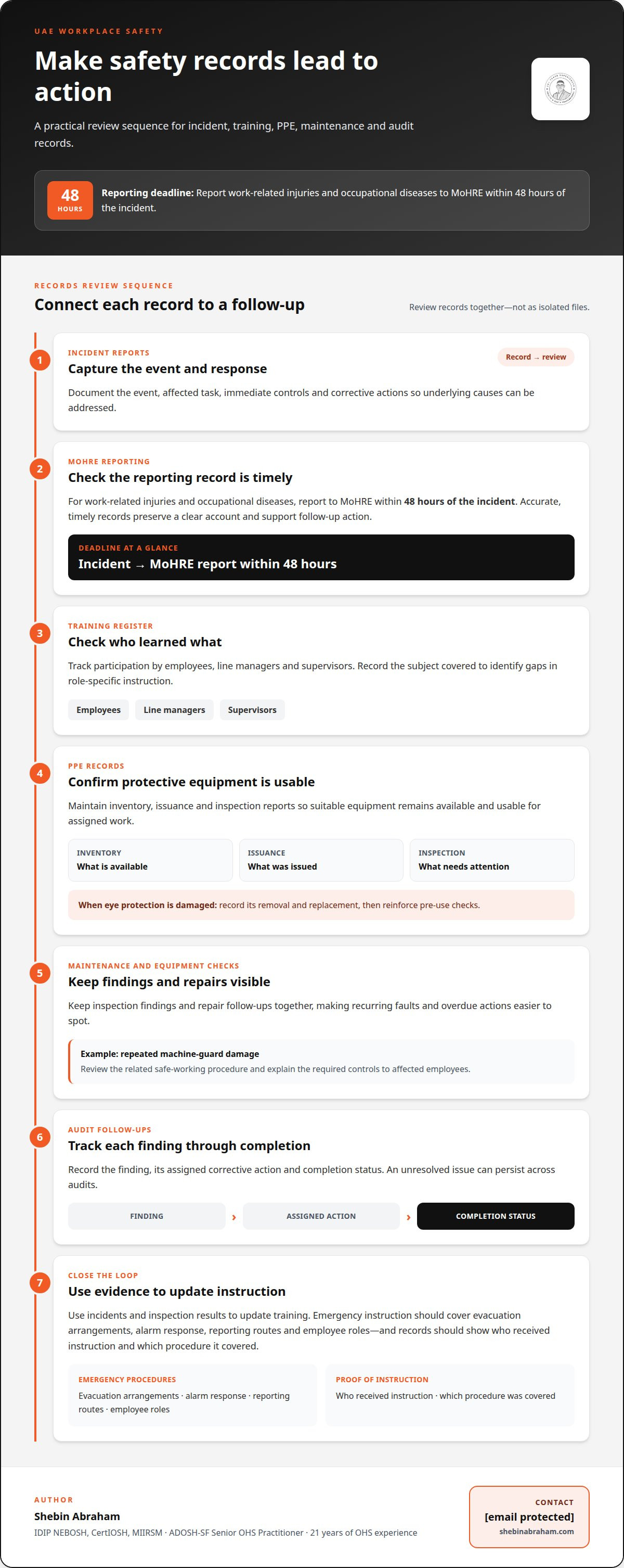
Review records together, not as isolated files. A training register may show that a session took place, while an incident report reveals whether employees understood and applied the procedure. In the UAE, employers must report work-related injuries and occupational diseases to MoHRE within 48 hours of the incident. Accurate, timely records help preserve a clear account and support follow-up action.
- Keep incident reports complete: Record the event, affected task, immediate controls, and corrective actions so the underlying causes can be addressed.
- Track training attendance: Document employee, line manager, and supervisor participation, plus the subject covered, to identify gaps in role-specific instruction.
- Review PPE records: Maintain inventory, issuance, and inspection reports, because suitable protective equipment must remain available and usable for assigned work.
- Log maintenance and equipment checks: Keep inspection findings and repair follow-ups together, so recurring faults or overdue actions remain visible.
- Close audit follow-ups: Record each finding, its assigned corrective action, and completion status, because an unresolved issue can persist across audits.
Emergency procedures need evidence of practical instruction, not just a file in a shared folder. Cover evacuation arrangements, alarm response, reporting routes and the roles employees must follow. Training records should show which employees received instruction and which procedure it covered. For example, a warehouse team needs to know how to raise an alarm and keep access routes clear during an evacuation.
Use incidents and inspection results to update training. If a maintenance record shows repeated damage to a machine guard, review the related safe-working procedure and explain the required controls to affected employees. If PPE inspection reports identify damaged eye protection, record its removal and replacement, then reinforce pre-use checks. This links records to action.
A workplace safety compliance checklist UAE employers can use should connect evidence from hazard assessments to training, equipment inspection, incident reporting, and corrective action. This makes gaps easier to trace across records. A focused review of safety records can help identify differences between written procedures and workplace practice.
Keep the checklist useful as operations change. After introducing new equipment, for example, record the relevant training, inspection arrangements and any revised procedures. A workplace safety compliance checklist maintained as part of routine reviews can help keep these records aligned across UAE operations. Assign follow-up actions to responsible roles so findings are addressed, not merely recorded.
Fire safety and emergency preparedness
In Dubai, building fire and life safety measures include compliant detection, alarms, suppression systems, clear escape routes, and regular evacuation drills. Treat these as connected safeguards: an alarm has limited value if occupants cannot hear it or the nearest exit is blocked. Include each measure in the workplace inspection and emergency plan.
Check the building’s fire arrangements against the actual work areas and occupancy. A storage room, workshop, kitchen and office can each present different ignition sources and evacuation needs. Confirm that detection and alarm systems cover relevant areas, suppression equipment suits the risks, and escape routes remain usable. Record deficiencies, assigned corrective actions and evidence of completion.
- Test detection and alarms: Confirm that systems operate as intended, because an unnoticed fault can delay evacuation during a fire.
- Inspect suppression equipment: Check access and condition, because blocked or damaged equipment can impede the response.
- Keep exits clear and marked: Remove stored items from escape routes so people can identify and use them during an incident.
- Plan evacuation drills: Practise the procedure and record observations, because drills can reveal confusion about routes or responsibilities.
- Review emergency roles: Make reporting and evacuation responsibilities clear, so employees know what to do when an alarm sounds.
For labour accommodation, the checklist gives an extinguisher deployment guideline of one extinguisher per 200-300 m². It also specifies firefighting stairs at least 1,200 mm wide. Treat these as accommodation checklist details, not as a substitute for assessing the building’s design and applicable requirements.
NFPA 101 is cited for keeping emergency exits unobstructed and clearly marked in the labour camp checklist. In practice, inspect exit doors, signs, corridors, and stair access together. A clear sign does not solve an obstruction, and an open corridor does not help if occupants cannot identify the correct route.
After each evacuation drill or fire-related incident, document what happened and what needs correction. Note whether employees heard the alarm, followed the designated route and reached the assembly point. Assign follow-up actions to a responsible role, then record their completion. Review these findings alongside fire-system inspection records and emergency procedures, so recurring problems lead to changes rather than remaining isolated notes.
Keep the fire safety checklist practical: name the area inspected, record the finding and specify the corrective action. This creates a usable record for health and safety reviews and helps teams maintain appropriate emergency arrangements as workplace layouts or activities change.
Outdoor work and heat stress controls
Plan outdoor and semi-outdoor work around UAE summer conditions. Dubai temperatures regularly exceed 45 degrees Celsius, making heat a seasonal hazard. The UAE midday break prohibits work under direct sunlight and in open areas between 12:30pm and 3pm from 15 June to 15 September each year. Build that restriction into schedules for site teams, delivery crews, and maintenance tasks.
Use a task-based assessment to identify when workers face heat exposure, including work near hot equipment or in areas with limited airflow. Record the task, location, exposure conditions and controls in the risk assessment. Revisit it when work schedules or site conditions change. This gives supervisors a clear basis for briefing teams and adjusting work arrangements.
- Schedule work around the midday break: Move outdoor tasks outside the prohibited period, rather than relying on workers to stop informally.
- Provide shaded rest areas: Make shaded places available during breaks so workers can rest away from direct sunlight.
- Plan work-rest arrangements: Consider task intensity, exposure, clothing, and available shade when organizing outdoor duties.
- Brief workers and supervisors: Explain the day’s heat controls and who coordinates changes to outdoor work.
- Review changing conditions: Reassess tasks when the work area, schedule, or equipment changes.
Select protective equipment carefully for hot conditions. Check whether clothing, gloves, helmets and other required items suit the task while allowing workers to perform it safely. Do not remove protective equipment to reduce discomfort. Instead, review hazard controls, equipment suitability and work arrangements together. Record any concern and the action taken.
Outdoor work can combine heat with other hazards. A maintenance crew working beside electrical equipment may need controls for both heat exposure and electrical risks. A landscaping or cleaning task may involve chemical products as well as sun exposure. Include these combined conditions in the assessment rather than treating heat as the only risk. This helps teams coordinate controls before work starts.
Where ISO 45001 informs a workplace’s occupational health and safety arrangements, record heat controls alongside other task-specific risks. Use the same review process for reported discomfort, near misses, or injuries: capture the task and conditions, identify control gaps, and document follow-up. This helps reveal whether the planned arrangements match work as performed.
Keep the record practical. Name the work area, identify the exposure, note the control and assign follow-up responsibility. A briefing for an outdoor maintenance shift, for example, can cover the midday restriction, shaded breaks, protective equipment and how to raise concerns. Review these arrangements as seasonal conditions and work activities change.
What UAE federal laws and regulations govern workplace health and safety?
UAE workplace health and safety duties sit across federal laws and emirate-level requirements. Federal Decree-Law No. 33 of 2021 sets the national occupational health and safety baseline and took effect in February 2022. Cabinet Resolution No. 33 of 2022 sets out detailed occupational health and safety requirements. MOHRE enforces workplace safety rules across the country.
Under UAE Labour Law, employers must provide a safe and appropriate work environment, safety training, regular assessments and safety measures. Keep these duties visible in risk assessments, work procedures, training records and equipment maintenance records. Controls should reflect the work being done, not just a generic policy.
- Federal Decree-Law No. 33 of 2021: Use this as the national starting point for occupational health and safety responsibilities.
- Cabinet Resolution No. 33 of 2022: Account for its detailed workplace health and safety requirements when reviewing operational controls.
- Federal Law No. 5 of 1985, as amended: The UAE Civil Code provides a further basis for workplace safety obligations, including maintaining equipment so it does not harm employees.
- Law No. 13 of 2020, as amended: The UAE Public Health Law established a National Committee of Public Health, with responsibilities including maintaining health and safety measures for employers and employees.
- Federal Law by Decree No. (31) of 2021, as amended: The UAE Penal Code is also cited in relation to workplace health and safety offences.
These laws support practical prevention. Employers are required to take preventive measures against occupational diseases and accidents. These include protective equipment and safety training, displayed safety instructions, and worksite hygiene. Under the Civil Code, employers must also ensure safety measures are in place and equipment is maintained. Workers exposed to occupational hazards must undergo periodic health checks.
Local requirements matter too. OSHAD-SF applies to businesses operating in Abu Dhabi, while Dubai Municipality’s HSE rules apply to businesses operating in Dubai. ISO 45001 is not legally mandatory for buildings in Dubai. A checklist should therefore identify the rules relevant to the emirate, industry, and activity, rather than treating a voluntary standard as a legal requirement.
Federal occupational health and safety breaches can carry fines from AED 5,000 to AED 1,000,000. Workplace health and safety failures may also lead to criminal charges, including for a general manager or health and safety officer responsible for safety who fails in that duty. The applicable requirements depend on the workplace and the nature of the breach.
For a practical review of UAE workplace obligations, discuss your OHS compliance requirements and how they apply to your operations.
Shebin Abraham
Shebin Abraham can help turn UAE workplace safety obligations into practical controls, records, and review processes that fit your operations. Consider OHS support when risk assessments need updating, incident or training records reveal gaps, or teams need clearer alignment with applicable requirements. For Abu Dhabi workplaces, Freelance ADOSH-SF OHS consulting can support work involving those standards; Trakhees OHS consulting is relevant to Trakhees requirements.
The focus is on connecting compliance expectations with the work people carry out each day. That can mean reviewing how procedures, assessments, and follow-up actions work together, rather than treating each document as a separate task. Shebin Abraham brings 21 years of OHS experience and is an ADOSH-SF Senior OHS Practitioner.
Contact Shebin Abraham to discuss the workplace safety issues your team is working through.
Make safety reviews part of daily operations
Compliance is stronger when a checklist serves as a management tool, not simply a file prepared for an inspection. Use a workplace safety compliance checklist for UAE operations to connect each control with clear ownership, evidence of implementation and follow-up. This keeps safety governance close to the work teams perform and helps carry review decisions into daily practice.
As operations evolve, record decisions where relevant teams can access them and bring unresolved risks into management discussions. A consistent review process helps maintain continuity between planned controls and actual workplace conditions. It also keeps attention on the people affected by each safety decision.
Shebin Abraham offers OHS Services, a Freelance HSE Service, and Freelance ADOSH -SF Freelance OHS consulting for organizations seeking practical occupational safety support. Contact Shebin Abraham to discuss workplace safety, and take a considered next step toward safer, more consistent operations.
Frequently Asked Questions
How often should workplace risk assessments be carried out?
Reassess sooner whenever a work process, layout or piece of equipment changes. Introducing a new machine, for example, can create hazards the previous assessment did not cover. Link revised controls to the affected task so supervisors can use current information when planning and briefing work.
What workplace safety requirements apply in Dubai, Abu Dhabi, and other emirates?
Federal workplace safety requirements provide a UAE-wide baseline, alongside emirate-specific frameworks. OSHAD-SF is relevant to businesses operating under its requirements, and Dubai Municipality’s HSE rules apply to businesses within its jurisdiction. In other emirates, identify applicable local requirements alongside federal duties. Companies operating across emirates should map activities and sites to the rules relevant to each location.
What items should be included in a UAE workplace safety compliance checklist?
Include hazard assessments, control measures, training and PPE records, inspection findings, maintenance follow-ups, incident reports and emergency procedures. Make each item traceable by recording the work area, finding, assigned action and closure status. For example, a damaged guard should be linked to its inspection record and corrective action. Organize checks by workplace activity and risk so teams can quickly find the relevant controls.
What are UAE requirements for fire safety, emergency plans, and Civil Defence approvals?
Fire and life safety arrangements include compliant detection, alarms, suppression, clear escape routes and regular evacuation drills. Keep the workplace emergency plan consistent with the building’s fire arrangements, including evacuation routes and response roles. Civil Defence approvals relate to building fire and life safety requirements and are distinct from an employer’s operational emergency procedures. Keep relevant approval records with building safety documentation and review them when arrangements change.
What UAE rules cover heat stress, outdoor work, and midday breaks?
The UAE midday break prohibits work under direct sunlight and in open areas between 12:30pm and 3pm from 15 June to 15 September each year. Employers must provide shaded rest areas during breaks. Plan outdoor schedules around the restricted period, including for maintenance and delivery tasks. Assess heat exposure for semi-outdoor work as well, since hot equipment or limited airflow can affect working conditions.
What first-aid, incident reporting, and workplace injury recordkeeping requirements apply in the UAE?
Employers must report work-related injuries and occupational diseases to MoHRE within 48 hours of the incident. Keep a clear incident record, including the event, affected task, immediate response, and follow-up actions. A practical first-aid record can also show where arrangements are located, who is responsible for maintaining them, and when supplies were reviewed. These records help connect incident response with prevention and future training.
How often must UAE employers inspect equipment, review risk assessments, and renew safety approvals?
Review risk assessments at least annually and sooner after operational changes. Equipment inspection intervals depend on the equipment and applicable requirements, so document the schedule, findings and repairs. Inspect PPE before each use or according to manufacturer guidance. Safety approval renewal periods depend on the specific approval and its terms; track each approval’s validity and renewal process rather than applying one interval to all approvals.


