

A lower quote may not cover the same work. The cost of a Bureau Veritas safety audit versus a freelance auditor depends on the scope, site complexity and reporting required, not just the provider’s name. Fees are quoted for the specific assignment, with those requirements shaping the price.
It is reasonable to compare fees, but the report and any certification route matter too. An audit report records findings; certification is a separate outcome. Make sure the audit’s purpose and deliverables are clear before comparing quotations.
This article explains how pricing, reporting and certification, and auditor qualifications can differ in the UAE. You’ll see what to compare when assessing audit scope, how ISO 45001 and ISO 19011 relate to the work, and why an audit by a certification body is not automatically interchangeable with a freelance audit. The aim is to help you choose an approach that fits your operational needs and gives your team useful findings to act on.
Key Takeaways
- Compare audit proposals by scope, site complexity, deliverables and follow-up, not the headline fee alone.
- Separate an audit report, which documents findings, from certification, which is a distinct outcome.
- For independent third-party audits, auditors are expected to know ISO 17021, according to the International Organization for Standardization (ISO).
- Freelance audit fees depend on the work required, including the number of locations, processes and reporting needs.
- Clarify whether your objective is internal improvement, regulatory support or certification before choosing an audit route.
Audit reporting and certification
An audit produces findings; certification is a separate outcome. This distinction matters when comparing Bureau Veritas with a freelance auditor. A report can document evidence, gaps and corrective actions without certifying a management system. Before commissioning work, decide whether you need an independent assessment, a certification audit or a practical improvement review.
The standards involved shape the report’s purpose. The International Organization for Standardization (ISO) identifies ISO 45001 as an occupational health and safety management standard, and ISO 9001 as a quality-management standard. ISO 14001 and ISO 27001 are also examples of management-system standards identified by the International Organization for Standardization (ISO). Each scope calls for relevant criteria and evidence.
For independent third-party audits, auditors are expected to know ISO 17021, according to the International Organization for Standardization (ISO). That matters when the intended result is certification through a third-party process. An auditor’s report and a certification decision are not interchangeable. Confirm the engagement’s stated purpose and deliverables, especially if your organisation needs a certificate rather than internal assurance.
Useful reporting turns observations into actions. For example, a finding about incomplete contractor induction records should identify the evidence reviewed, the relevant requirement and the corrective action needed. A report can distinguish nonconformities from improvement opportunities, helping managers assign responsibility, track closure and assess whether controls work in practice.
ISO 19011:2018 provides guidance for auditing management systems. Its Chapter 7 offers orientation on auditor qualifications, and clause 7.2.3.1 says auditors should have the knowledge and skills needed to achieve audit objectives. In practice, evaluate whether the auditor understands the applicable standard, workplace processes, legal requirements and audit methods. Relevant communication skills also help make findings clear.
How long does a safety audit take with Bureau Veritas versus a freelance auditor? There is no single duration for either option. Timing depends on the agreed scope, sites, processes, records and reporting needs. Certification work may also involve steps beyond the site assessment.
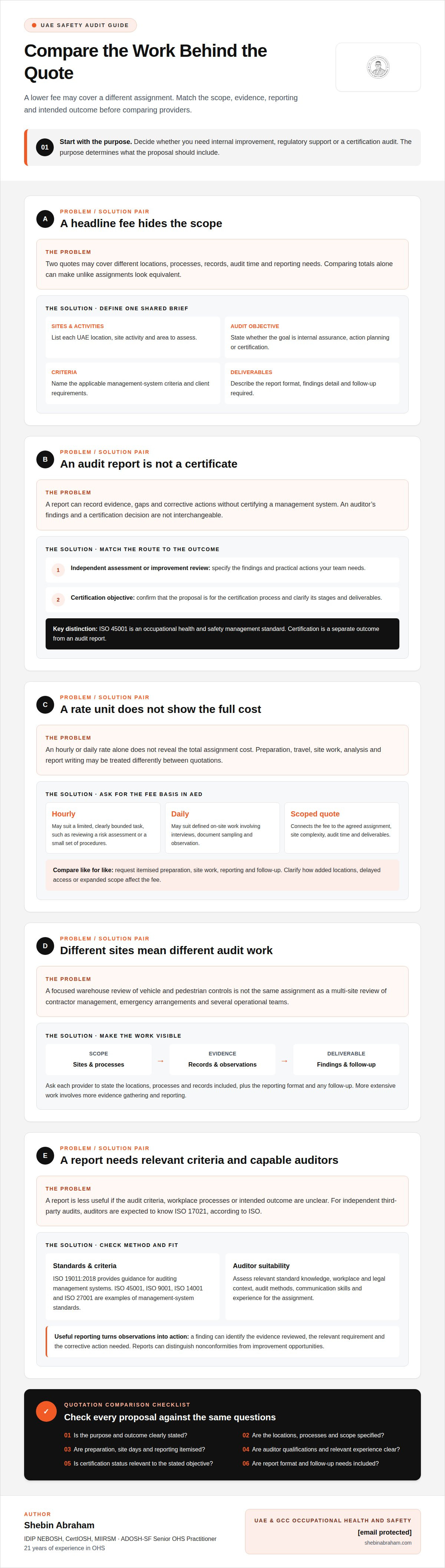
Compare quotations on the same basis. Give each provider the same scope, site details, standards, objectives and expected report format. Ask for audit stages, site days, document review, reporting and follow-up to be itemised. Fees depend on the assignment, with scope, site complexity, audit time and deliverables shaping the quote.
How can a UAE business request and compare safety audit quotations? Prepare a written brief that describes the locations, activities, applicable standards and intended outcome. Compare each quotation’s scope, auditor qualifications, reporting format, certification status and follow-up to see whether each proposal meets the same need.
What is the typical freelance safety auditor hourly or daily rate in the UAE?
In the UAE, a freelance safety audit is best priced through a scoped quotation, not a universal hourly or daily benchmark. The fee reflects the agreed work, including site access, records reviewed, operational risks and reporting requirements. Request a quotation in AED that clearly states its billing basis and included tasks.
An hourly rate can suit a limited assignment, such as reviewing a risk assessment or checking a small set of procedures. A daily rate may suit an on-site inspection involving worker interviews, document sampling and observation of work. The unit alone does not show the total cost. Confirm whether preparation, travel, analysis and report writing are included.
For a freelance audit, the fee is quoted for the specific assignment and reflects its scope, site complexity, audit time and deliverables. Check whether the quotation covers one location or several, which work areas are included, and what records the auditor will assess. These details make the fee easier to interpret.
Consider a UAE warehouse seeking a focused review of vehicle and pedestrian controls. That scope differs from a multi-site assessment covering contractor management, emergency arrangements and several operational teams. The broader assignment requires more evidence gathering and reporting. Comparing headline rates alone misses the difference in work.
Before requesting quotations, prepare a brief so auditors can price the same assignment. Include:
- The UAE location, site activities and areas requiring assessment.
- The audit objective, such as internal assurance or action planning.
- The applicable management-system criteria and any client requirements.
- The expected report format, findings detail and follow-up needs.
Compare the cost structure, not just the total. Check whether the quote separates site work from preparation and reporting. Clarify how extra locations, delayed access or expanded scope affect the fee. For example, adding a workshop to a warehouse inspection changes the activities and evidence to review.
A freelance auditor’s relevant experience matters too. For assignments involving specific requirements or processes, familiarity with the relevant framework and work context can help an auditor assess them effectively. Match the auditor’s experience to the task, then compare the proposed method, report deliverables and fee basis.
Hourly pricing can suit a tightly bounded task with clear expected work. A daily quotation may fit a defined package of site assessment and reporting. Either way, request an itemised scope in AED. This gives your team a practical basis for comparing quotations without treating different assignments as equivalent.
What factors affect safety audit pricing in the UAE?
In the UAE, the cost of a Bureau Veritas safety audit versus a freelance auditor depends on the assignment, not just the provider category. A quotation reflects the agreed scope, site conditions, evidence review and final outputs. A single-office review, for example, differs from assessing a logistics site with vehicle movements, contractor activity and several work areas.
Scope and audit criteria: Reviewing one procedure requires less assessment than examining a wider management system. ISO 45001, identified by the International Organization for Standardization as an occupational health and safety management standard, sets specific criteria for relevant audits. Adding criteria changes which records, interviews and processes the auditor needs to examine.
Site footprint and access: Separate locations require coordination and site-specific evidence. A warehouse and workshop may involve different hazards, controls and teams. Restricted access, active operations or limited interview availability can also increase assessment time. Provide accurate site details and operating conditions so the quote reflects the planned visit.
Operational complexity: Activities determine how much observation and sampling are needed. Reviewing office procedures differs from assessing lifting operations, equipment maintenance or contractor work. The auditor may need to examine additional controls and consult staff across functions. Share an activity list to define a workable scope and reduce unplanned additions.
Documents and preparation: The organisation and completeness of records affect review time. A structured set of risk assessments, procedures, training records and incident logs is easier to assess than scattered files. Describe the available documents and their format so the auditor can plan the review around the evidence your business can provide.
Reporting and follow-up: A short findings summary differs from a detailed report with evidence, priorities and corrective-action guidance. State who will use the report and what decisions it should support. If follow-up is needed, specify whether it means a discussion, document review or another site visit. Each deliverable affects the work involved.
Auditor expertise and assignment model: Relevant sector experience matters when processes are specialised. A construction review requires different operational knowledge from an office assessment. Bureau Veritas and freelance auditors may structure planning, review and reporting differently. Compare their proposed methods and deliverables rather than assuming the provider type determines the fee.
Fees are quoted for the specific assignment, with scope, site complexity, audit time and reporting requirements shaping the price. For a fair comparison of the cost of a Bureau Veritas safety audit versus a freelance auditor, give each the same brief. Include locations, activities, criteria, access arrangements and outputs, then review exclusions and additional-work terms. A proposal for one visit is not directly comparable with one that includes preparation, document review and follow-up.
What is included in a Bureau Veritas safety audit versus a freelance audit?
The auditor’s name alone does not define the deliverables. Bureau Veritas may be engaged for a defined assessment or third-party certification audit. A freelance auditor may be engaged for an independent review, compliance support or improvement assessment. Compare written scopes rather than making assumptions about either provider.
Start with the audit objective. An ISO 45001 assessment, for example, examines occupational health and safety management-system criteria. The engagement should state whether the auditor will review documents, visit work areas, interview staff, sample records or assess controls. A focused review of a risk assessment differs from a broader site audit.
Site work can include observing activities, speaking with employees and checking evidence against agreed criteria. At a UAE warehouse, this might involve reviewing pedestrian routes, vehicle controls and relevant operating procedures. The specific activities depend on the agreed scope. The proposal should state which locations, departments and processes are included.
Reporting is another key point to compare. A useful report can describe the evidence reviewed, findings, relevant criteria and corrective actions. It may also distinguish improvement opportunities from nonconformities. For example, a finding about missing inspection records should identify the records sampled and explain the gap. Reporting depth should match the decisions your management team needs to make.
Certification is not automatically included in an audit. A freelance report can support internal improvement without issuing a certificate. A third-party certification audit has a specific purpose and process; the contract should state whether that outcome is included. An audit report and an accredited certificate are distinct deliverables, so do not treat one as a substitute for the other.
Compare proposals using the same checklist:
- Scope: named sites, activities, criteria and exclusions.
- Method: document review, interviews, site observations and sampling.
- Outputs: report format, findings, evidence and corrective-action guidance.
- Follow-up: included discussion, closure review or additional assessment.
Then examine auditor competence against the assignment. ISO 19011:2018 provides guidance for auditing management systems, including orientation on auditor qualifications. A construction site review, for example, requires understanding of the activities and controls being assessed. For an independent third-party audit, ISO 17021 knowledge is expected, according to the International Organization for Standardization (ISO).
Ask each provider to distinguish included work from optional follow-up. The fee is quoted for the specific assignment and reflects its scope, site complexity, audit time and deliverables. Matching the scope and outputs helps a UAE business compare Bureau Veritas and freelance proposals on the work provided, not just the provider labels.
Do UAE authorities require an accredited safety auditor or certification body
The requirement depends on the audit’s purpose and the organisation receiving the results. A workplace review for internal improvement differs from a certification audit. A UAE business should identify whether its authority, client contract or certification objective specifies an accredited certification body. Do not assume every safety audit requires accreditation or that every audit report can support certification.
Start by identifying who will receive the report. For internal management, define the scope and criteria your team needs assessed. If the report must meet a project, client or authority requirement, use that requirement to set the auditor’s qualifications and deliverables. For example, a contractor submitting evidence for project approval may face different acceptance criteria from a company reviewing its own procedures.
Separate three concepts: auditor competence, certification-body status and the audit report. A qualified individual can assess workplace controls and document findings. That does not, by itself, make the report a certificate. Certification involves a separate conformity-assessment process. For independent third-party audits, auditors are expected to know ISO 17021, according to the International Organization for Standardization (ISO).
For a certification objective, identify the management-system standard and the certification scope. ISO 45001 concerns occupational health and safety management. Ask whether the proposed engagement is intended to assess readiness, conduct a certification audit, or provide an internal review. Those are different assignments. A gap assessment can help prepare a business, but shouldn’t be presented as certification.
For an authority-facing or client-facing audit, use this practical sequence:
- Identify who will receive or rely on the audit result.
- Read the relevant project, contract or submission requirement.
- Record the requested standard, auditor credentials and acceptance criteria.
- Match the proposal’s scope and report format to those criteria.
- Keep internal improvement work distinct from certification deliverables.
For example, a UAE company seeking an internal review of contractor controls can define a practical scope around records, interviews and site observations. A company pursuing ISO 45001 certification needs a certification route, not merely a freelance report. The right choice follows the required outcome, not the provider’s brand name.
Before appointing an auditor, state the report’s intended use in the brief. Include the named standard, recipient, sites and expected evidence. Then compare credentials and deliverables against that purpose. This helps avoid commissioning an informative report that cannot meet a separate certification or submission requirement.
If you’re assessing an ADOSH-SF or Trakhees-related OHS requirement, discuss your audit scope and compliance needs before settling the engagement’s purpose and outputs.
State the intended use in the appointment brief and match the auditor’s competencies to the work. For internal auditors, relevant competencies include knowledge of standards, applicable legal requirements, processes, audit methods and social skills. Audits can identify ineffective or non-compliant processes, future risks, improvement opportunities and breaches of legal requirements. These findings can guide internal improvement, while the recipient and purpose determine whether the audit meets an external requirement.
Shebin Abraham: OHS Services
Shebin Abraham provides OHS support to UAE businesses assessing workplace safety needs. Services include freelance HSE, ADOSH-SF OHS consulting and Trakhees OHS consulting. These can support businesses seeking practical help with workplace health and safety compliance or advice aligned with the relevant framework.
Shebin Abraham holds IDIP NEBOSH, CertIOSH and MIIRSM credentials. He is an ADOSH-SF Senior OHS Practitioner with 21 years of OHS experience. If you’re comparing audit routes, define your objective, sites and required outcomes first. That gives the discussion a clear operational focus.
For support with your OHS requirements, contact Shebin Abraham or visit shebinabraham.com.
Turn your audit findings into a clear next step
An audit’s value depends on how your organisation acts on its findings. Before appointing an auditor, decide who will own corrective actions, how management will review them and what evidence will show that controls work in practice. This can help clarify whether you need certification or focused OHS support.
Compare the cost of a Bureau Veritas safety audit versus a freelance auditor using the same scope and intended outcome. Then identify any UAE-specific framework or operational challenge requiring practical attention. Shebin Abraham’s OHS Services include freelance HSE and ADOSH-SF OHS consulting to support businesses with workplace health and safety compliance.
Prepare your objectives, site information and required deliverables, then contact Shebin Abraham to discuss your audit. A clear conversation about your operational priorities is a sound starting point for strengthening safety oversight and supporting the people who rely on it.
Frequently Asked Questions
What additional fees may apply for travel, follow-up audits, reports, or certification?
Potential additional charges may cover travel, a return visit to verify corrective actions, a more detailed report or certification activities. For example, a quote may cover the site assessment and findings summary but list a follow-up inspection separately. Certification is distinct from an audit report, so request a clear breakdown of certification-related charges. Before approving the work, review the proposal’s inclusions, exclusions, travel arrangements and terms for additional work.


