

Chemical storage compliance in Dubai involves more than one authority. Trakhees chemical storage regulations apply within Trakhees’ jurisdiction, while dangerous-goods storage also requires Dubai Civil Defence approval and, depending on the facility’s location, approval from Dubai Municipality or the relevant free-zone authority. In JAFZA, Trakhees’ EHS department oversees hazardous activities.
There is no single rulebook for every facility: obligations depend on the site’s location and the chemicals stored. This article explains the authorities involved in the UAE and how containment, bunding, chemical segregation and hazard classification shape day-to-day compliance.
You’ll also learn how these requirements affect practical decisions about storage areas, spill control and safe handling. The aim is to clarify the regulatory landscape and help you identify when specialist OHS or Trakhees compliance advice can support your next steps.
Key Takeaways
- Identify the authority responsible for your site’s location: Trakhees, Dubai Civil Defence, Dubai Municipality or the relevant free-zone authority may have roles in approval and oversight.
- Size secondary containment against the largest container. For a 1,000-litre IBC, the stated 110% capacity is 1,100 litres.
- Separate chemicals that could react dangerously, and use hazard information to guide storage layout and handling controls.
- Use hazard classification and clear labelling to help workers recognize chemical risks and follow appropriate precautions.
- Review outdoor storage access and spill controls together, so containment measures support safe movement and effective response.
1. Outdoor bunding and access control
Outdoor chemical storage needs a containment plan that suits the materials and location. Trakhees applies zone-level chemical-storage rules in JAFZA and DWC. The hazardous chemical storage warehouse regulation is identified as DD-19.0. Federal Law No. 24 of 1999 provides a basis for environmental liability when spills occur without proper containment. For an outdoor area, bunding helps prevent released liquid from spreading beyond the storage footprint.
Plan the bund around the containers, access route and drainage. Leave sufficient space between stored materials and walls to support safe access and inspection. A chemical-resistant floor or lining helps protect the storage surface. Keep access clear for routine handling and emergency movement. Provide prominent windsocks at chemical facilities, so wind direction can be seen during an incident. The layout should make container labels and safety signboards visible.
Access control depends on clear identification and a reliable inventory. JAFZA chemical-storage facilities must keep an accurate inventory showing stored chemicals, quantities, locations and movement dates. Dangerous-goods areas should display the goods stored, emergency contact details and evacuation routes. Ensure every dangerous-goods container has clear, internationally recognized hazard symbols. This helps staff identify what is present before moving a container or responding to a spill.
Manage waste and contaminated water as part of containment. Chemical waste disposal must meet DM / Environmental Control Rules and Requirement. In JAFZA, chemical waste must be handled by approved waste contractors. Chemical storage, handling and manufacturing facilities must provide fire-runoff collection for contaminated water for at least 30 minutes of fire-system operation. Keep drainage arrangements separate from uncontrolled discharge pathways. A bund that holds a spill but allows contaminated runoff to escape does not protect the surrounding environment.
Ventilation should reflect the chemical hazards and the storage arrangement. Keep containers closed when not in use, follow their Material Safety Data Sheets, and avoid placing incompatible products together. Windsocks show outdoor wind direction, but they do not replace safe access or suitable handling procedures. Electrical and lighting fittings, fixtures and wiring in hazardous chemical storage, handling or manufacturing areas must meet NFPA 70 requirements.
UAE summer heat can exceed 45 degrees Celsius from June through September. Consider this exposure when positioning outdoor containers and protecting labels from deterioration. A practical inspection should check bund condition, visible leakage, container closures, signs and drainage. Record defects and correct them promptly. This routine connects the physical controls with the inventory and waste arrangements, helping teams maintain safe access without weakening spill protection.
2. Secondary containment capacity
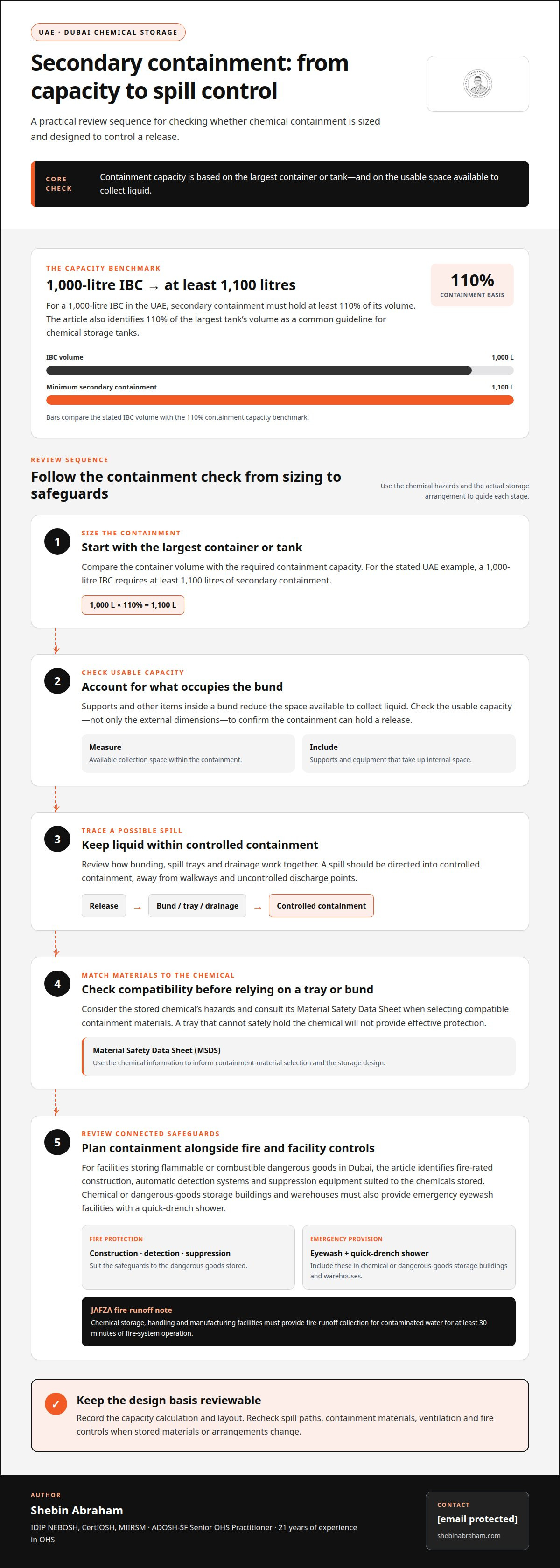
Chemical store design should combine suitable ventilation, fire protection and spill containment. The UAE Fire and Life Safety Code is identified as the fire and life safety standard for storage facilities. To control spills, hazardous chemical stores should use bunding, spill trays and drainage systems that prevent chemical runoff.
For a 1,000-litre IBC in the UAE, secondary containment must hold at least 110% of its volume, or 1,100 litres. A common guideline for chemical storage tanks is containment capacity equal to 110% of the largest tank’s volume. These figures provide a clear starting point when assessing a storage layout.
Size containment for the container or tank it protects, and account for how equipment sits inside it. Supports and other items within a bund reduce the space available to collect liquid. Check usable capacity, not just the bund’s external dimensions, to determine whether it can contain a release. Keep the capacity calculation and layout information together for review.
Spill containment also depends on where leaked liquid can flow. A bund, spill tray or drainage system should direct liquid into controlled containment, away from walkways and uncontrolled discharge points. Consider the stored chemical’s hazards and consult its Material Safety Data Sheet when selecting compatible containment materials. A tray that cannot safely hold the chemical will not provide effective protection.
Fire protection also shapes facility design. Facilities storing flammable or combustible dangerous goods in Dubai need fire-rated construction, automatic detection systems and suppression equipment suited to the chemicals stored. Buildings and warehouses used for chemical or dangerous-goods storage must also provide emergency eyewash facilities with a quick-drench shower. Plan these provisions alongside spill containment.
Choose ventilation based on the chemical hazards and storage arrangement. Review the Material Safety Data Sheets, container closures and potential for vapour release when planning airflow. General ventilation does not replace appropriate containment or fire controls. The right combination depends on the substances stored and how the facility handles them.
For a design review, compare each tank or IBC with its containment capacity, then trace potential spill paths. Confirm that bunding, spill trays and drainage work together. Review ventilation and fire controls at the same time, so a change in storage layout does not leave another safeguard overlooked. Record the design basis and update it when stored materials or arrangements change.
3. Segregation of incompatible chemicals
The Dubai Dangerous Goods Code requires 3 to 10 metres between incompatible hazard classes. The required separation depends on the hazard classes involved. Chemical storage facilities in Dubai must segregate chemicals that may react dangerously. Treat segregation as a layout decision, not merely a label check. A clear arrangement helps prevent incompatible products from sharing storage space or handling routes.
Start with the chemical inventory and each product’s Material Safety Data Sheet. Record the hazard information and storage requirements for every product, then use them to identify which products must be kept apart. Don’t infer compatibility from similar packaging, colour or container size. Containers that look alike may hold chemicals with different hazards.
Next, assign each product a defined storage location. Compare those locations with the separation distances required for the relevant hazard classes. If two classes need separation, for example, mark the distance between their assigned storage areas on the layout. Keep the plan clear for workers receiving, moving or returning containers. Visible location markings help prevent accidental placement in the wrong area.
Physical segregation can make the layout easier to follow. Separate storage zones make boundaries clear during routine handling. Keep containers within their assigned zones, and don’t use open floor space for temporary storage of unidentified products. When a new chemical arrives, review its hazard information before assigning a location. This helps prevent a delivery from disrupting the existing arrangement.
Make segregation visible in daily operations. Match container labels to the inventory and storage map, and train handlers to check product identity and assigned location before moving a container. If a container is damaged or its label is unreadable, don’t place it beside other chemicals based on guesswork. Follow the site’s handling procedure and keep a clear record of the product’s location.
Review the arrangement whenever the inventory or storage layout changes. A new product can create a compatibility issue even if existing containers stay in place. Check that assigned locations still meet the applicable separation distances. Include temporary staging and transfer areas in the review: chemicals can come into contact during handling even when their permanent storage zones are separate.
Keep the inventory, product information and storage layout aligned. If the inventory lists a chemical in one location but floor markings show another, workers may face conflicting instructions. Reconcile these records during routine reviews. The practical test in Dubai is whether workers can identify a chemical, understand its hazards and return it to a location that maintains the required separation.
4. Chemical hazard classification
Chemical classification is the starting point for safe storage decisions. Most regulators use the Globally Harmonized System (GHS) to classify chemical hazards. It provides a consistent way to organize information about a product’s hazards. A flammable liquid, for example, presents different storage concerns from a corrosive substance. Classification gives teams a common basis for reviewing products, planning storage and communicating hazards.
In Dubai, dangerous-goods warehousing must meet UN classification rules and strict fire safety codes. Keep chemical hazard classification separate from dangerous-goods transport classification. They inform related decisions but serve different purposes: product hazard information guides workplace storage and handling controls, while dangerous-goods classification informs transport and warehousing requirements. Apply the classification relevant to each activity rather than treating them as interchangeable.
Start with the product’s Material Safety Data Sheet (MSDS). Match the document to the product name and container, then record the relevant hazard information in the chemical inventory. Keep a separate record for each product in a store. This prevents a broad category such as “cleaning chemicals” from obscuring different hazards. Use product information to guide storage locations and handling instructions.
Classification should shape the facility plan. Use hazard information to decide which products need separate storage, what containment is appropriate and which controls workers need. If a product’s information identifies a fire hazard, consider it when assessing storage and fire-protection arrangements. If it identifies corrosive hazards, consider whether storage surfaces and equipment are compatible. Base these decisions on product information, not appearance.
Clear identification connects classification with daily work. Check that each container’s hazard symbols match its product information and inventory entry. Keep the product name readable and make sure workers can find the relevant handling instructions. If the label and MSDS appear inconsistent, pause routine handling and resolve the discrepancy through the site’s chemical-management process. Don’t assign an unidentified container a storage position by assumption.
Review classification records whenever products or storage arrangements change. A replacement product may have a different hazard profile, even if it serves the same purpose. Update its inventory entry and reassess its storage location, segregation and handling controls. Make the revised information available to staff who receive, store or use the chemical. This links each decision to the product, its documented hazards and its assigned controls.
5. Chemical-storage enforcement authorities, including TRAKHEES
In JAFZA, Trakhees oversees hazardous activities through its EHS department. Dangerous-goods storage also requires Dubai Civil Defence approval and, depending on location, approval from Dubai Municipality or the relevant free-zone authority. Each authority has a distinct role, so one approval does not replace another.
Trakhees is the regulatory arm of the Ports, Customs and Free Zone Corporation (PCFC). The hazardous chemical storage warehouse regulation is identified as DD-19.0. The UAE Fire and Life Safety Code also applies as the fire and life safety standard for storage facilities. Electrical and lighting fittings in hazardous chemical areas must meet NFPA 70 requirements.
Companies handling dangerous goods in JAFZA usually need Trakhees approval before starting operations. Requirements depend on the site’s jurisdiction and activity. A facility in JAFZA may be overseen by Trakhees, while Dubai Civil Defence and the relevant municipality or free-zone authority also have approval roles. This is how Trakhees chemical storage regulations fit within wider Dubai and UAE requirements.
Prepare facility information for the applicable approval process. Keep the chemical inventory accurate, including product quantities, locations and movement dates, and maintain Material Safety Data Sheets (MSDS) for stored products. Keep risk assessment recommendations available and implement them during design, construction and operation. Building completion or operation fitness inspections may check these recommendations.
Dangerous-goods facilities should maintain clear evidence of their safety arrangements, including storage layouts, hazard identification, fire-protection provisions and spill-control measures. These records show how the facility manages the chemicals it actually stores. Requirements vary by site and activity, so map each approval to the authority responsible for that location.
Non-compliance can lead to operational consequences. Chemical-storage non-compliance in JAFZA can result in fines, stop-work orders or licence suspension. Under UAE Law No. 4 of 2025, chemical-storage fines range from AED 1,000 to AED 1,000,000. Repeat chemical-storage violations under UAE Law No. 4 of 2025 double the original fine.
For approval, identify the site authority, prepare facility and chemical records, and address applicable safety requirements before operations begin. Approval fees follow the relevant authority’s process and depend on the facility’s approval pathway. Trakhees-specific OHS advice can help teams organize compliance requirements and records; explore OHS Freelancer Trakhees Consulting.
The same authority-led approach applies across Dubai’s free zones. Dangerous goods stored in free zones such as JAFZA or DAFZA must meet the hazardous-goods handling rules set by the relevant authority. Identify which authority governs the site and align handling arrangements with its applicable rules before storing dangerous goods. This connects the approval process to the site’s location and regulatory oversight.
Shebin Abraham: OHS Services
Shebin Abraham provides OHS support for teams managing chemical-storage responsibilities in the UAE. Use his OHS Freelancer Trakhees Consulting for help interpreting site-specific requirements, organizing compliance records and aligning workplace controls with Trakhees expectations. His services also include OHS Services, Freelance HSE Service and Freelance ADOSH-SF OHS consulting.
Shebin Abraham is an IDIP NEBOSH, CertIOSH, MIIRSM-qualified ADOSH-SF Senior OHS Practitioner with 21 years of OHS experience. His practical perspective can help teams connect regulatory obligations with the controls workers use every day.
For support with your OHS requirements, contact Shebin Abraham or visit shebinabraham.com.
Make compliance part of everyday operations
Make regulatory responsibilities clear in daily work. Assign ownership for reviewing chemical records, facility changes and corrective actions. Keep decisions traceable so teams know which controls are required, who maintains them and when they need attention.
Consistent application of Trakhees chemical storage regulations means treating compliance as an ongoing operational discipline, not a document prepared only for inspection. Changes to products, processes or site arrangements are prompts to revisit relevant controls and responsibilities. This keeps written procedures aligned with the way work is actually done.
For guidance on the OHS considerations behind your next compliance decision, discuss your requirements with Shebin Abraham. A clear, practical next step can help your team strengthen its approach with care and confidence.
Frequently Asked Questions
Who Enforces Chemical Storage Regulations in the UAE?
Enforcement depends on the facility’s location and activity. Trakhees, the regulatory arm of the Ports, Customs and Free Zone Corporation, oversees hazardous activities in JAFZA through its EHS department. Dangerous-goods storage requires Dubai Civil Defence approval and, depending on location, approval from Dubai Municipality or the relevant free-zone authority. Federal authorities also issue import permits for certain restricted and hazardous chemicals.
What are Trakhees requirements for chemical storage in Dubai?
Trakhees requirements depend on the site, stored products and facility activity. For a chemical storage warehouse, the identified regulation is DD-19.0. Facility planning should also account for applicable fire safety, electrical, containment and risk-assessment provisions. For example, design teams should connect each stored product’s hazards with the proposed storage arrangement and documented risk controls, then keep those records available for relevant building or operational inspections.
What chemical classifications and hazard groups does Trakhees use?
Chemical hazard classification commonly follows the Globally Harmonized System (GHS), while dangerous-goods warehousing in Dubai must meet UN classification rules. These classifications guide different decisions: workplace hazard information informs storage and handling, while dangerous-goods classification informs warehousing and transport controls. Use product safety data to identify hazards, then ensure the inventory and container identification reflect the correct product and classification.
What are Trakhees requirements for chemical storage quantities and segregation?
Containment capacity and separation depend on the stored containers and hazard classes. For a 1,000-litre IBC, the stated secondary-containment capacity is 1,100 litres. The Dubai Dangerous Goods Code requires 3 to 10 metres between incompatible hazard classes. Keep an accurate inventory of quantities and locations, and assess the combined storage layout so each product remains in its designated area.
What are Trakhees rules for chemical labeling, safety data sheets, and inventory records?
Keep product identification consistent across containers, safety data sheets and inventory records. Dangerous-goods containers should carry internationally recognized hazard symbols, while storage areas should identify stored goods and show emergency contacts and evacuation routes. In JAFZA, inventory records should capture quantities, locations and movement dates. An SDS older than 5 years triggers a compliance flag during UAE chemical-storage inspections, so document control matters.
What inspection, monitoring, and emergency response requirements apply to chemical storage?
Documented IBC checks are recommended monthly, and chemical-handling training should be refreshed at least once a year. Facilities should provide emergency eyewash with a quick-drench shower, plus a decontamination room with PPE storage. Fire-runoff collection should capture contaminated water for at least 30 minutes of fire-system operation. Keep inspection records organized, record defects and corrective actions, and ensure staff understand product hazards and spill response procedures.


