

A safer workplace depends on more than written procedures. To understand how to build a safety management system, start with a practical framework for identifying hazards, assessing risks, setting controls, and learning from what happens at work. Its purpose is to protect people through consistent action, not simply to document compliance.
That takes clear responsibilities, worker involvement, suitable training, and regular monitoring. A system also needs to adapt as operations change. This guide explains how to establish and improve those elements, and how ISO 45001’s Plan-Do-Check-Act structure supports continual improvement for organizations across the UAE.
The guidance draws on the occupational health and safety experience of Shebin Abraham, IDIP NEBOSH, CertIOSH, MIIRSM, an ADOSH-SF Senior OHS Practitioner with 21 years of experience. His practical perspective helps connect management system principles with the decisions and safeguards that shape safer work.
Key Takeaways
- Build a safety management system around identifying workplace hazards, assessing risks, and putting practical controls in place.
- Use leading and lagging indicators, audits, and incident information to see whether controls are working and where improvements are needed.
- Support safer work through clear communication, relevant training, and a workplace culture where employees can raise safety concerns.
- Align the system with ISO 45001’s Plan-Do-Check-Act approach to make improvement an ongoing part of safety management.
- Set clear responsibilities and review the system when operations change so it remains useful in practice.
What Is the Purpose of a Safety Management System?
In the UAE, businesses must meet the occupational health and safety requirements that apply to their activities and jurisdiction. A safety management system organizes workplace risk management, but it does not replace legal duties. It helps identify hazards, assess risks, and put controls in place to protect people during everyday operations.
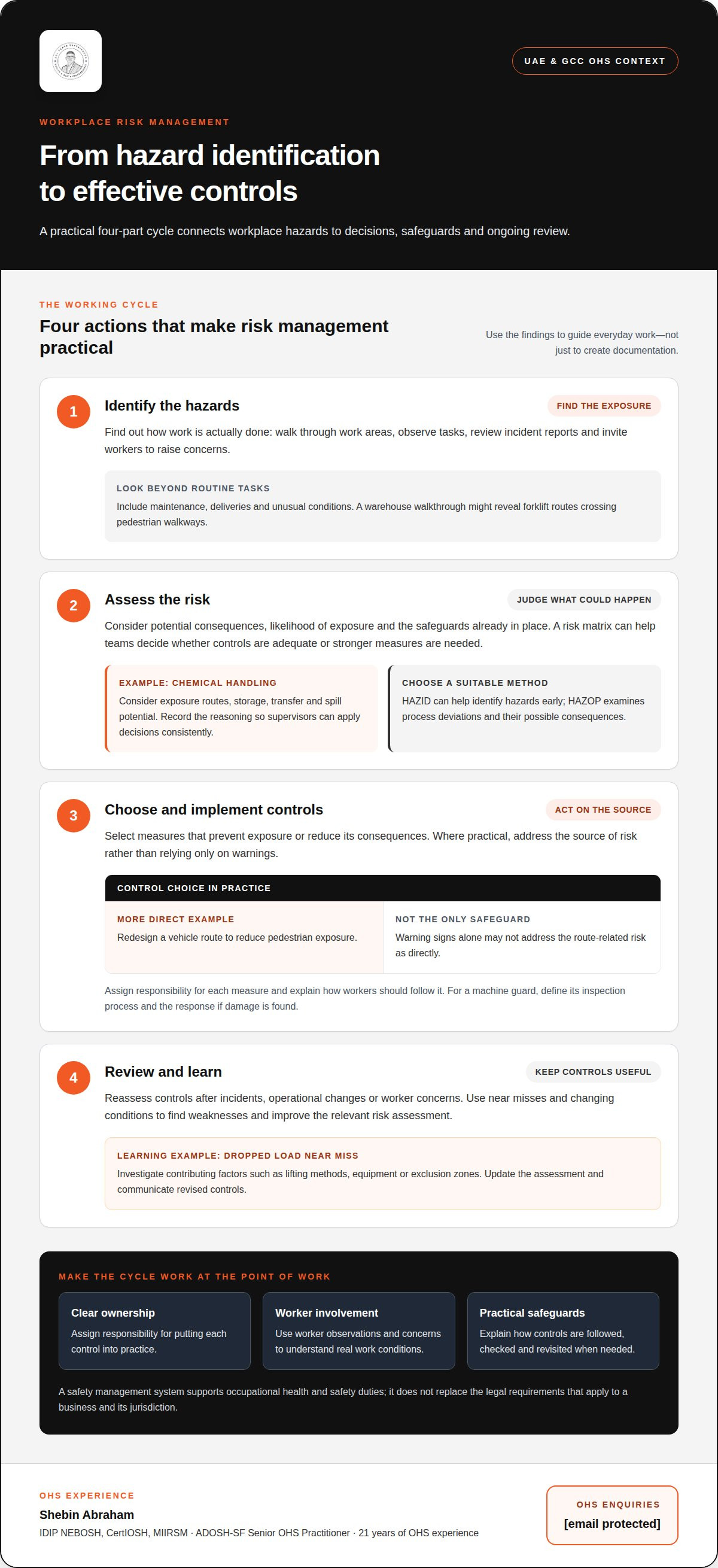
Begin by finding out how work is actually done. Walk through work areas, observe tasks, review incident reports, and invite workers to raise concerns. A warehouse assessment, for example, might reveal forklift routes crossing pedestrian walkways. Include routine tasks, maintenance, deliveries, and unusual conditions, since each can expose workers to different hazards.
Assess each hazard by considering the potential consequences and likelihood of exposure. A risk matrix can help teams decide whether existing controls are adequate or stronger measures are needed. For a chemical handling task, consider exposure routes, storage, transfer, and spill potential. Record the reasoning so supervisors can apply decisions consistently.
Choose hazard identification methods that fit the work and its complexity. HAZID can help teams identify hazards early, while HAZOP examines process deviations and their possible consequences. Use the findings to select controls that address the source of risk where practical. For example, redesigning a vehicle route can reduce pedestrian exposure more directly than relying only on warning signs.
- Identify: Record hazards, affected people, tasks, and operating conditions.
- Assess: Consider potential harm, exposure, and existing safeguards.
- Control: Select measures that prevent exposure or reduce its consequences.
- Review: Reassess controls after incidents, operational changes, or worker concerns.
Risk management continues after a control is selected. Assign responsibility for putting each measure into practice and explain how workers should follow it. A machine guard, for instance, needs a defined inspection process and a clear response if damage is found. This connects hazard assessment to everyday work instead of leaving controls on paper.
Preventing workplace hazards also means learning from near misses and changing conditions. A near miss involving a dropped load may reveal problems with lifting methods, equipment, or exclusion zones. Investigate contributing factors, update the relevant risk assessment, and communicate revised controls. Knowing how to build a safety management system means creating a repeatable cycle, not relying on a one-time inspection.
Businesses must meet the occupational health and safety requirements that apply to their activities and jurisdiction. A safety management system supports this work, but it does not replace those obligations.
Performance monitoring, audits, and continuous improvement
Monitoring shows whether safety controls work during real operations, not just on paper. Use indicators, audits, and management reviews to turn evidence into practical decisions.
Safety Performance Monitoring
Safety performance monitoring means regularly measuring and reviewing workplace safety information. Incident counts alone cannot show whether workers follow controls or risks are changing. Track inspection findings, reported concerns, overdue corrective actions, and incidents. For example, a rise in reports of damaged access equipment may reveal a maintenance issue before someone is injured.
Assign an owner and review period to each measure. A site manager might review open actions during routine operational meetings, while senior management considers trends across the organization. Compare results with objectives and previous findings. If the same concern keeps appearing, investigate why existing controls are not resolving it.
Safety Performance Indicators and Metrics
Safety performance indicators measure safety activities and outcomes. Leading indicators track prevention work, such as completed inspections or closed corrective actions. Lagging indicators record outcomes, such as injuries and illnesses. Using both helps teams assess whether preventive effort is translating into safer results.
Choose metrics that support specific objectives and can be applied consistently. The total recordable incident rate measures recordable injuries and illnesses per 100 full-time workers in a year. Pair outcome measures with operational evidence, such as action completion or training records. Review definitions and data sources so comparisons remain meaningful across departments.
Safety Audits and Assurance
A safety audit is a structured check of whether procedures and controls are implemented and effective. It gives leaders evidence beyond routine reports and helps identify gaps between documented arrangements and actual work practices. Internal audits may be scheduled quarterly or half-yearly, depending on the risk profile.
Audit findings should describe the issue, its operational significance, and who owns the corrective action. Track actions to completion, then check whether the change addressed the finding. Senior management reviews may be scheduled quarterly or annually. Comparing audit results with incident information and performance data can reveal recurring weaknesses that a single measure might miss.
Continuous Safety Improvement
Continuous improvement uses monitoring, audits, and investigations to strengthen the system over time. Review objectives, key performance indicators, and controls when results reveal a gap. For example, repeated delays in closing maintenance actions may call for clearer ownership or revised work planning.
Use trends and worker feedback to prioritize practical changes, then measure whether those changes work. Compare performance against relevant industry benchmarks and standards to identify improvement opportunities. For organizations preparing safety evidence for ADNOC HSE prequalification, ADNOC HSE Prequalification Support can help connect safety documentation with the assurance process.
Safety promotion, training, and communication
People need clear information, practical skills, and a safe way to raise concerns. A useful safety culture makes each employee’s role and accountability clear in everyday work.
Safety Communication and Reporting
Safety communication and reporting give workers clear ways to share hazards, incidents, and concerns. Supervisors cannot act on issues they do not hear about. Explain how to report a damaged ladder, a near miss, or an unclear procedure, and identify who receives each report.
Make reporting straightforward in every work setting. A worker on a busy construction site may need to tell a supervisor immediately, while a written system can preserve details for follow-up. Explain what information to include, such as the location, task, and immediate risk. Respond to reports with an update so employees know their concerns have been considered.
Communication also supports accountability. Brief teams on revised procedures before the affected task begins, and use shift handovers to flag temporary hazards. Recognize employees who report issues or suggest workable safeguards. Recognition can reinforce commitment without turning reporting into a competition or discouraging people from sharing difficult news.
Workforce Training and Competency
Workforce training develops the knowledge and practical skills workers need to identify hazards, follow procedures, and respond to emergencies. Written instructions cannot guide a task if employees do not understand how they apply. Tailor training to the work, equipment, and responsibilities people actually have.
For example, a worker using machinery needs to understand its safe operating procedure and how to report a fault. A new employee may need an orientation covering site rules, emergency arrangements, and supervision. Use demonstrations or supervised practice for tasks where reading instructions alone will not establish competence.
Keep training records that show the subject, attendees, and completion. Supervisors can then identify who needs instruction before assigning a task. Revisit training when procedures, equipment, or responsibilities change. Ask workers to explain or demonstrate key steps instead of treating attendance alone as proof that essential information has been understood.
Worker Awareness and Adoption
Worker awareness and adoption mean employees understand safety expectations and apply them during daily work. A procedure supports prevention only when it becomes part of how a task is performed. Connect each instruction to a recognizable hazard, such as keeping a marked walkway clear of vehicle movements.
Use short toolbox discussions to explain the day’s work, relevant controls, and reporting route. Invite questions from the employees performing the task, as their feedback may reveal a practical obstacle. If workers repeatedly bypass a step, examine whether instructions, equipment, or work planning create the barrier before assuming they lack commitment.
Promote a culture where employees can raise concerns without blame and supervisors respond constructively. Share lessons from incidents by focusing on causes and prevention, not embarrassment. Recognize useful safety contributions and explain what changed as a result. This visible follow-through helps workers see how communication and training shape real decisions.
Implementing a health and safety management system aligned with ISO 45001
Plan implementation around your organization’s risks, resources, and operational priorities. ISO 45001 provides a structured approach to managing occupational health and safety.
Developing an SMS Implementation Plan
An implementation plan explains how the organization will establish, introduce, and maintain its safety management system. Clear priorities and ownership help turn documented intentions into consistent practice.
Start with a gap analysis of current arrangements, then set objectives, responsibilities, and milestones. Identify the procedures and records needed, such as risk assessments, safe work procedures, training records, incident reports, audit findings, and corrective actions. Documentation should reflect actual operations and clarify responsibilities, rather than create paperwork teams cannot use.
Introduce processes in phases. An organization might first establish incident reporting and workplace inspections, then add further functions as those processes mature. Choose EHS technology to support defined needs, such as recording inspection findings or tracking actions. A mid-sized organisation with a solid foundation can use 12 to 18 months as a realistic implementation timeline to achieve ISO 45001 certification.
Plan-Do-Check-Act Implementation
Plan-Do-Check-Act is a repeating framework for managing safety work and continual improvement. The International Organization for Standardization describes this structure as part of ISO 45001. It helps organizations connect objectives with operational action and review, rather than treating implementation as a one-time project.
Plan by setting objectives, responsibilities, and risk controls. Do by putting procedures into operation and providing the necessary resources. Check by monitoring results, reviewing records, and conducting audits. Act by addressing findings and adjusting arrangements. For example, an audit that identifies inconsistent equipment checks can prompt clearer instructions, assigned ownership, and follow-up monitoring.
OHSMS Implementation Benefits
An occupational health and safety management system coordinates responsibilities, processes, and performance reviews. This helps an organization understand how safety arrangements connect across departments and work activities.
Clear procedures support consistent decisions, while records help managers trace whether actions were completed. Planned reviews can also reveal when operational changes require updated controls. These benefits depend on using the system in practice: a procedure that does not reflect the task cannot reliably guide workers or supervisors.
Comparing Safety Management Standards
Safety management standards differ in their focus, so organizations should select one that fits the intended management system. ISO 45001 focuses on occupational health and safety; ISO 9001 is a quality management standard, while ISO 14001 provides a framework for environmental management systems.
They address distinct management areas and are not substitutes for one another. ISO 45001 is the relevant standard when the goal is an occupational health and safety management system. Comparing scope helps an organization define which risks, objectives, procedures, and audits belong within each management system, while coordinating shared processes where useful.
Occupational health and safety management systems
An occupational health and safety management system (OHSMS) gives an organization a framework for managing work-related risks. Its core elements include leadership, worker participation, planning, operational controls, performance evaluation, and continual improvement.
The International Organization for Standardization identifies ISO 45001:2018 as the current edition of the international occupational health and safety management systems standard. It offers organizations a structured framework, while effective implementation depends on how well responsibilities and processes fit actual work.
Leadership gives the system direction. Senior management sets safety commitments, defines responsibilities, and provides resources for planned controls. ISO 45001 assigns top management accountability for the effectiveness of the OHSMS under Clause 5. This makes safety governance part of organizational decision-making, rather than an issue left solely to operational staff.
Worker participation brings practical knowledge into planning. Employees often understand task-level obstacles that written procedures miss. For example, a maintenance worker can explain why a lockout step is difficult to follow during a particular repair. Listening to that input helps leaders determine whether the procedure, resources, or work planning need attention.
Risk management connects the system’s policy with operational decisions. The organization identifies workplace hazards, assesses safety risks, and establishes controls suited to the work. In a facility with vehicle movements, this might mean planning pedestrian routes, setting operating procedures, and assigning responsibility for maintaining separation. The system should explain how these arrangements are implemented and reviewed.
Documentation supports accountability when it clearly records decisions and responsibilities. Useful records may include the safety policy, risk assessments, defined roles, operational procedures, training information, incident reports, audit results, and corrective actions. Keep documents relevant to the organization’s activities. A procedure that does not match the task can create confusion rather than help workers perform it safely.
Performance evaluation gives leaders evidence about how the system functions. Internal audits, incident information, worker feedback, and progress against safety objectives can show where arrangements need improvement. Management reviews should consider these findings and changes in operations. When a process changes, review the affected risk assessments and procedures so the OHSMS stays aligned with current work.
Organizations should align an OHSMS with their activities, risks, and applicable jurisdictional requirements. ADOSH-SF or Trakhees requirements may also apply to particular organizations. Aligning the framework with operational and regulatory needs helps clarify responsibilities without confusing certification with day-to-day risk control.
For practical guidance on OHS management arrangements, discuss your workplace safety management needs.
Shebin Abraham
Shebin Abraham helps organizations turn occupational health and safety requirements into practical workplace arrangements. For support with risk controls, responsibilities, and monitoring processes, his OHS Services and Freelance HSE Service offer a relevant next step.
Shebin’s work includes Freelance ADOSH-SF OHS consulting and Trakhees OHS consulting. He is an IDIP NEBOSH, CertIOSH, MIIRSM, ADOSH-SF Senior OHS Practitioner with 21 years of experience in OHS. His practical perspective can help organizations address safety management needs in the context of their operations.
If you’re developing or strengthening workplace safety arrangements, contact Shebin Abraham to discuss your OHS needs.
Put your safety commitments into practice
The real test of how to build a safety management system is whether it helps people make safer decisions during everyday work. Treat the system as an active part of operations, not a document set aside after implementation. When work changes, consider whether your safety arrangements still fit.
If you’re deciding what to address first, a focused discussion can connect your organization’s priorities with practical occupational health and safety support. Shebin Abraham provides OHS Services, Freelance HSE Service, and Freelance ADOSH-SF OHS consulting. Start by clarifying the work, the risks, and the outcomes your organization needs.
Contact Shebin Abraham to discuss your workplace safety management needs. Each considered improvement can help make safer work a lasting part of how your organization operates.
Frequently Asked Questions
How Can You Ensure Success?
Success depends on leadership commitment, clear ownership, and follow-through in everyday operations. Give each action an accountable owner, practical resources, and a way to evaluate progress. For example, when a site introduces a new procedure, supervisors can gather worker feedback during routine briefings and report barriers to management. Use those findings to adjust the procedure, then review whether the change is being applied consistently.
How do you implement an SMS?
Implement an SMS by defining its scope, reviewing current arrangements, assigning responsibilities, and introducing processes in manageable phases. Start with priorities that address significant operational needs, such as a reliable incident reporting route or inspection process. Then develop supporting procedures, training, and review arrangements. Keep implementation connected to actual work, and use audit findings and employee feedback to refine processes as they become established.
How do you measure SMS effectiveness?
Measure effectiveness by checking whether the system’s processes improve control of workplace risks. Review preventive activity alongside injury, illness, and incident information. For example, compare recurring equipment defects with maintenance actions and follow-up inspection results. Check whether actions resolve the identified problem, not just whether records show completion. Trends, worker feedback, and audit evidence together give leaders a stronger basis for decisions.
How does worker participation improve safety outcomes?
Worker participation helps an organization identify practical problems managers may not see in written procedures alone. Involve employees when reviewing a task, testing a proposed control, or discussing a near miss. A worker may explain that a procedure conflicts with the sequence of work, allowing the organization to address the obstacle. Participation also helps teams understand why a control matters and how to apply it reliably.
What is ISO 45001?
ISO 45001 is an international standard for occupational health and safety management systems. It provides a framework organizations can use to manage work-related risks and improve their OHS arrangements. According to the International Organization for Standardization, ISO 45001:2018 is the current edition of the standard. It supports systematic management, but organizations still need to apply relevant requirements to their own activities and responsibilities.
What are the steps to build and implement a safety management system?
To build a safety management system, define its scope and review existing arrangements. Identify hazards, assess risks, and establish suitable controls. Then set responsibilities, objectives, procedures, and worker communication arrangements. Introduce the processes, provide role-specific instruction, and keep useful records. Evaluate performance through audits and operational feedback. Assign corrective actions based on the findings, and adapt the system when work or organizational conditions change.
How do you identify workplace hazards and assess safety risks?
Observe tasks and work areas, consult employees, and review incidents, near misses, and maintenance records. Consider routine work as well as deliveries, cleaning, and equipment changes. For each hazard, identify who could be exposed and how harm might occur. Assess existing safeguards and decide whether additional controls are needed. A risk matrix can help teams apply consistent criteria, while task observation can reveal hazards missing from written records.
How do you create a safety policy, objectives, and measurable performance indicators?
Write a policy that states the organization’s safety commitments and assigns clear leadership responsibilities. Turn those commitments into objectives linked to operational priorities, such as improving the timely closure of corrective actions. Define indicators that show activity and outcomes, with consistent data sources and review ownership. For example, track inspection completion alongside findings and their resolution. Review results with workers and revise objectives when priorities change.


