

An OHS management system kept in folders won’t protect people during everyday work. For UAE organizations, the practical challenge is turning applicable requirements into clear controls that workers and supervisors can follow. This guide explains how to implement OHS management system UAE operations can rely on, without making documentation the goal in itself.
It’s understandable to feel unsure where to begin. Requirements can vary across federal, emirate-level, free-zone and sector-specific frameworks, while responsibilities need to be clear at every level. A workable system starts with identifying applicable requirements, assessing operational risks and involving workers in controls that fit the job.
Follow a practical, risk-led sequence to plan, document and put your system into use, then monitor performance and improve controls over time. You’ll also see how to assign responsibilities and make procedures useful in normal operations. This guidance reflects the experience of Shebin Abraham, IDIP NEBOSH, CertIOSH, MIIRSM, ADOSH-SF Senior OHS Practitioner, with 21 years of OHS experience supporting organizations across the UAE and GCC.
Key Takeaways
- Learn how to implement OHS management system UAE operations can use by defining the system’s scope around real work and workforce exposure.
- Turn leadership commitment and worker input into clear responsibilities and practical risk controls.
- Use a requirements register to connect applicable obligations with owners, procedures and evidence.
- Prioritize workplace controls during rollout, then use monitoring, incident learning and review to improve the system.
- Apply practical guidance informed by Shebin Abraham, IDIP NEBOSH, CertIOSH, MIIRSM, ADOSH-SF Senior OHS Practitioner, with 21 years of OHS experience.
How to implement an OHS management system in the UAE: define its purpose and scope
Before writing a policy or choosing forms, decide what the system needs to control. An occupational health and safety (OHS) management system connects responsibilities, processes, operational controls and review activities so an organization can manage risks consistently. A Safety Management System provides a broad overview of this structured approach. Its practical value depends on how closely it reflects the organization’s actual work.
Start by mapping the work people do, where and how they do it, and the hazards they may encounter. A policy folder or a set of completed forms isn’t a working system if procedures don’t guide decisions or workers don’t understand the controls they’re expected to use. This is the foundation of how to implement OHS management system UAE operations can use: define the boundaries first, then build requirements and controls around real exposure.
Set boundaries for the OHS management system
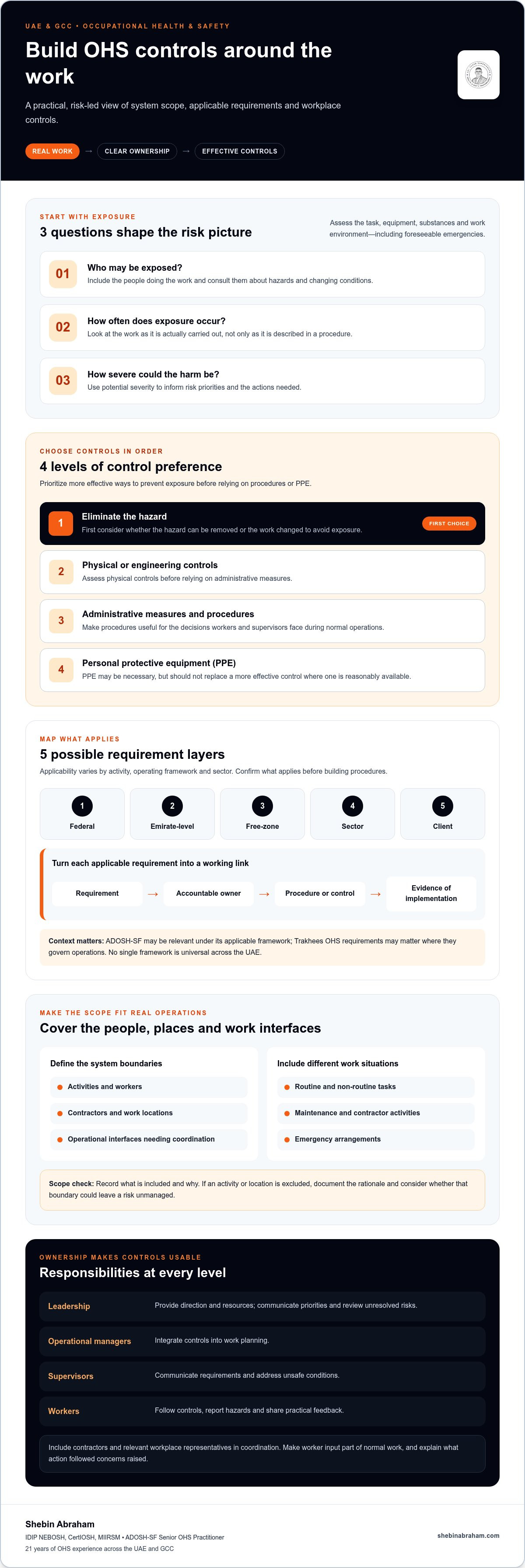
Identify the activities, workers, contractors, work locations and operational interfaces the system will cover. Include routine tasks as well as non-routine work, maintenance, contractor activities and emergency arrangements. For example, maintenance may involve different people, equipment and coordination than normal production. Consider these differences when setting the scope and defining controls.
Record what’s included and why. Clear scope decisions help teams see who is covered, where controls apply and which interfaces need coordination. If an activity or location is excluded, document the rationale and consider whether that boundary could leave a risk unmanaged. The aim isn’t to make the scope broad for appearance’s sake. It’s to make it complete enough to support effective risk control.
Identify applicable UAE requirements before drafting procedures
Requirements can vary with an organization’s activities, operating framework and sector. Map the relevant federal, emirate-level, free-zone, sector and client requirements to the work they affect. For each applicable requirement, record an accountable owner, the relevant procedure or control, and the evidence used to check implementation. Confirm that requirements are current and applicable before relying on them. No single framework should be treated as universal across the UAE.
For example, ADOSH-SF may be relevant to organizations operating under its applicable framework, while Trakhees OHS requirements may matter where they govern operations. Don’t copy a framework’s procedures wholesale. Identify what applies, then tailor the system to the organization’s risks and operating context. Shebin Abraham, IDIP NEBOSH, CertIOSH, MIIRSM, ADOSH-SF Senior OHS Practitioner, brings 21 years of OHS experience to practical system design and implementation across the UAE and GCC.
Build the UAE OHS system around leadership, worker participation, and risk
A defined scope becomes a functioning system when people know who makes decisions, how hazards are raised and what action follows. Leadership commitment must be visible in practice: managers allocate suitable resources, communicate priorities, review unresolved risks and hold assigned owners accountable. If production pressures repeatedly override agreed controls, workers will see the gap between policy and practice.
ISO 45001 and the ILO’s international OHS management system guidelines can inform system design. Treat them as reference frameworks, not automatic proof that an organization meets applicable UAE requirements. To build a system that operations can sustain, connect leadership decisions to worker knowledge and the risks present in each task.
Assign responsibilities and establish worker consultation
Set clear responsibilities at each level. Leadership provides direction and resources; operational managers integrate controls into work planning; supervisors communicate requirements and address unsafe conditions; and workers follow controls, report hazards and share practical feedback. Include contractors and relevant workplace representatives in coordination so responsibilities don’t stop at organizational boundaries.
Make worker input part of normal work, not a one-time sign-off. Use channels suited to the workplace, such as brief work discussions, hazard reporting and follow-up on concerns. Close the loop by explaining what action was taken, who owns any remaining work and why a control may have changed. This builds trust and helps surface problems that a procedure written away from the work can miss.
Assess hazards and select controls that fit the work
Review tasks, equipment, substances and work environments, including foreseeable emergency situations. Consider who may be exposed, how often exposure occurs and the potential severity of harm. Consult the people doing the work. They can identify variations, workarounds and changing conditions that a desk-based assessment may overlook.
Choose controls in order of effectiveness. First consider whether a hazard can be eliminated or the work changed to avoid exposure. Then assess physical or engineering controls before relying on administrative measures, procedures or personal protective equipment (PPE). PPE may be necessary, but it shouldn’t substitute for a more effective control where one is reasonably available.
For significant risks, record the selected actions, accountable owners, priorities and evidence that will show whether controls are working. Set review triggers, such as changes to the task, equipment or work environment, or learning from an incident. Shebin Abraham, IDIP NEBOSH, CertIOSH, MIIRSM, ADOSH-SF Senior OHS Practitioner, brings 21 years of OHS experience to practical system implementation. Explore OHS system implementation support to connect risk priorities with workplace responsibilities and controls.
Translate UAE OHS requirements into useful procedures, records, and competence
Once responsibilities and risks are clear, turn applicable requirements into controls people can follow and evidence that shows how those controls work. Keep operational documents distinct from supporting records: a safe-work procedure guides a task, while a completed inspection or training record helps show what was checked or communicated. Both should reflect the organization’s actual risks, activities and applicable UAE requirements.
A requirements register keeps these links visible. For each applicable requirement, record its source, the responsible owner, the relevant procedure or control, and the evidence used to monitor implementation. This makes gaps easier to spot and keeps requirements from becoming disconnected references. It’s a practical part of how to implement OHS management system UAE organizations can maintain without creating paperwork for its own sake.
| Document or record | Purpose in the system |
|---|---|
| OHS policy | Sets direction, commitments and the basis for responsibilities. |
| Risk assessment | Records hazards, exposure, selected controls and actions. |
| Safe-work procedure | Explains how a task should be carried out using agreed controls. |
| Training record | Shows what instruction was provided and supports competence tracking. |
| Incident record | Captures what happened, follow-up actions and learning. |
Create controlled documentation that supports work
Include the information needed to manage the system, such as policy, responsibilities, risk controls, emergency arrangements and review processes. Link each procedure or form to the relevant hazards, tasks, roles and operational decisions. Before release, assign approval responsibility and identify the document clearly. Keep revision history, make current versions accessible where work happens, and remove obsolete copies from use. Set retention arrangements that suit the record and applicable requirements.
Keep instructions clear enough to use under normal working conditions. If workers can’t readily find the current procedure or understand the action it requires, improve the control instead of adding another form.
Build competence and communication into implementation
Set competence needs by role, task, hazard and relevant framework requirements. Provide induction, task-specific instruction and refresher communication where needed. Check understanding through practical demonstration, discussion or observation, as appropriate to the work. Track training and any role-related authorization, but don’t treat attendance alone as proof that someone can perform a task safely.
Shebin Abraham, IDIP NEBOSH, CertIOSH, MIIRSM, ADOSH-SF Senior OHS Practitioner, brings 21 years of OHS experience to system documentation, implementation and competence support across the UAE and GCC.
Roll out the OHS management system through controlled workplace action
Put the system into practice in stages. Assign an owner to each action, prioritize controls for higher-risk work identified in your assessments, and set clear points to communicate progress and review what’s working. Address urgent operational control gaps before expanding lower-priority system activity. This keeps effort focused on protecting people as the wider arrangements develop.
A practical sequence is to confirm priorities and owners, brief affected teams, test the relevant controls, check implementation, then refine and extend the arrangements. Supervisors are central to this process. During daily work, they can check whether controls are in place, listen for difficulties and raise unresolved issues through an agreed escalation route. A control that exists only in a procedure but isn’t workable in practice needs attention.
Pilot controls and communicate changes before wider rollout
Choose an activity or operational area where the new arrangements can be tested. Before work begins, explain what is changing, who is responsible, how the work method is affected and how workers or contractors can report a concern. Keep the briefing relevant to the task. A general announcement won’t replace clear instruction for people whose work is changing.
Gather feedback during the pilot. Check whether workers can follow the procedure, whether supervisors can verify the control and whether reporting routes are clear. Record findings and make practical adjustments before extending the approach. Capture evidence of communication and implementation, but use it to improve the rollout rather than as a substitute for observing the work.
Monitor actions, incidents, and operational performance
Choose leading and lagging indicators that reflect actual risks and organizational objectives. Leading indicators might track completion of planned control checks or corrective actions; lagging indicators can include incidents and near misses. Use measures to guide decisions, not simply to fill a dashboard. Give each action an owner, monitor overdue items and check whether completed actions have reduced or controlled the risk.
Review incidents, near misses, control failures and worker feedback for recurring patterns. If similar issues return, examine whether the control is suitable, understood and consistently applied. Use lessons to update procedures, communication or supervision. This also helps teams address common OHS compliance mistakes in the UAE, such as treating paperwork as evidence that workplace risks are controlled.
For practical guidance on planning a rollout, assigning ownership and following through on controls, explore OHS implementation support from Shebin Abraham, IDIP NEBOSH, CertIOSH, MIIRSM, ADOSH-SF Senior OHS Practitioner, with 21 years of OHS experience.
Review and improve your UAE OHS system, then plan the next step
Implementation doesn’t end when procedures are issued. Monitoring, incident learning, internal audits and management review help determine whether controls remain suitable and work as intended. Use these activities to test the system against real operations, not just whether documents exist. A practical UAE workplace safety audit guide can also help teams prepare for an internal review by organizing evidence and identifying areas to examine.
Keep internal evaluation distinct from accredited certification or a formal regulatory assessment. An internal audit helps an organization examine its own arrangements and identify improvement actions. It doesn’t itself confer accredited certification or establish a regulator’s assessment outcome. This distinction matters when planning how to implement OHS management system UAE organizations can maintain with clear expectations.
Use review findings to strengthen the system
Bring together information that shows system performance and changing conditions: progress against objectives, control effectiveness, incidents, audit findings, updates to applicable requirements, worker feedback and open actions. Look for patterns. Repeated reports about a difficult procedure, for example, may indicate a need to improve the control or how it’s communicated.
Management review should result in decisions, not just discussion. Record agreed priorities, responsible owners, required resources and follow-up arrangements. Update controls when work changes, new risks emerge or applicable requirements are revised. Then check whether completed actions have resolved the issue and whether workers can apply the revised arrangements.
Plan the next implementation step with experienced support
System design, implementation planning, documentation, compliance assessment and maintenance work together. A review may identify that a procedure needs revision, workers need further instruction or an action needs clearer ownership. Carry those findings into the next cycle of planning and improvement, focusing effort on the risks and requirements that matter to the organization.
Shebin Abraham, IDIP NEBOSH, CertIOSH, MIIRSM, ADOSH-SF Senior OHS Practitioner, brings 21 years of OHS experience across the UAE and GCC. His OHS consulting supports organizations with system design, implementation, documentation, assessment, training and maintenance, including ADOSH-SF and Trakhees requirements where applicable.
Use review findings to identify your next priority and consider how experienced OHS consulting can support the system. A well-maintained system isn’t a finished file; it’s a continuing commitment to effective controls and the people who rely on them.
Make your OHS system part of everyday work
A practical OHS management system begins with the risks and requirements that apply to your operations. Give leaders and workers clear roles, translate priorities into usable procedures and controls, then review evidence and feedback to keep improving. That’s the foundation of how to implement OHS management system UAE organizations can sustain: a system built for real work, not paperwork alone.
Implementation isn’t a one-time project. Start with your priorities, assign owners and keep checking whether controls work in practice. Shebin Abraham, IDIP NEBOSH, CertIOSH, MIIRSM, ADOSH-SF Senior OHS Practitioner, brings 21 years of OHS experience and UAE and GCC advisory expertise to supporting organizations with system design, implementation and maintenance.
Discuss a practical OHS management system for your operations. With clear responsibilities and steady follow-through, you can build a system that supports safer work and continual improvement.
Frequently Asked Questions
How do you implement an OHS management system in the UAE?
Start by defining the system’s scope and identifying the requirements that apply to your operations. Assess work activities and risks, assign responsibilities, involve workers, and establish practical controls and supporting procedures. Communicate the arrangements, check that they work in practice, and use monitoring, incident learning and review to improve them. This is how to implement OHS management system UAE operations can use without reducing safety to paperwork.
What should an OHS management system include?
An OHS management system should connect leadership responsibilities, worker participation, hazard identification, risk assessment and operational controls. It also needs procedures and records suited to the work, arrangements for competence and communication, incident reporting, monitoring and system review. The specific content depends on an organization’s activities and applicable requirements. For example, a higher-risk task may need clear safe-work instructions, trained personnel and checks that selected controls are in place.
Is ISO 45001 mandatory for UAE companies?
ISO 45001 isn’t, by itself, a general legal requirement for every UAE company. It’s an international standard organizations can use to structure an occupational health and safety management system. However, applicable regulatory frameworks, client requirements or contracts may set additional expectations. Identify the obligations relevant to your operations before deciding how to use the standard. Alignment with ISO 45001 doesn’t automatically prove compliance with every UAE requirement.
How do I identify which OHS requirements apply to my UAE business?
Map requirements against your activities, operating framework, sector and applicable regulatory or contractual obligations. Consider relevant federal, emirate-level, free-zone, sector and client requirements, then link each applicable item to an owner, control or procedure, and evidence. Frameworks such as ADOSH-SF or Trakhees OHS requirements matter where they apply to your operations. Confirm that requirements are current and applicable before drafting procedures, since no single framework covers every UAE organization.
Can a small business implement an OHS management system without a full-time HSE team?
Yes. A small business can develop a system proportionate to its operations by assigning clear responsibilities, focusing first on significant risks and keeping procedures practical. Leaders and supervisors can manage assigned actions, while specialist support can assist with system design, documentation, training and maintenance. Shebin Abraham, IDIP NEBOSH, CertIOSH, MIIRSM, ADOSH-SF Senior OHS Practitioner, has 21 years of OHS experience supporting organizations across the UAE and GCC.
How often should an OHS management system be reviewed?
Review the system at planned intervals set by the organization, and revisit relevant parts when circumstances change. Useful triggers include changes to work activities, equipment or requirements, incidents, failed controls, audit findings and worker feedback. There isn’t one review frequency that suits every organization. The important point is to check whether controls remain effective, assign owners to improvement actions and follow up to see whether those actions address the findings.
What is the difference between an OHS management system and OHS certification?
An OHS management system is the organization’s working arrangements for managing occupational health and safety risks, including responsibilities, processes, controls and review. Certification is a separate, formal assessment against a specified standard by an appropriate certification body. Internal audits and system reviews help an organization assess and improve its own arrangements, but they don’t amount to accredited certification or determine the outcome of a regulatory assessment.


