

What if a workplace safety audit could strengthen protection without bringing operations to a halt? A well-scoped workplace safety audit UAE employers can use does more than check documents. It connects applicable requirements with conditions on site and confirms whether corrective actions are completed. It can be difficult to know which records, work areas and controls deserve attention, especially when requirements vary by activity and authority.
This practical checklist helps you plan an audit around workplace risks, review evidence systematically and turn observations into clear, prioritised actions. It covers preparation, site observations, records, interviews and corrective-action tracking, with a focus on making the process useful rather than adding paperwork without follow-through.
UAE requirements can include federal obligations alongside frameworks such as ADOSH-SF or Trakhees requirements, where applicable. With experienced HSE guidance, findings can be linked to accountable owners, realistic deadlines and a review process that helps improvements last.
Key Takeaways
- Tailor a workplace safety audit UAE to the site’s activities, hazards, workforce and applicable authority requirements.
- For each audit area, connect a practical question with records to sample and conditions to observe on site.
- Choose an audit type that matches its purpose, whether reviewing operations, management systems or authority-related requirements.
- Prioritise findings consistently by risk, assign an accountable owner and verify that corrective actions address the issue.
- Use specialist HSE support to strengthen audit scope and follow-up while keeping employers responsible for decisions and implementation.
Workplace Safety Audit UAE: What Employers Should Expect
A workplace safety audit is a structured review of workplace risks, the controls intended to manage them, evidence of how those controls work, and the responsibilities assigned to people. It identifies where safety arrangements are effective and where they need attention, then produces prioritised findings and practical corrective actions.
A workplace safety audit UAE employers can use effectively reflects the work actually being done, not just a standard template. Set the scope according to the site’s activities, hazards, workforce, contractors and relevant authority requirements. A warehouse handling powered equipment, for example, needs a different audit emphasis from an office or a site with outdoor work.
Audits and routine inspections serve different purposes. An inspection usually checks conditions or tasks at a particular time, such as whether an access route is clear or a machine guard is in place. An audit looks more broadly at whether the arrangements behind those conditions are working: are hazards assessed, controls maintained, workers prepared and problems followed through? Both can reveal useful information, but neither replaces the other. For a global overview of Occupational safety and health (OSH), consider how the field connects hazard prevention with the health and wellbeing of workers.
What questions should a UAE workplace safety audit answer?
Use questions that test both the documented system and conditions on site:
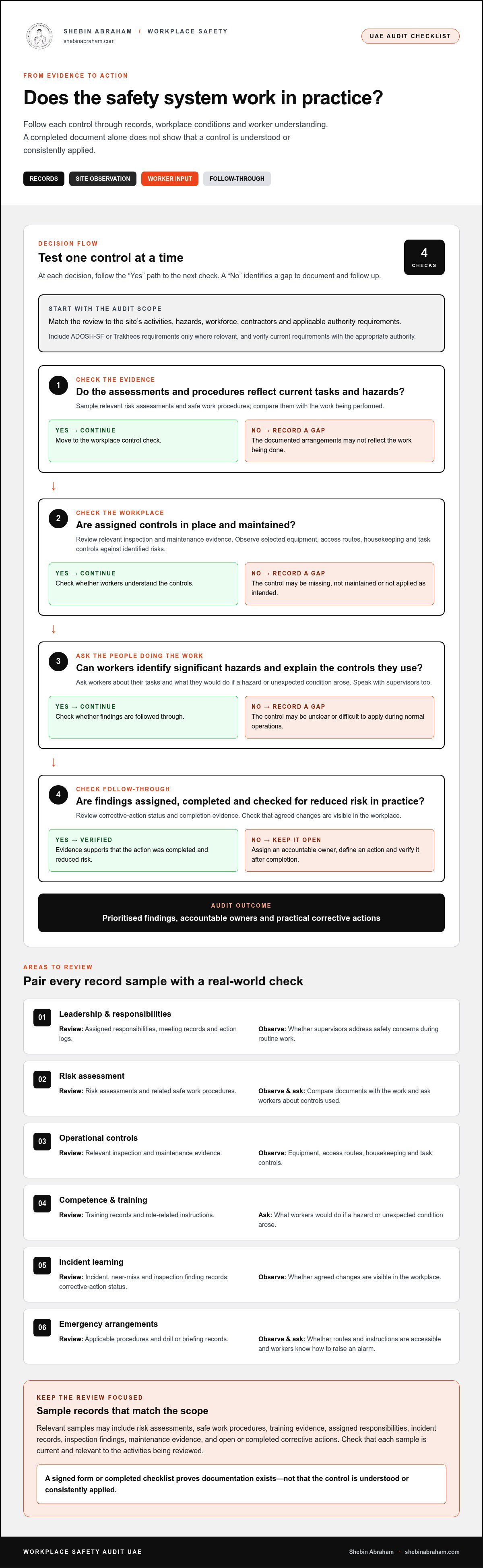
- Understanding: Can workers identify significant hazards in their tasks and explain the controls they’re expected to use?
- Implementation: Are assigned controls in place and maintained? Do records, such as training or maintenance evidence, support what you observe?
- Follow-through: Do findings lead to an accountable owner, a defined action and completion evidence? Is there a check that the action has reduced risk in practice?
Speak with workers as well as supervisors. Their answers can show whether procedures are understood and workable, or whether a documented control is difficult to apply during normal operations.
Which UAE requirements belong in the audit scope?
Start by identifying the employer’s relevant jurisdiction, activities and authority requirements. Map applicable requirements to internal procedures and the evidence that shows how they’re followed. UAE requirements can depend on the entity and its activities, so don’t assume one framework applies everywhere. Include ADOSH-SF or Trakhees requirements only where relevant, and verify current requirements with the appropriate authority before citing specific duties, records or audit frequencies.
A clear scope keeps the audit focused and helps minimise unnecessary disruption. For broader context on advisory responsibilities and workplace safety systems, read the UAE OHS consultant practical guide.
UAE Workplace Safety Audit Checklist: Areas and Evidence to Review
Use this checklist as a starting point, then tailor it to the hazards, work scope and applicable requirements of your workplace. A useful workplace safety audit UAE review tests whether the safety system works in practice, not simply whether documents exist. The International Labour Organization describes a safe and healthy working environment as a fundamental principle and right at work, giving each checklist item a clear human purpose.
Documents show what should happen; workplace observation shows whether it does. Review both. For each area, sample relevant evidence and check how the arrangement operates on site:
- Leadership and responsibilities: Are safety roles and reporting lines understood? Review assigned responsibilities, meeting records and action logs. Observe whether supervisors address safety concerns during routine work.
- Risk assessment: Do assessments reflect current tasks and hazards? Sample risk assessments and related safe work procedures, compare them with the work being performed, and ask workers about the controls they use.
- Operational controls: Are controls implemented and maintained? Review relevant inspection and maintenance evidence. Observe selected equipment, access routes, housekeeping and task controls against identified risks.
- Competence and training: Can workers carry out tasks safely? Sample training records and role-related instructions. Ask workers what they would do if a hazard or unexpected condition arose.
- Incident learning: Are incidents, near misses or inspection findings followed up? Review relevant records and corrective-action status. Check whether agreed changes are visible in the workplace.
- Emergency arrangements: Do people understand the arrangements relevant to their work area? Review applicable procedures and drill or briefing records. Observe whether routes and instructions are accessible and workers know how to raise an alarm.
Which documents and records should auditors sample?
Select records that match the audit scope: risk assessments, safe work procedures, training evidence, assigned responsibilities, incident records, inspection findings, maintenance evidence, and open or completed corrective actions. Check that each sample is current and relevant to the activities being reviewed. A signed form or completed checklist proves that documentation exists, but not that a control is understood or consistently applied.
What should the site and worker review include?
Observe selected tasks and work areas, including access routes, housekeeping and controls tied to identified hazards. Ask workers and supervisors how hazards are reported, which procedures guide the task and what controls they use. Record factual observations, location and relevant context so findings can be followed up. Avoid collecting personal or confidential information unless it’s necessary for the audit.
For an independent review of your checklist, explore freelance HSE and OHS consulting support tailored to workplace risks and applicable requirements.
Workplace Safety Audit Types in the UAE: Compare Scope and Purpose
Audit scope depends on an organisation’s risks and applicable requirements. A focused review may examine a specific activity or work area, while a broader audit may assess how safety responsibilities and controls operate across the organisation. Choose the type based on the question you need answered, not because one approach is universally better.
| Audit type | Purpose and typical scope | Evidence emphasis | Likely output |
|---|---|---|---|
| Internal audit | Provide organisational assurance against defined internal criteria or applicable requirements. | Procedures, assigned responsibilities, records and sampled work practices. | Documented findings and actions for management follow-up. |
| Operational site review | Examine selected tasks, work areas or controls in day-to-day operation. | Site observations, worker and supervisor discussions, and relevant task records. | Practical observations and actions tied to specific operational risks. |
| Management-system audit | Review how safety processes are established, implemented and monitored across a defined system or organisational scope. | System procedures, records, responsibilities, performance monitoring and evidence of implementation. | A structured view of system strengths, gaps and improvement actions. |
| Authority-focused assessment | Assess relevant arrangements against requirements applicable to the entity, activity or authority framework. | Applicable criteria, compliance evidence and related site conditions. | A gap review or findings aligned to the stated assessment scope. |
An ISO 45001 management-system audit examines the safety management system against the audit criteria. It is not itself certification. Certification is a separate process carried out by an accredited certification body; an audit or advisory review does not issue an accredited certificate.
How does an internal audit differ from an independent review?
An internal audit is an organisational assurance activity. It should have a defined scope, clear criteria and documented evidence, even when employees conduct it. An independent consultant can bring an external perspective, question assumptions and help connect findings with practical improvements. Independence alone doesn’t guarantee quality: competence, transparent criteria and sound evidence matter. Management remains accountable for decisions and implementation.
When should an employer consider a focused compliance assessment?
Consider one after an operational change, the introduction of a new activity, recurring findings or a relevant authority requirement. Define the applicable criteria first. UAE workplaces don’t all fall under the same framework, so establish what applies to the organisation and activity before assessing gaps. Where recurring issues point to wider weaknesses, see common UAE OHS compliance mistakes for further context.
How to Run a Workplace Safety Audit and Close Findings
A disciplined audit follows a clear path from planning to verification. To make a workplace safety audit UAE employers can use for practical improvement, keep the process proportionate to the risks and plan site visits around operational realities. Schedule interviews and observations with supervisors, avoid interrupting critical tasks, and never ask workers to perform an unsafe activity for audit purposes.
- 1. Define the scope. Identify the work areas, activities, people and controls to review, along with the audit’s purpose and boundaries.
- 2. Prepare the criteria. Set out the applicable requirements, procedures and other agreed benchmarks. Confirm which criteria apply to the entity and activity.
- 3. Sample evidence. Review selected records, observe relevant work and speak with workers and supervisors. Record what you checked and what you found.
- 4. Report findings. Describe each gap clearly, including the evidence and the activity or control involved. Distinguish a verified issue from a question that needs further checking.
- 5. Assign corrective actions. Name an accountable owner, set a proportionate action and target date, and identify any management oversight needed.
- 6. Verify closure. Review completion evidence and confirm that the action works in the relevant workplace or process.
How should audit findings be prioritised and assigned?
Use a consistent, risk-based method throughout the audit. Consider the potential severity of harm, likelihood or exposure, and whether existing controls are effective. Don’t rely on an arbitrary universal score. Document the reasoning behind each priority so managers can understand why one issue needs attention before another.
Each finding should state the evidence, affected activity, risk significance and applicable requirement where relevant. Separate an immediate control need from a longer-term system improvement. For example, a control that isn’t working during a task may need prompt attention, while a recurring weakness in planning may call for a broader review. Assign an owner and a realistic target date for each action.
How can employers verify corrective actions effectively?
An audit finding is not closed until evidence shows the action is effective. A completed form or purchase record may show that something was done, but it doesn’t prove that risk has been reduced. Revisit the workplace or process where the finding arose, and check whether workers can apply the revised control during normal work.
Track open, overdue and recurring findings through management review, then use that information to shape future audits. If you need support turning audit observations into accountable actions, get practical HSE and OHS audit support.
When UAE Employers Benefit from Workplace Safety Audit Support
Some employers have the internal competence and time to plan an audit, assess evidence objectively and follow findings through to effective closure. Internal capability may be sufficient when the scope is clear, relevant requirements are understood and reviewers can examine the work without overlooking familiar risks. Specialist support can add value when the audit scope is uncertain, findings keep recurring, requirements need interpretation or follow-up actions are stalling.
A workplace safety audit UAE employers can use to improve protection should be collaborative. An adviser can help examine evidence, challenge assumptions and make recommendations practical for the work being done. The employer still decides how to respond, assigns resources and remains responsible for implementation.
What can an experienced freelance HSE consultant contribute?
Shebin Abraham brings more than 20 years of QHSE and occupational health and safety experience. His freelance HSE and OHS consulting supports audit planning, workplace safety systems, compliance assessments and practical recommendations that connect findings with clear responsibilities and follow-up.
Where relevant to an organisation and its activities, support can include ADOSH-SF or Trakhees advisory. Establish the applicable framework and requirements for the particular entity rather than assuming they apply across the UAE. Tailored training or mentorship can also help address an audit finding, for example when workers or supervisors need support to understand a revised procedure or control.
What should employers do after reviewing the checklist?
Turn the checklist into a manageable plan before the audit begins. Confirm its purpose and workplace scope, identify responsible participants, and establish which requirements apply. Organise representative records, then plan access to relevant work activities and people in a way that respects operational demands. This preparation helps keep the review focused and gives the auditor a clearer view of how arrangements work in practice.
After the review, make sure each finding has an owner, a proportionate corrective action and a way to verify effectiveness. Keep management involved in decisions and follow-up. The aim isn’t simply to complete an audit; it’s to strengthen the systems that protect people and support reliable operations.
If you’d like to discuss a workplace audit or compliance assessment, discuss workplace safety audit support with Shebin Abraham. Focus the conversation on your audit purpose, applicable requirements and the practical support your workplace needs.
Make Your Next Safety Audit a Step Forward
A workplace safety audit UAE employers can put to work should do more than identify gaps. It should connect applicable requirements with evidence from real work, prioritise risks clearly and carry corrective actions through to verified results. Tailor the scope to your activities and responsibilities, and use both records and site observations to understand whether controls are working.
Keep the process practical. Assign each action an owner, check that improvements work in the workplace, and use recurring findings to guide future reviews. When internal teams need added perspective, experienced advisory support can help strengthen the scope and turn observations into manageable next steps, while your organisation retains responsibility for decisions and implementation.
Shebin Abraham brings more than 20 years of QHSE and OHS experience, including ADOSH-SF and Trakhees OHS advisory where applicable. Discuss a practical workplace safety audit for your organisation and take the next step toward safer, continually improving work. Make the audit a constructive tool for protecting people and strengthening everyday operations.
Frequently Asked Questions
What is a workplace safety audit in the UAE?
A workplace safety audit in the UAE is a structured review of how an organisation identifies hazards, applies controls, maintains relevant records and manages improvement. Its scope should reflect the organisation’s activities, applicable jurisdiction and relevant authority requirements. Unlike a quick site inspection, an audit examines responsibilities and evidence as well as workplace conditions. The aim is to determine whether safety arrangements work in practice and identify appropriate actions where they don’t.
Is a workplace safety audit mandatory in the UAE?
Whether a particular audit is mandatory depends on the organisation, its activities and the authority or framework that applies. Don’t assume one audit rule or schedule governs every UAE workplace. Identify current requirements relevant to your operations, then distinguish regulatory obligations from internal assurance or management-system audits. Before relying on a specific audit frequency, record list or checklist as a legal requirement, verify the current guidance with the relevant authority.
How often should a workplace safety audit be conducted?
There’s no single audit frequency that fits every workplace. Set a schedule based on risk, operational changes, previous findings, incident patterns and applicable requirements. Higher-risk activities or recurring weaknesses may call for closer review; more stable areas can follow a planned cycle. Document why the schedule is suitable, and revisit it when work or conditions change. Confirm any mandatory timing with the relevant authority rather than assuming a universal interval.
What should a workplace safety audit checklist include?
A useful checklist covers leadership responsibilities, hazard identification, risk controls, safe work procedures, worker competence, incident reporting, inspections, maintenance and relevant emergency arrangements. It should guide reviewers to sample records and observe actual work practices. For example, compare a safe work procedure with how the task is performed and ask workers about the controls they use. Tailor the checklist to workplace activities and applicable requirements; a generic form can’t capture every site’s risks.
What is the difference between a safety audit and a safety inspection?
A safety inspection usually checks a work area, piece of equipment or task for conditions needing attention. A safety audit takes a broader view, examining whether responsibilities, procedures, controls and assurance processes work as intended. Organisations can use both: an inspection may flag an immediate issue, while an audit can help identify recurring weaknesses or gaps in follow-up. Neither should be treated as a substitute for the other.
Can a freelance HSE consultant help with a workplace safety audit?
Yes. A freelance HSE consultant can help plan the audit, review evidence, assess workplace controls and turn findings into prioritised actions. Shebin Abraham provides freelance HSE and OHS consulting, drawing on more than 20 years of QHSE and occupational safety experience. Specialist ADOSH-SF or Trakhees advisory may be relevant to particular organisations or activities. Employers retain responsibility for their safety arrangements, decisions and implementation.
What happens after a workplace safety audit identifies a finding?
Record each finding clearly, including objective evidence, the affected activity and its risk significance. Assign an accountable owner and a proportionate corrective action, then track progress to completion. Don’t close a finding just because a document was updated. Check that the action has been implemented and that the relevant control works in practice. Review recurring findings for wider system causes, and use open or repeated issues to guide management review and future audit priorities.


