

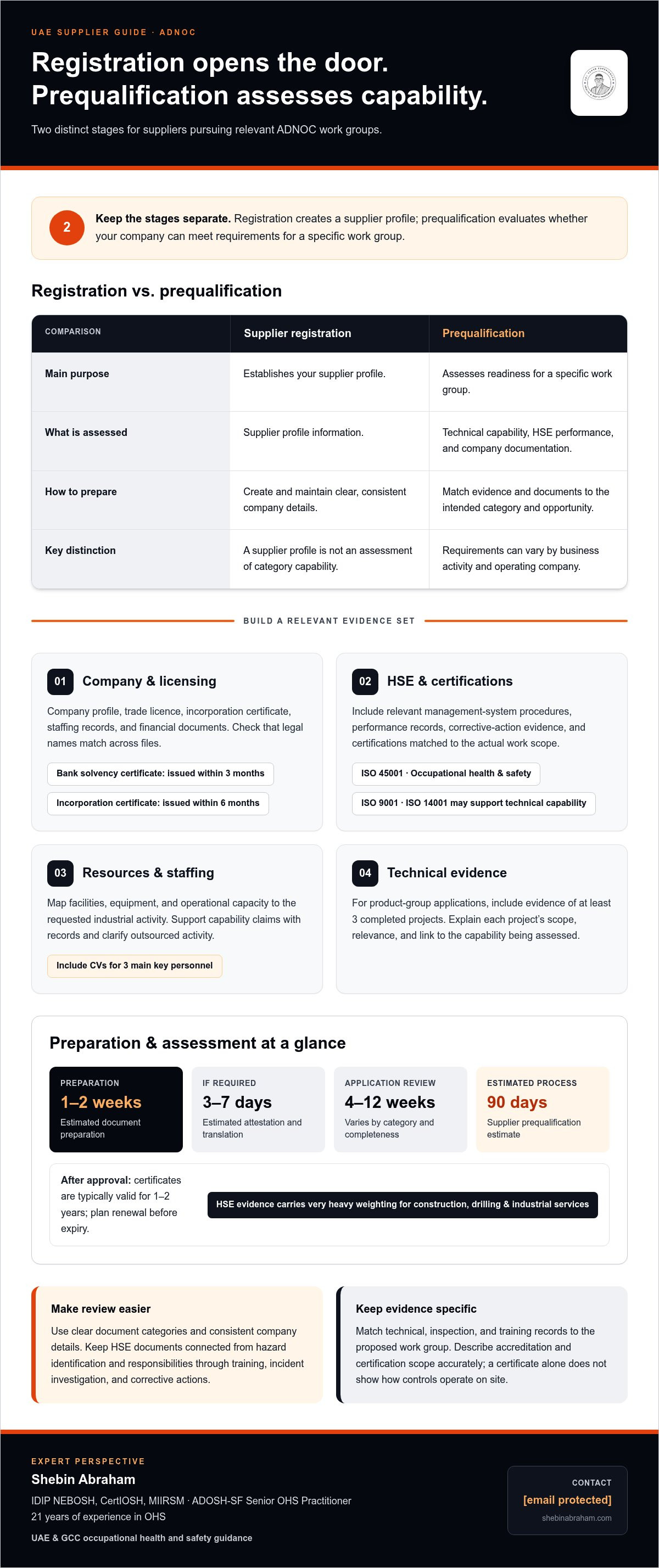
Registration opens the door to ADNOC opportunities; prequalification separately assesses whether your company is ready for a specific category. For suppliers in the UAE, ADNOC HSE prequalification support helps clarify the documents and HSE evidence needed for that assessment. Registration creates a supplier profile, while prequalification evaluates capability for relevant work groups.
It’s easy to mistake the two processes for one long application. Knowing where registration ends and prequalification begins helps you prepare in the right order and focus on relevant evidence, including technical capability, HSE performance, and company documentation.
This guide explains the steps, what technical evaluation and HSE compliance involve, and how to prepare a clear application. It also introduces Shebin Abraham, IDIP NEBOSH, CertIOSH, MIIRSM, an ADOSH-SF Senior OHS Practitioner with 21 years of OHS experience, whose perspective informs this practical guidance.
Key Takeaways
- Prepare company, financial, staffing, and certification records around the specific ADNOC work category you’re applying for.
- Build your technical case with relevant project experience and clear evidence of your company’s capability.
- Separate supplier registration, which establishes your profile, from prequalification, which assesses suitability for specific categories.
- Organize HSE records, including accident and lost-time injury statistics, so your safety performance is easy to assess.
- Use the article’s preparation steps to identify gaps early and assemble a more complete application.
What Is ADNOC Prequalification?
ADNOC prequalification assesses whether a supplier can meet the requirements for a specific work group. Requirements can differ by business activity and operating company, so match each application to its intended commercial opportunity with professional guidance from Shebin Abraham.
-
Gather Supplier and Licensing Documents
Assemble the company profile, trade licence, incorporation certificate, staffing records, and financial documents. Check that legal names match across every file before uploading. The document list includes audited financial statements for the last 2-3 years, a bank solvency certificate issued within 3 months, and a certificate of incorporation issued within 6 months. Expired documents, inconsistent names, and incomplete attestations can delay an application.
-
Compile HSE and ISO Documentation
Collect HSE records that reflect how the company manages risks in its proposed work group. Include relevant management-system procedures, performance records, and evidence of corrective action. ISO 45001 relates to occupational health and safety, while ISO 9001 and ISO 14001 may support technical capability. Match certifications to the actual scope; a certificate alone doesn’t demonstrate how controls operate on site.
-
Map Infrastructure and Staffing
Map your infrastructure and staffing to the requested industrial activity. Describe facilities, equipment, and operational capacity, and support each claim with records. Include CVs for three main key personnel and make each person’s role clear. A manufacturer should distinguish its own production capability from outsourced activity. This helps reviewers compare your stated resources with the work group’s demands.
-
Prepare Work-Group HSE Management Documents
Prepare work-group HSE management documents as a connected set. Show how your company identifies hazards, assigns responsibilities, trains workers, investigates incidents, and tracks corrective actions. Include procedures relevant to the work, not a generic manual that doesn’t reflect site activities. Keep document titles, revision details, and implementation evidence consistent, so reviewers can follow the system from policy to field practice.
-
Plan Document Collection
Plan document collection before starting the application. Preparation is estimated at 1-2 weeks, while attestation and translation, if required, are estimated at 3-7 days. Start early if licensing records need renewal or overseas manufacturer documents need formal handling. Confirm every file is legible, current, and correctly associated with the company. A complete, organized submission reduces avoidable clarification cycles during assessment.
ADNOC quality prequalification lists ISO 17020 as relevant industrial accreditation; audited financial statements should cover the last two years. Start early: HSE documentation carries very heavy weighting for construction, drilling, or industrial services, requiring expert ADNOC HSE prequalification support UAE to ensure compliance.
Technical evaluation and prequalification approval
ADNOC supplier prequalification is estimated to take 90 days. Application review typically takes 4 to 12 weeks, depending on category and completeness; certificates are typically valid for 1 to 2 years and require renewal before expiry.
- Match technical evidence to the work group. Describe the products, services, and activities your company proposes to provide. For product-group applications, include evidence of at least three completed projects. Explain each project’s scope and relevance, then link it to the capability under assessment. This shows what your supplier experience demonstrates, rather than relying on broad claims about technical capacity.
- Present inspection evidence clearly. If third-party inspection forms part of your application, identify the inspection scope, applicable standard, and evidence supplied. ADNOC and ENAS approval should not be treated as interchangeable claims: describe the actual accreditation and its scope accurately. For example, ISO 17025 may be relevant to an applied work group. Keep inspection records tied to the specific technical activity they support.
- Organize the application for review. Submit documents under clear categories and use consistent company details throughout. ADNOC review timing depends on the industry category and whether the application is complete. The review estimate is 4-8 weeks in the application timeline, while the typical review range is 4 to 12 weeks. Respond to clarification requests with the exact supporting record, not a replacement document that obscures the original evidence.
- Link HSE training records to job roles. Provide a training matrix showing each relevant role, completed training, and related work activity. Include course names, completion evidence, and competency records where applicable. Don’t describe a course as ADNOC-approved unless the documentation supports that exact status. Clear records help reviewers assess whether workers’ preparation matches the hazards and responsibilities of the proposed work.
- Track the decision and renewal date. Monitor the application status through the relevant supplier process and retain the submitted version of each document. Once approved, record the certificate’s validity period and plan renewal before expiry. Approval typically lasts 1 to 2 years. If the application needs revision, map each requested change to its evidence, such as a project record, inspection document, or training entry.
For practical help aligning HSE records and technical evidence, explore ADNOC HSE prequalification support.
ADNOC registration versus prequalification
ADNOC registration and prequalification are separate stages, not two names for one approval. Complete registration first, then address the assessment for the categories relevant to your work.
- Establish your supplier profile. Submit the registration application through ADNOC’s official system. Registration creates your company profile in ADNOC’s supplier process and makes your company eligible to participate in tenders and supply goods or services to ADNOC entities. Treat the profile as an entry point, not proof that your technical capability has been assessed for every sector or work category.
- Identify the opportunity you intend to pursue. Before preparing for prequalification, define the goods or services you plan to offer and the relevant category. ADNOC formally assesses suppliers for specific categories. If you’re seeking one work group, organize evidence for that scope rather than assuming a general profile covers every activity. This keeps your application aligned with the intended opportunity.
- Submit consistent registration information. Use matching company details across your profile and supporting documents. Make the business activity clear, and ensure the evidence represents the same legal entity named in the application. Registration documents can include a trade licence, company profile, financial statements, and certifications. Clear, consistent records establish the supplier profile before category-specific assessment begins.
- Prepare for the separate prequalification assessment. Once registered, review the requirements for your intended work category and arrange supporting evidence around that scope. The assessment considers whether your company meets the relevant category requirements. Technical documents, project evidence, and HSE records should support the activities described in your profile. Registration alone does not replace this formal evaluation or establish approval for every category.
- Plan the sequence and allow time. ADNOC registration in the UAE typically takes 8 - 10 weeks. Keep registration progress distinct from prequalification review, since these are separate stages with different purposes. If your company wants to work directly with ADNOC or participate in its tenders, registration is required. Build your schedule around the registration step first, then prepare the category-specific assessment materials.
The ADNOC Supplier Registration and Prequalification User Guide cited on this page was updated on 24 July 2023. Use that dated guide as a reference point when organizing the two stages, and verify that the instructions you rely on are still the ones currently presented in ADNOC’s official system. Keep a record of the guidance consulted and check that each submission follows the applicable instructions for registration or for the relevant category assessment. This helps avoid treating older guidance as confirmation of a current requirement.
Health, Safety & Environment compliance
ADNOC evaluates a supplier’s HSE compliance as part of prequalification. Prepare a management system that connects written controls with workplace practice and supporting records.
-
Review HSE Management System Requirements
Map your HSE management system to the proposed work and its hazards. An integrated QHSE system can demonstrate how safety, environmental controls, and quality processes work together. Use ISO 45001 as a reference for occupational health and safety management. Keep responsibilities, procedures, training, monitoring, and corrective actions consistent across the system, rather than presenting documents that describe disconnected processes.
-
Assess HSE Compliance Criteria
Organize evidence around the assessment: policies, risk controls, incident records, and follow-up actions. ADNOC applicants are asked for lost-time injury and accident statistics covering the past 3 years, starting from the immediately preceding year. Check that reporting periods and definitions match across records. Explain corrective measures where an incident appears, and show how the relevant control was reviewed or improved.
- Connect procedures to field activity. Select procedures that reflect the work category, such as permit controls, emergency arrangements, or contractor oversight where relevant. For each procedure, identify the responsible role and the record showing implementation. A vendor proposing industrial work should clearly connect hazards, controls, worker responsibilities, and monitoring. Avoid submitting a broad manual without evidence that its processes are used.
- Use standards in context. ISO 45001 is an international occupational health and safety management system standard. ADNOC guidance also identifies ASME and API as examples of relevant international standards. State which standard or technical reference applies to the proposed activity, then connect it to the corresponding procedure or record. Don’t imply that one certificate alone proves operational HSE compliance.
- Check category-specific instructions. HSE requirements can depend on the prequalification category. For Category C, no attachments are required, and the request isn’t reviewed by the HSE Department. Don’t apply this exception to other categories. Ensure your HSE documents match the application’s category and work scope, and keep a copy of submitted records for consistent follow-up.
- Make records traceable. Arrange documents so a reviewer can move from a policy to its procedure, responsible person, and implementation evidence. Use consistent document titles and revision details. For example, pair an incident investigation procedure with investigation and corrective-action records. This structure helps an ADNOC supplier show how its management system supports worker protection and ongoing compliance.
What are ADNOC HSE prequalification requirements for contractors and suppliers?
ADNOC assesses HSE compliance as part of supplier prequalification. Prepare evidence that matches your company’s work category and operating scope.
- Match the HSE submission to the work category. Identify the contractor activities, services, or products covered by your application. Organize procedures and records around the hazards and controls relevant to that scope. For example, a supplier proposing industrial maintenance should show how its HSE arrangements relate to that work. Avoid relying on generic documents that don’t explain your actual activities.
- Provide client references with usable details. ADNOC prequalification guidance calls for a minimum of 3 client references with contact details. Select references connected to the work category in your application. Make each record easy to understand by identifying the client, project scope, and relevant service. Check that contact information is complete and that the reference supports the experience your company describes.
- Present HSE performance in a clear record set. Include applicable statistics and supporting records for your company’s operating history. Suppliers established for less than three years may provide available HSE statistics from their establishment date through the application date. Clearly state the reporting period and ensure summaries align with underlying records. This gives the assessment a consistent view of performance across your available history.
- Review the supplier portal before preparing final files. ADNOC’s requirements can evolve, so review the supplier portal regularly while assembling your application. Compare current instructions with your document register and work category. This helps identify changes to requested evidence, document formats, or category details. Record the version used to prepare your submission so your team can trace its decisions if requirements change.
- Address local representation where relevant. A non-UAE manufacturer must appoint a local Abu Dhabi agent supported by an attested agency agreement. Include the agreement in the application evidence and ensure it clearly relates to the manufacturer and proposed activities. For other suppliers, arrange HSE and technical records under the applying company’s own details. This distinction helps keep company identity and operating responsibilities clear.
- Consider ICV separately from initial HSE readiness. A strong In-Country Value score isn’t mandatory for initial ADNOC prequalification, but it can improve a supplier’s chances and is often required to win tenders later. ISO certification doesn’t contribute to an ICV score. Treat these as separate workstreams: prepare category-specific HSE evidence for assessment, and address ICV when planning tender participation.
Prepare your application with ADNOC HSE prequalification support tailored to its category and evidence requirements.
Shebin Abraham: OHS Services
Shebin Abraham provides OHS Services to organizations strengthening workplace health and safety. Turn to him when your team needs practical HSE guidance to organize responsibilities, procedures, and records around its operations.
His services include Freelance HSE Service and Freelance ADOSH-SF OHS consulting, supporting organizations with occupational safety arrangements and relevant ADOSH-SF requirements. He also provides OHS Freelancer Trakhees Consulting for businesses managing Trakhees OHS compliance.
Shebin Abraham holds IDIP NEBOSH, CertIOSH, and MIIRSM credentials, is an ADOSH-SF Senior OHS Practitioner, and brings 21 years of OHS experience. His approach connects sound compliance practices with the daily protection of workers and operational stability.
To discuss your OHS needs, contact Shebin Abraham or visit shebinabraham.com.
Make Your Next Compliance Step Practical
Use your preparation to build a working system, not just a submission folder. Assign responsibility for keeping HSE procedures, training evidence, and operational records aligned as your activities develop. This discipline helps your team maintain readiness beyond the initial application.
ADNOC HSE prequalification support in the UAE can turn assessment requirements into an organized plan, identify gaps in your evidence, and keep preparation grounded in your company’s actual work. The next step is a focused discussion about your intended category, current documentation, and the support your team needs.
Contact Shebin Abraham to discuss your prequalification support and identify a practical way forward. A well-managed process starts with clear responsibilities and steady attention to the people your HSE system is designed to protect.
Frequently Asked Questions
Is the guide the final word on ADNOC requirements?
No. Use this guide to plan your preparation, then follow the current instructions for your supplier category in ADNOC’s supplier portal. Requirements may evolve, and relevant evidence can depend on your work scope and operating company. For example, a document suitable for one work group may not address another group’s technical or HSE expectations. Keep your document register aligned with the portal guidance as you prepare.
What is ADNOC Registration?
ADNOC registration creates a supplier profile in the company’s system. It establishes your presence in the supplier process, but doesn’t mean every work category has been assessed. Keep the profile’s legal name and business activity consistent with supporting records. If your company details change, review the profile and related documents together before applying for a specific opportunity.
How do companies register for ADNOC HSE prequalification in the UAE?
Start by creating or completing your supplier profile through ADNOC’s official system, then identify the work category relevant to your planned tender. Prepare information for that category and submit the prequalification application through the applicable process. Keep a copy of submitted documents and note any follow-up requests. Depending on its circumstances, a foreign company may need local presence or a partnership for registration.
Which documents are required for ADNOC HSE prequalification?
Documents can include a trade licence, company profile, financial statements, relevant certifications, and HSE evidence. Create a document index listing each item’s owner, issue date, expiry date, and application category. This makes it easier to spot an outdated licence or a certificate that doesn’t match the proposed work. Add technical and project records that directly support your company’s stated capability.
How is ADNOC contractor HSE prequalification scored or audited?
ADNOC assesses HSE compliance as part of prequalification, but don’t assume one universal numerical score applies across categories. Prepare by linking safety procedures to implementation records, performance information, and corrective actions. For example, connect an incident record to its investigation and follow-up. The assessment also considers the relevant work category, so organize evidence around the contractor activities being proposed.
What common reasons cause ADNOC HSE prequalification applications to fail?
Applications can encounter problems when evidence is incomplete, inconsistent, expired, or unrelated to the selected category. Examples include different legal names across documents, missing reference contact details, or HSE statistics that don’t match supporting records. A generic procedure may also fail to explain controls for the proposed work. Before submitting, compare each requirement with its evidence and resolve gaps or conflicting details.
How can a company check its ADNOC supplier or contractor prequalification status?
Use the supplier account in ADNOC’s official system to review the application and any status updates or requests for information. Keep the submission reference and copies of correspondence together, so the team can track follow-up actions. If assistance is needed with the supplier process, the ADNOC Suppliers Support Center can be contacted at 8004455. Record the date and outcome of each status enquiry for internal tracking.
What are the costs of ADNOC HSE prequalification support or consultancy in the UAE?
ADNOC does not charge a fee for the prequalification process itself.


