
What if your safety documents look complete, but the controls are difficult to apply where the work actually happens? For UAE employers, an occupational health and safety consultant UAE organizations engage should connect real workplace risks with applicable requirements and practical improvements, rather than add another layer of paperwork.
It can be difficult to decide which risks need attention first, particularly when requirements depend on the activity and applicable framework. Effective consulting starts with understanding your operations, then helps turn that picture into workable controls, clear procedures, and relevant training. Your organization remains responsible for safety. A consultant provides guidance and works alongside your team to strengthen its approach.
This article explains the practical scope of OHS consulting, how specialist advice can support consistent work, and when it may help your organization. It also covers how different requirements can shape the support needed. The author, Shebin Abraham, is an IDIP NEBOSH, CertIOSH, MIIRSM, ADOSH-SF Senior OHS Practitioner with 21 years of OHS experience.
Key Takeaways
- An occupational health and safety consultant UAE employers work with can help translate applicable requirements and workplace risks into practical, prioritized improvements.
- Useful advice reflects real tasks, workers, contractors, equipment, and operating conditions, rather than relying on generic documents.
- Consulting can support focused reviews, ongoing guidance, or specialist regulatory advice. The employer retains responsibility for workplace safety.
- Prepare for productive support by gathering your objectives, current concerns, risk assessments, procedures, training records, and relevant authority correspondence.
- Shebin Abraham, IDIP NEBOSH, CertIOSH, MIIRSM, ADOSH-SF Senior OHS Practitioner, brings 21 years of OHS experience to collaborative consulting across the UAE and GCC.
Occupational Health and Safety Consultants in the UAE
An occupational health and safety consultant helps an organization understand workplace risks and strengthen its safety arrangements. The work connects everyday tasks with controls people can follow in practice. It supports the organization in protecting workers’ health and maintaining safe operations, while helping it consider requirements relevant to its activities. Advice can inform decisions, but it cannot guarantee compliance or transfer management’s responsibilities to the consultant.
OHS consulting is broader than a one-time inspection. An inspection can identify conditions at a particular moment. Advisory support can also help interpret findings, prioritize actions, and improve procedures and communication. The focus is practical guidance that helps an organization strengthen its own safety management.
The wider field of occupational safety and health (OSH) brings together different disciplines to protect people at work. In an organization, that principle becomes meaningful when risk controls suit the tasks, workers understand them, and management supports their use.
What workplace challenges can an OHS consultant help address?
A consultant can work with teams to identify hazards, assess risks, and prioritize proportionate controls. For example, a written procedure may describe a safe method but prove difficult to follow during the actual task. An adviser can help review how clearly it explains the work, whether it reflects the conditions on the job, and how well the people involved can use it. Procedures and records should support the work, not sit apart from it.
Guidance and training can help workers understand their responsibilities and the safe practices relevant to their tasks. The aim is not simply to share information, but to help teams apply it consistently. Shebin Abraham, an IDIP NEBOSH, CertIOSH, MIIRSM, ADOSH-SF Senior OHS Practitioner with 21 years of OHS experience, provides consulting and training support to organizations.
Why does UAE context matter when seeking OHS advice?
The requirements relevant to an organization depend on its activities and the framework that applies to its work. MoHRE, ADOSH-SF, and Trakhees are examples of authorities or frameworks that may be relevant in particular contexts. They do not apply universally to every organization. Establish which requirements apply to your operations before using them to shape procedures or actions.
This context matters because useful recommendations must fit both the relevant framework and the workplace. Specialist advisory support, including ADOSH-SF or Trakhees OHS consulting where relevant, can help teams interpret expectations and consider how to reflect them in day-to-day arrangements. Management retains responsibility for decisions and implementation; the consultant helps make those decisions better informed.
How an OHS Consultant Turns Requirements into Practical Workplace Controls
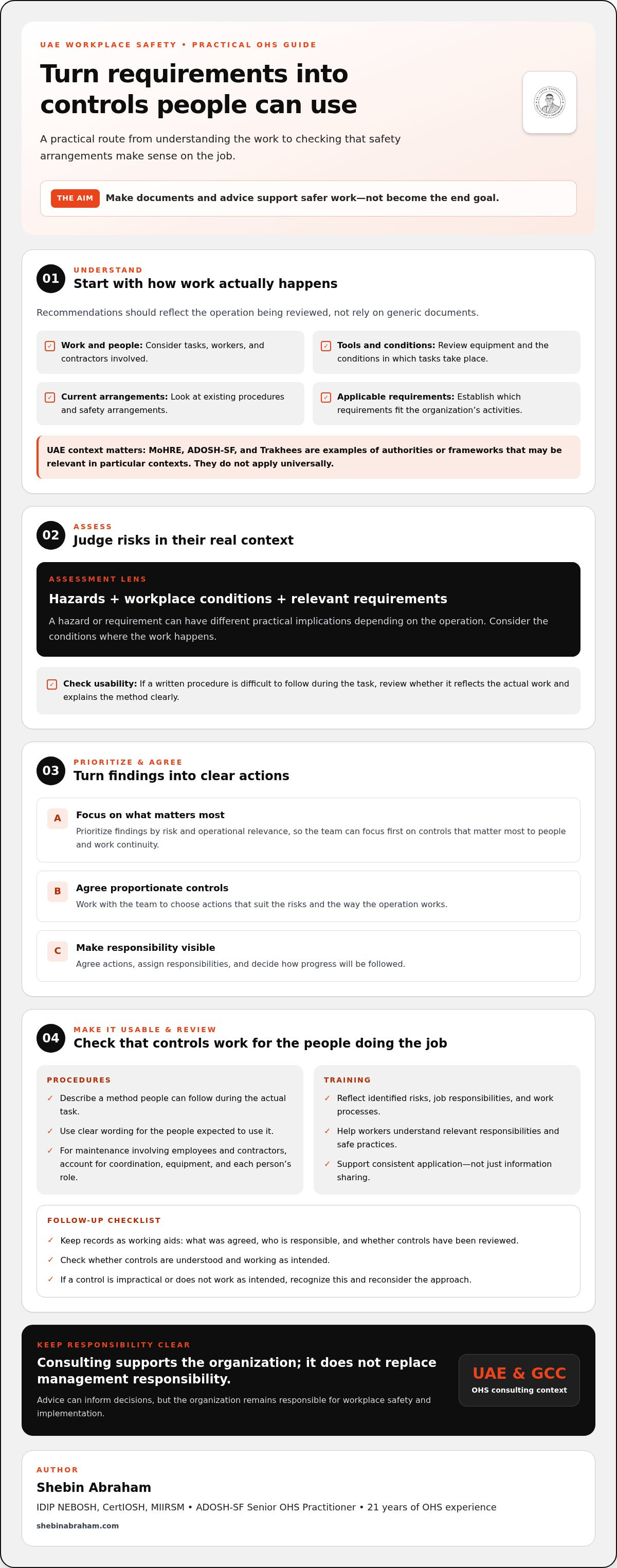
Useful advice follows a clear route: understand the work, identify applicable requirements, assess risks, and agree priorities with the organization. An occupational health and safety consultant UAE organizations engage should begin with operations and existing arrangements, then help turn findings into actions that make sense for real tasks. This keeps documents in their proper role as support for safer work, rather than treating them as the end goal.
From workplace context to a prioritized action plan
Start with how work is actually carried out. Consider the tasks, workers, contractors, equipment, and conditions involved, alongside current procedures and safety arrangements. A hazard or requirement can have different practical implications depending on the operation, so recommendations should reflect the specific work being reviewed.
Next, identify relevant requirements and assess risks in context. Prioritize findings by risk and operational relevance, so the team can focus first on controls that matter most to people and work continuity. Framework-specific advice should be based on the requirements that apply to the organization. The organization and adviser can then agree actions, assign responsibilities, and decide how to follow progress.
Making procedures and training relevant to real work
A procedure should help someone carry out a task safely, not just describe an ideal process that is difficult to follow. For example, if maintenance involves employees and contractors, advice should account for how the task is coordinated, what equipment is used, and whether everyone understands their role. The wording should be clear to the people expected to use it.
Training is most useful when it reflects identified risks, job responsibilities, and work processes. Keep records as working aids: they can show what was agreed, who is responsible for an action, and whether controls have been reviewed. Follow-up matters, too. If a control is impractical or does not work as intended, the team needs to recognize that and reconsider its approach.
- Understand: Review operations, existing arrangements, and relevant requirements.
- Assess: Consider hazards and risks in the conditions where work happens.
- Prioritize: Agree proportionate controls and clear actions with the team.
- Review: Follow up to see whether controls are understood and working as intended.
Risk assessment identifies what needs attention; practical controls guide safer work; follow-up review shows whether those controls work as intended. Shebin Abraham, an IDIP NEBOSH, CertIOSH, MIIRSM, ADOSH-SF Senior OHS Practitioner with 21 years of OHS experience, works collaboratively with organizations to turn findings into workable actions. Learn about practical OHS consulting support for your organization.
When Is an OHS Consultant Useful, and What Stays with the Employer?
An external adviser can strengthen safety management, but the organization’s management retains responsibility for its decisions and arrangements. Consulting does not transfer accountability. Its value is in helping employers understand concerns, consider practical options, and support their teams in making informed improvements.
The right level of support depends on the need. An occupational health and safety consultant UAE organizations engage may provide a focused review of a particular issue, ongoing advisory support, or specialist guidance on a relevant framework. These approaches can complement internal capability rather than replace it.
| Situation | Relevant support | Intended outcome |
|---|---|---|
| A specific process or concern needs attention | Focused review and recommendations | Clearer priorities and practical next steps |
| Teams need continuing guidance | Ongoing advisory support alongside internal staff | More consistent safety decisions and follow-up |
| A framework may apply to the organization | Specialist advice based on applicable requirements | Better understanding of relevant expectations |
Can a consultant help when an organization already has safety staff?
Yes. Internal safety personnel know the operation and its people. An adviser can add capacity, offer a fresh perspective, or provide a structured review while drawing on that operational knowledge. Collaboration may be useful when work changes, a new project brings different risks, findings keep recurring, or the team needs to consider a framework-specific question. The aim is to support internal personnel, not displace their role.
When might framework-specific advice be relevant?
ADOSH-SF advice is relevant where its requirements apply to the organization. Trakhees OHS consulting is relevant to operations governed by that framework. Applicability depends on the organization, its activities, and the requirements that apply to its work, so advice should be grounded in those circumstances rather than assumption.
Shebin Abraham, an IDIP NEBOSH, CertIOSH, MIIRSM, ADOSH-SF Senior OHS Practitioner with 21 years of OHS experience, provides freelance OHS consulting shaped around organizational needs. The employer remains responsible for deciding how to use the advice and overseeing its implementation.
How to Prepare for Useful OHS Consulting Support
Good preparation helps an adviser focus on the issues that matter to your operation. Before engaging an occupational health and safety consultant UAE organizations can benefit from summarizing how work is carried out, what concerns need attention, and what you want the support to achieve. You do not need a perfect file. A clear picture of the workplace and its priorities is more useful than paperwork assembled without context.
What information helps an adviser understand the workplace?
Briefly describe your activities, workforce roles, contractors, and higher-risk tasks. Note operational changes, incidents, recurring concerns, or upcoming compliance milestones that may affect priorities. Include practical constraints, such as work schedules or access arrangements, if they shape how advice can be applied.
Gather available records that relate to the work. These might include:
- Risk assessments and safety procedures
- Training records and relevant workplace safety arrangements
- Authority correspondence related to the matter under review
- Notes on incidents, recurring findings, or planned changes
Not every organization will have the same documents. Share what is available and explain where records may be outdated or incomplete. If you are preparing for an audit, the workplace safety audit guide offers related preparation guidance.
How can employers make follow-up clear and manageable?
Agree the purpose and scope of the support at the outset. Identify decision-makers, workplace contacts, relevant workforce groups, and the managers who can act on findings. Be clear about the practical outputs you need and how recommendations will be reviewed. This gives everyone a shared understanding of the work and its boundaries.
After findings are discussed with relevant managers and workers, track each agreed action with an owner, status, and suitable evidence of completion. Set a review approach that helps the organization consider whether actions are effective and what needs further attention. Follow-up should support improvement, not simply close out a record.
Shebin Abraham, an IDIP NEBOSH, CertIOSH, MIIRSM, ADOSH-SF Senior OHS Practitioner with 21 years of OHS experience, provides collaborative OHS consulting shaped around organizational operations and objectives. Explore OHS consulting support.
How Shebin Abraham Supports OHS Across the UAE and GCC
Effective OHS advice needs to fit the organization, its people, and the work being done. Shebin Abraham provides freelance HSE and OHS consulting across the UAE and GCC, working collaboratively with teams to shape practical support around their operational priorities. He is an IDIP NEBOSH, CertIOSH, MIIRSM, ADOSH-SF Senior OHS Practitioner with 21 years of OHS experience.
For employers seeking an occupational health and safety consultant UAE organizations can work with directly, his experience supports informed discussion of workplace safety systems and applicable requirements. Advice should reflect the organization’s risks and operating context, rather than applying one approach everywhere. Management retains responsibility for its decisions and implementation.
Tailored OHS and regulatory advisory
Support includes freelance HSE consulting and workplace safety system guidance, as well as specialist ADOSH-SF or Trakhees OHS advice where the relevant framework applies. ADOSH-SF consulting can address documentation, compliance assessments, and implementation of applicable standards. Trakhees OHS consulting can guide operations and projects through relevant safety protocols, permitting documentation, and compliance inspections. Consulting is advisory support, not certification or a guarantee of approval.
Training and mentorship can connect written arrangements to the people who use them. Workshops can be tailored to identified risks, roles, and work processes, helping teams build knowledge they can apply in daily work. For organizations pursuing relevant opportunities, ADNOC HSE prequalification support can help them work through their HSE preparation needs, without promising a particular decision or result.
If you are reviewing where your arrangements could be stronger, the guide to common OHS compliance mistakes offers further points to consider. Use those insights to identify questions specific to your operations, rather than treating a general list as a substitute for a workplace-focused review.
A practical next step for UAE employers
Begin with a short description of your activities, the people involved, and the safety challenge you want to address. It could be a system that needs review, a framework-specific question, a training need, or support with HSE prequalification. Sharing your priorities helps shape the discussion around your organization’s context.
Practical support starts with understanding the work and agreeing what would be useful. Discuss your OHS consulting needs.
Make Your Next Safety Improvement Practical
Effective OHS consulting connects workplace risks and applicable requirements with controls people can use in daily work. Start by identifying the issues that matter most, then agree practical actions and review whether they are working. An occupational health and safety consultant UAE employers engage can provide a specialist perspective, but management remains responsible for its organization’s safety arrangements.
Useful support should reflect your operations, not rely on generic documents. Shebin Abraham brings 21 years of OHS experience across UAE and GCC contexts. He is an IDIP NEBOSH, CertIOSH, MIIRSM, ADOSH-SF Senior OHS Practitioner, offering collaborative advice shaped around organizational needs.
Whether you are addressing a specific concern or strengthening your wider safety approach, start with a clear account of your priorities and the work involved. Discuss your OHS consulting needs to identify a practical next step.
Frequently Asked Questions
What does an occupational health and safety consultant do in the UAE?
An occupational health and safety consultant UAE organizations engage helps them understand workplace risks and strengthen safety arrangements. Support may include reviewing hazards, advising on practical controls, improving procedures, and providing relevant training or regulatory guidance. The scope depends on the organization’s activities and applicable requirements. Consulting supports informed employer decisions; it does not transfer the organization’s responsibility for managing workplace safety and reviewing its arrangements.
Is an OHS consultant mandatory for every UAE company?
No. Employers should not assume that hiring an OHS consultant is mandatory for every UAE company. Applicability can depend on an organization’s activities, workforce, and current requirements. Verify the rules relevant to your circumstances rather than relying on a general statement. An adviser can help interpret applicable requirements and strengthen safety arrangements, but that support does not make consulting a universal obligation or replace the organization’s responsibility for managing workplace safety.
Can an OHS consultant guarantee workplace compliance?
No. Consulting can help an organization understand relevant requirements, identify possible gaps, recommend actions, and support implementation, but it cannot guarantee automatic or ongoing compliance. Results depend on the organization’s decisions, resources, daily practices, and changing circumstances. Management remains responsible for applying and reviewing its arrangements. Treat advice as support for sound decisions and practical improvement, not as a guarantee that requirements have been met or will continue to be met.
When should a business hire an occupational health and safety consultant?
A business may seek advice when work changes, safety concerns recur, internal staff need specialist input, or applicable requirements are difficult to interpret. Consulting can also support a review of existing arrangements or help plan relevant training. Start by describing the work, the concern, and the outcome you want. This gives the adviser useful context to shape the discussion around your organization’s priorities rather than offer generic recommendations.
Can an OHS consultant help with ADOSH-SF requirements?
Yes. Where ADOSH-SF applies, specialist advice can help an organization understand relevant requirements and consider documentation, compliance assessments, and implementation. Applicability and current requirements should be established for the organization’s circumstances. Shebin Abraham, an IDIP NEBOSH, CertIOSH, MIIRSM, ADOSH-SF Senior OHS Practitioner with 21 years of OHS experience, provides ADOSH-SF consulting. The advice can guide the work, but it does not guarantee approval or transfer the organization’s responsibilities.
What does a Trakhees OHS consultant help with?
Trakhees OHS consulting supports organizations whose activities fall under applicable Trakhees requirements. Depending on the organization’s needs, advice may address safety protocols, permitting documentation, or preparation for compliance inspections. The relevant scope depends on the activity and framework applicability. Trakhees requirements should not be treated as applying to every UAE organization, and consulting cannot guarantee approval or inspection outcomes.
What information should I prepare before speaking with an OHS consultant?
Prepare a concise overview of your operations, workforce roles, relevant tasks, and current safety concerns. Available risk assessments, procedures, training records, and relevant authority correspondence can help explain your starting point. Identify decision-makers and people who understand how the work is done in practice. These details help focus the conversation on your organization’s actual needs and useful priorities, rather than assumptions or generic recommendations.


