
HSE career growth rarely comes from qualifications alone. Safety practitioner mentorship in the UAE can help you build practical leadership judgment, strengthen professional connections, and discuss your career with experienced Certified Safety Professionals (CSPs).
If you’re working toward a senior role, you already know technical knowledge matters. The challenge is applying it confidently, communicating risk clearly, and understanding how experienced practitioners make operational decisions.
This guide explains how mentorship can support career advancement, industry networking, and HSE leadership goals. It covers what to discuss with a CSP, how to make mentoring conversations useful, and how UAE professional requirements may shape your next steps.
Written by Shebin Abraham, IDIP NEBOSH, CertIOSH, MIIRSM, an ADOSH-SF Senior OHS Practitioner with 21 years of experience in occupational health and safety, this introduction to mentorship is grounded in practical HSE work across the UAE and GCC.
Key Takeaways
- Turn career goals into focused mentoring discussions about leadership readiness, professional development and the experience needed for your next role.
- Build industry connections through purposeful conversations, thoughtful follow-ups and practical contributions to professional networks.
- Prepare specific questions for established CSPs to gain useful perspectives on career decisions and day-to-day HSE leadership.
- Compare formal mentoring opportunities with informal peer guidance, and assess which structure best suits your goals and working context.
- Use UAE and GCC experience to frame your development priorities, including the regulatory and operational settings relevant to your work.
Career advancement and HSE leadership roles
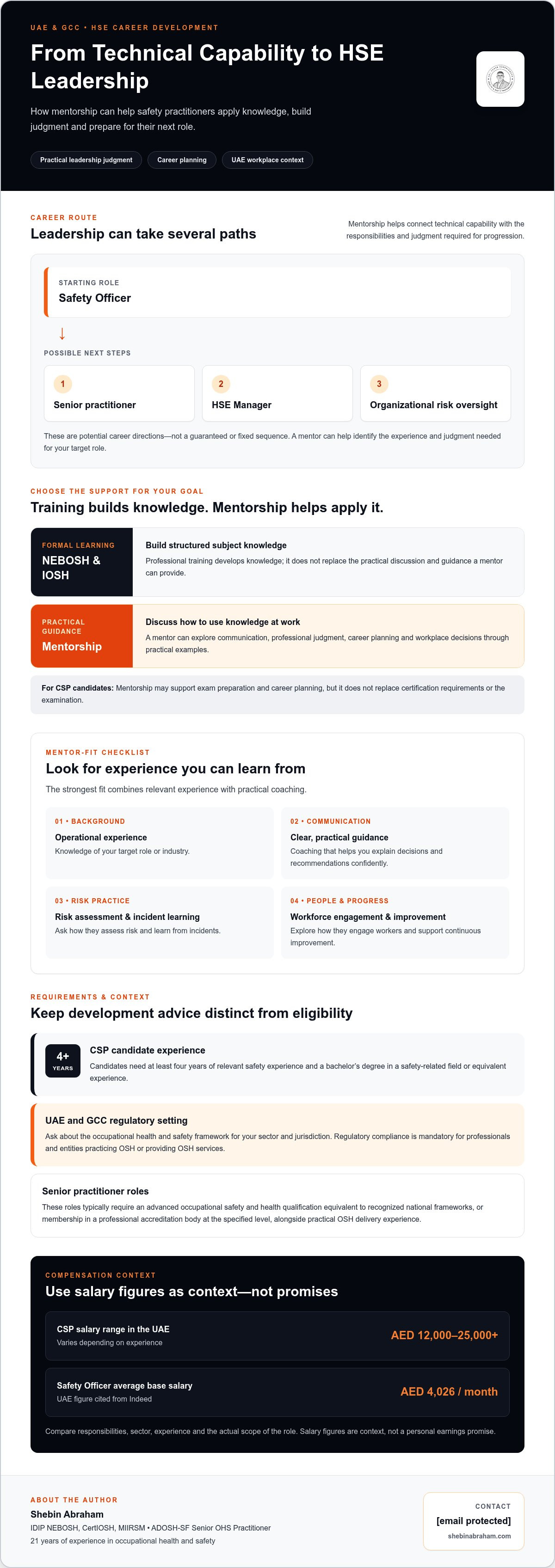
In the UAE, mentorship can help safety practitioners connect technical capability with leadership responsibilities. Career progression may lead from Safety Officer to senior practitioner, HSE Manager, or a role overseeing organizational risk. A safety practitioner mentorship UAE pathway can help you identify the experience and judgment needed at each transition.
Mentorship and Professional Training
NEBOSH and IOSH training build structured knowledge; mentorship helps practitioners apply that learning to workplace decisions. Choose based on your goal: formal education develops subject knowledge, while a mentor can discuss communication, judgment, and professional development through practical examples.
For CSP candidates, a mentor can support exam preparation and career planning, but mentorship does not replace certification requirements or the examination. Candidates need at least four years of relevant safety experience and a bachelor’s degree in a safety-related field or equivalent experience.
Ask a mentor to explain the occupational health and safety framework relevant to your sector and jurisdiction. Regulatory compliance is mandatory for professionals and entities practicing occupational safety and health or providing OSH services, aligning with national safety frameworks.
Mentor Qualifications and Experience
Look for a mentor with operational experience, clear communication, and knowledge of your target role or industry. Ask how they approach risk assessment, incident learning, workforce engagement, and continuous improvement. Practical coaching matters alongside qualifications.
Mentors should distinguish career advice from formal eligibility requirements. For senior practitioner applicants, roles typically require an advanced occupational safety and health qualification equivalent to recognized national frameworks, or membership in a professional accreditation body at the specified level, alongside years of practical OSH delivery experience.
Mentorship can help practitioners prepare for leadership discussions, identify skills to develop, and present recommendations confidently. CSP certification is internationally recognized and useful when applying for international roles. UAE employers in oil and gas, construction, manufacturing, and infrastructure prefer it.
Mentorship fees depend on the format, mentor expertise, session frequency, and program support. Providers share pricing after a quote request. Duration depends on your goals, meeting arrangements, and agreed development plan. Set these expectations early when planning safety practitioner mentorship in the UAE.
Employers can create a workplace safety mentorship program by defining development goals, matching practitioners with experienced mentors, and agreeing on confidentiality and meeting expectations. Review progress against practical objectives, such as improving toolbox talks or presenting corrective actions.
Compensation can be one consideration when weighing advancement options. CSP salaries in the UAE are stated to range from AED 12,000 to AED 25,000 or more, depending on experience. Treat this range as context rather than a promise of earnings; experience remains part of the stated variation, and role fit and responsibilities also matter when considering a next step.
The stated preference for CSP certification in UAE oil and gas, construction, manufacturing, and infrastructure can inform career planning. A mentor can help relate that preference to your target role, experience, and development priorities, while keeping certification requirements distinct from salary expectations. Focus on the leadership responsibilities you want to take on and the evidence of capability you can demonstrate.
Career support and industry networking
Professional connections can help UAE safety practitioners find useful advice, understand employer expectations, and identify development priorities. Make each conversation purposeful: bring a career goal, a current workplace example, and one specific question.
Build your network through professional institutes, sector events, and colleagues involved in safety management. For example, someone working in construction could ask an experienced contact how they present inspection findings to project managers. Follow up with a concise note explaining one action you took based on the advice. This turns an introduction into a professional relationship grounded in practical work.
Career conversations can also support informed earning discussions. According to Indeed, early 2026 data gives the UAE average base salary for a Safety Officer as AED 4,026 per month. Use that figure as context, not a personal salary promise. Compare responsibilities, sector, experience, and the role’s actual scope before discussing compensation.
No-cost options can include employer-led peer mentoring and professional institute networks. Treat government-supported training separately: funding or access to education does not automatically include one-to-one career guidance. Ask what the program provides, such as a named mentor, scheduled conversations, or feedback on workplace examples.
Make networking reciprocal. Share a useful tool, offer a thoughtful observation, or describe how your team handled a safety challenge. Keep confidential employee and incident details private. Clear boundaries build trust while allowing practitioners to discuss lessons, regulatory questions, and training needs responsibly.
Use a simple follow-up process after meeting a new contact:
- Record the person’s role, sector, and the topic discussed.
- Send a short thank-you note that names one useful insight.
- Apply that insight to a real task, such as revising a briefing.
- Reconnect with a specific update or question, not a general request.
For example, a practitioner preparing for contractor-facing work can ask which safety management evidence clients expect to see. Organizations working toward ADNOC requirements can also explore HSE prequalification support as a practical complement to their career development.
Track progress through concrete outcomes, not contact counts. Note whether a discussion helped you improve a presentation, identify relevant safety training, or understand a regulatory expectation. This keeps professional development continuous and gives future mentors a clear basis for useful guidance.
Training conversations can help you decide which learning options fit your goals. Before enrolling, ask what skills a course covers and how you can apply them to your current responsibilities. Standard industry safety certifications in the UAE typically take two days to five days, so discuss the time commitment and course relevance with a provider before making plans. Keep the conversation focused on practical needs, such as strengthening safety knowledge or preparing for broader workplace responsibilities.
CSP certification is respected and accepted across industries in the UAE. If you’re considering it, ask contacts how the credential relates to your career direction and the roles you hope to pursue. Compare advice from more than one experienced professional, then decide on a next step that fits your circumstances. A focused discussion can turn a general career aim into a learning decision and a practical action.
Connecting with established CSPs for insights and advice
A focused conversation with an experienced CSP can clarify how safety skills translate into workplace decisions. Bring a real example, such as explaining a recurring hazard to engineering managers.
Available Mentorship Programs
In the UAE, mentoring may be arranged through an employer, a professional institute, or an informal practitioner network. These arrangements differ from courses: a course follows a learning plan, while mentoring focuses on applying occupational health and safety knowledge to your role.
Before joining, ask about the mentor’s relevant sector experience, meeting format, confidentiality, and goals. For example, someone in facilities management may want feedback on contractor communication rather than general guidance about global safety practice.
Organizations Offering Mentorship
Start with your organization’s HSE department, professional institutes, and training providers. Ask whether they can connect you with a CSP for career guidance or whether their support is limited to certification and courses. This helps you find a suitable contact without assuming every organization runs a formal mentorship program.
At work, a senior HSE colleague can explain internal systems, while an external CSP may offer a broader professional perspective. Compare their experience with your goals, such as strengthening hazard controls or moving into safety management.
Finding a Mentor Across the Emirates
Wherever you work in the UAE, start by asking your employer’s safety team or professional network for a relevant introduction. State your sector, current responsibilities, and the skill you want to develop, such as presenting risk findings to project leaders.
To apply for or join a mentorship program, prepare a short profile and a clear objective. Contact the relevant employer, institute, or training provider, then ask about mentor matching, participation expectations, and how progress is reviewed.
Make the first discussion specific. Share a work example without disclosing sensitive employee or incident details, then ask how the CSP would assess hazards, communicate controls, or involve a supervisor. This gives both of you a practical basis for deciding whether your experience and goals align.
Keep each conversation useful with a simple follow-up:
- Agree on one development goal, such as improving risk briefings.
- Bring a work question that connects directly to that goal.
- Record an action and apply it to a suitable task.
- Return with the result and a focused next question.
If you’re seeking advice on the UAE’s occupational safety environment, ask about the mentor’s relevant emirate and sector experience. Discuss how local workplace expectations intersect with global practice, then identify one skill to strengthen through further learning or supervised application.
Approach CSP conversations as professional learning, not as a request for a guaranteed job referral. Clear goals, respectful follow-up, and practical questions help turn an introduction into useful career guidance.
What mentorship programs are available for safety practitioners in the UAE?
Safety practitioners in the UAE can use different mentoring formats depending on their employer, career stage, and development goals. Consider whether the support focuses on workplace practice, technical development, or progression into greater responsibility.
Employer-based mentoring pairs a practitioner with an experienced colleague who understands the organization’s procedures and operational risks. For example, a new HSE officer could review contractor briefings with a senior colleague and learn how site teams apply internal controls.
Peer mentoring brings practitioners together to discuss shared challenges. A small group might compare approaches to communicating inspection findings while protecting confidential employee and incident information. This format works well when members bring different sector experience and agree on clear discussion boundaries.
One-to-one career mentoring centres on an individual’s development plan. A practitioner seeking a supervisory role could work with a mentor on delegation, reporting, and presenting recommendations to managers. Agree on specific objectives and review progress through examples from actual work.
Technical coaching focuses on applying a defined system, standard, or workplace process. In Abu Dhabi, practitioners may need to distinguish professional development from Qudorat registration. Applications are submitted digitally through TAMM and reviewed by ADPHC against competency criteria. The program aligns with ADOSH-SF, but registration is not a mentorship arrangement.
Before joining a program, examine its structure. Clarify who selects the mentor, whether discussions follow a planned schedule, and how confidentiality is handled. Ask how progress is recorded, for example through agreed actions, reflective notes, or feedback on a work task.
- Match the format to your goal, such as operational coaching or leadership development.
- Choose a mentor with experience relevant to your sector and responsibilities.
- Agree on discussion topics, boundaries, and review methods at the outset.
- Bring one practical workplace example to each meeting.
A useful first meeting can focus on a current challenge, such as improving a risk briefing or explaining corrective actions. A mentor can help you examine the decision, identify communication gaps, and plan a suitable next step. Keep the discussion grounded in your responsibilities and workplace conditions.
For practitioners working across emirates, local context matters. Abu Dhabi’s ADOSH-SF and Qudorat processes may be relevant to particular roles, while a mentor should also understand your sector and organization. The right format makes professional development practical without confusing mentoring with certification, registration, or formal training.
Which UAE organizations offer occupational health and safety mentorship?
Start with your employer’s HSE department, where a senior practitioner can explain internal procedures and operational expectations. Ask whether the organization can match you with a colleague for development discussions. For example, a new site practitioner might review inspection findings with an experienced HSE manager.
Professional institutes and training providers can also help you find practitioner networks and career guidance. NEBOSH and IOSH offer professional learning routes, but training and mentorship serve different purposes. Ask specifically whether an organization provides mentor matching, peer discussions, or only course-based education.
In Abu Dhabi, distinguish mentorship from formal occupational safety and health registration. The Qudorat Program aligns with ADOSH-SF, and applications are submitted digitally through TAMM for ADPHC review against competency criteria. These processes concern registration, not necessarily one-to-one career mentoring.
That distinction matters when planning your next step. Someone seeking advice on workplace communication may benefit from an experienced colleague, while someone preparing a registration application needs to understand the applicable competency requirements. Keep these objectives separate when approaching an organization.
Ask a professional institute, employer, or training provider focused questions before joining a network or program:
- Does it connect participants with experienced occupational safety practitioners?
- Can discussions address your sector, such as construction or oil and gas?
- Are conversations individual, group-based, or part of formal training?
- How are confidentiality and workplace examples handled?
Use the answers to identify the right route. For example, an HSE practitioner in manufacturing could seek a mentor experienced in machine-risk controls, while a construction practitioner might prioritize contractor coordination. A good match depends on the mentor’s operational background and your specific development goal.
For UAE-wide networking, use existing professional relationships to request introductions across the country. Explain your current role, the skills you want to build, and the practical guidance you need. A clear request, such as feedback on presenting corrective actions, makes it easier for a contact to suggest a suitable practitioner.
Organizations can support mentoring without presenting it as a formal qualification. An employer could pair a developing practitioner with a senior colleague, agree on discussion topics, and review progress through work examples. Keep mentoring distinct from certification, course completion, and regulatory registration.
Before committing, compare the organization’s support with your objective. A course provider may focus on technical learning; an employer may offer operational coaching; an institute may help build professional connections. Choose the route that best fits the advice or experience you need.
Shebin Abraham: OHS Services
Shebin Abraham provides OHS Services for UAE organizations seeking practical occupational safety support. His work includes Freelance HSE Service, Freelance ADOSH-SF OHS consulting, and OHS Freelancer Trakhees Consulting. These services support organizations addressing workplace requirements or seeking guidance aligned with their operational context.
Shebin Abraham, IDIP NEBOSH, CertIOSH, MIIRSM, is an ADOSH-SF Senior OHS Practitioner with 21 years of OHS experience. His professional background helps connect safety principles with practical workplace application. For organizations working through ADOSH-SF or Trakhees-related OHS needs, focused consulting can complement a practitioner’s ongoing development and internal safety processes.
For OHS support relevant to your organization, contact Shebin Abraham.
Turn Career Intent into a Practical Next Step
Choose a professional capability to strengthen, then connect it to a real responsibility at work. You might prepare to lead a safety review, communicate risk to management, or build confidence in a regulatory discussion. A focused goal gives your next conversation purpose and helps you assess what guidance fits your role.
Safety practitioner mentorship in the UAE is most useful when it supports deliberate action, not just ambition. Bring a current challenge, identify the decision you need to make, and consider what experience or advice would help you move forward. For organization-specific OHS or ADOSH-SF needs, discuss how professional support can complement your development.
Shebin Abraham’s work focuses on practical occupational health and safety support for organizations. To discuss your goals and relevant support, contact Shebin Abraham.
Take the next step with a clear objective, and keep building your judgment through thoughtful practice.


