

Could a sound construction plan still be delayed because its safety submission is incomplete? Securing Trakhees OHS approval for construction projects depends on the site’s location and the safety and technical reviews required. In designated zones under Trakhees jurisdiction across the UAE, Trakhees serves as the relevant approval authority, and submissions may require accredited consultants and contractors.
It helps to understand the process before work begins. Complete documents, appropriately accredited professionals, and timely responses to review comments all matter. This guide covers typical submission documents, professional accreditation, safety oversight at different project stages, and how compliance gaps can lead to revisions or delays.
Shebin Abraham, IDIP NEBOSH, CertIOSH, MIIRSM, is an ADOSH-SF Senior OHS Practitioner with 21 years of experience in OHS. His UAE and GCC experience informs a practical, people-centred approach to occupational health and safety compliance, where careful preparation supports both project progress and the wellbeing of the people doing the work.
Key Takeaways
- Prepare a complete submission package, which may include architectural and structural drawings, MEP plans, land or lease documents, a trade licence, relevant NOCs and appointment letters.
- Account for Trakhees accreditation requirements: Dubai Municipality registration does not carry over to Trakhees submissions.
- Plan for safety oversight throughout the project, including inspections that assess compliance with approved plans, safety requirements and environmental standards.
- Address review queries and requested revisions promptly, as unresolved compliance issues can lead to corrective orders, fines or project delays.
- Approved consultants or contractors commonly support submissions, helping coordinate the documentation and responses required for the project.
Compliance risks, delays, and corrective actions
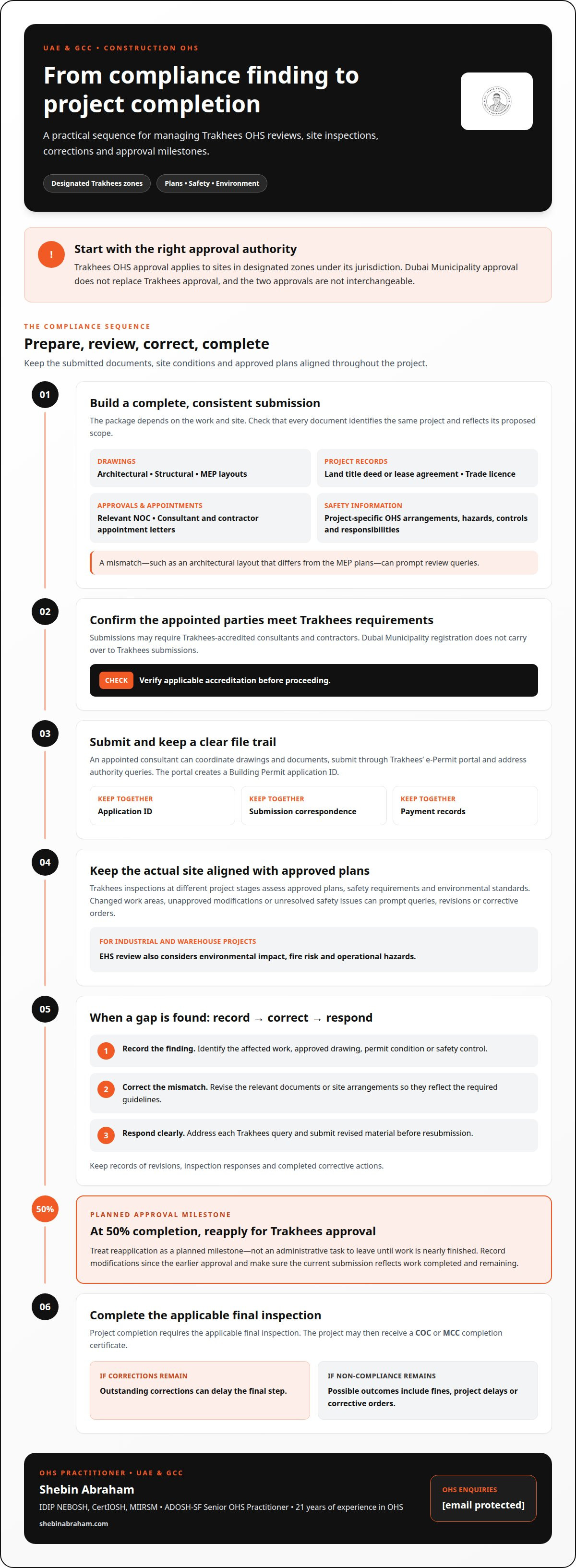
Trakhees OHS approval for construction projects applies to sites in designated zones under Trakhees jurisdiction. In those zones, Dubai Municipality does not replace Trakhees as the approval authority, so approval from one authority cannot be substituted for approval from the other.
Compliance risks often arise when site conditions, submitted drawings, and approved plans no longer match. Trakhees conducts inspections at different project stages to assess approved plans, safety regulations, and environmental standards. A changed work area, unapproved modification, or unresolved safety issue can prompt queries, revisions, or corrective orders. The responsible consultant must address review comments before resubmitting the application.
When a review or inspection identifies a gap, a structured response helps move the approval process forward:
- Record the finding: Identify the affected work, approved drawing, permit condition, or safety control.
- Correct the mismatch: Revise the relevant documents or site arrangements so they reflect the required guidelines.
- Respond clearly: Submit the revised material and address each Trakhees query before resubmission.
At 50% completion, a project must reapply for Trakhees approval. Treat this as a planned approval milestone, not an administrative task to leave until work is ready to finish. Reapplication gives the authority a point to review the project’s current status and its continuing compliance. Record modifications made since the earlier approval and ensure the current submission reflects the work completed and remaining.
Technical and environmental compliance also affects inspection outcomes. Trakhees checks work against approved plans, safety regulations, and environmental standards. For example, a site change that alters the approved layout may require revised documents and a response to the authority’s comments. Industrial and warehouse projects also require EHS review of environmental impact, fire risk, and operational hazards.
Facility permit regulatory compliance is another consideration for relevant projects. Trakhees offers a Facility Permit Regulatory Compliance accreditation course, underscoring the importance of understanding permit conditions alongside site safety. Connect permit requirements to actual operations rather than treating them as paperwork separate from the work.
Project completion requires the applicable final inspection. The project may then receive a COC or MCC completion certificate. Outstanding corrections can delay this step, while non-compliance may lead to fines, project delays, or corrective orders. Keep clear records of revisions, inspection responses, and completed corrective actions to show how identified issues were resolved.
Application documents and accredited professionals
A complete Trakhees submission connects project drawings, ownership or tenancy records, licensing, appointments, and safety information. The required package depends on the work and site location.
Required Drawings and Supporting Documents
A submission package may include architectural drawings, structural engineering drawings, and MEP layout plans. Supporting records may include a land title deed or lease agreement, a master developer or building management NOC, and consultant and contractor appointment letters. Check that each item identifies the same project and reflects the proposed scope, so the drawings and supporting documents are consistent.
For example, if the architectural layout differs from the MEP plans, the inconsistency can prompt review queries. An appointed consultant can coordinate the drawings before submitting them through Trakhees’ e-Permit portal, which creates a Building Permit application ID.
Project Documentation and Licensing
The project file may also require a trade licence and evidence of the land or lease arrangement. A master developer or building management NOC may also be required. These records establish the project setting and the parties’ roles; appointment letters connect the consultant and contractor to the proposed work.
A Trakhees OHS consultant manages the process by organizing the application, coordinating documents, and addressing authority queries before resubmission. The client provides the project scope, site and tenancy records, licensing documents, current drawings, and details of the appointed parties. Keep the application ID with submission correspondence and payment records for a clear file trail.
Health and Safety Plan Submission
Provide project-specific OHS arrangements that explain the work activities, foreseeable hazards, controls, and responsibilities. The plan should reflect the project’s actual scope and site layout, not rely on generic controls that do not fit the work. For industrial or warehouse projects, the EHS review also considers environmental impact, fire risk, and operational hazards.
Keep supporting safety information consistent with the drawings and proposed activities. If the work sequence or site arrangement changes, update the relevant safety documents before submission or resubmission.
Accreditation matters as much as document quality. Trakhees submissions may require consultants and contractors to hold Trakhees accreditation; Dubai Municipality registration does not transfer. Before proceeding, confirm that the appointed parties meet the applicable Trakhees requirements for their roles.
Keep the document set controlled. Use a clear project reference, identify drawing revisions, and ensure appointment letters match the parties named in the application. A structured file makes it easier to respond when Trakhees requests a revision and helps prevent outdated plans from being submitted again.
Occupational and industrial safety enforcement
After approval, Trakhees oversight continues through project stages rather than ending with permit issue. Trakhees conducts inspections to check work against approved plans, safety regulations, and environmental standards.
Contractors must carry out work in line with the approved project documents and safety arrangements. Consultants coordinate technical and safety information, support responses to Trakhees queries, and help keep revisions aligned with site conditions. For example, a changed work area should be reflected in the relevant drawings and safety controls.
The inspection schedule depends on project stages and applicable requirements. Trakhees inspects projects at different stages; there is no single fixed number or calendar interval for every project. Each inspection may assess whether the work matches approved plans and relevant safety and environmental standards.
This distinction matters for industrial and warehouse sites. Projects of these types in Trakhees areas require EHS review of environmental impact, fire risk, and operational hazards. A warehouse layout, material-handling activity, or change in operations may affect what inspectors compare with the approved project information.
Trakhees-regulated industrial facilities in JAFZA remain under authority oversight to ensure continued compliance with approved operational activities. The facility’s actual use matters as well as its construction records. A change from the approved activity can raise a compliance concern that needs to be addressed through the relevant authority process.
- Keep records aligned: Maintain current approved plans and supporting safety documents for the work underway.
- Track changes: Record changes to the site, activities, or operating arrangement and identify which documents they affect.
- Close findings: Document corrective actions and provide clear responses when Trakhees raises an inspection observation or query.
These steps help the project team show how an identified issue was handled. For example, if an inspection finds that site arrangements differ from approved plans, the team can identify the difference, make the required correction, and coordinate necessary document revisions before continuing affected work.
Trakhees inspections are not limited to a single final audit. They take place at different project stages and assess approved plans, safety regulations, and environmental standards. The inspection focus depends on the project’s scope and stage, while ongoing oversight of an industrial facility relates to its approved operational activities.
Dubai Municipality and Trakhees have different jurisdictional roles; approval requirements depend on the project’s location. For a site regulated by Trakhees, contractors and consultants should coordinate the relevant Trakhees approvals and keep site practices consistent with them.
Trakhees accreditation for design, construction and HSE
Trakhees accreditation supports quality and performance in design, construction, and HSE work within its jurisdiction. It complements project permits and design reviews but serves a different purpose: permits relate to project work, while accreditation relates to the professionals involved.
Trakhees issues construction permits, reviews project designs, conducts safety inspections, and enforces environmental and technical standards. Its accreditation programme supports these functions by addressing professional competence across design, construction, and HSE. Accreditation is relevant to the roles involved, but does not replace project-specific approval.
Physical works may require a Trakhees CED permit. The scope covers construction, renovation, fit-outs, structural changes, partitions, signage, and cladding. For example, a renovation involving a structural change requires attention to both the proposed design and the applicable permit process. Distinguish this project approval from an individual’s course or accreditation.
Trakhees offers accreditation courses with different technical focuses. Examples include Building Regulations and Design Guidelines courses for Architecture and Structural disciplines, and the Construction Materials Quality Control and Structural Inspection Guidelines course. The Safety Advisor Registration Scheme (SARS) and Manager Safety Awareness Program (MSAP) address HSE-related accreditation needs.
These are course fees, not the cost of project approval or consulting services. Match the course to the professional role and work involved. For example, structural design responsibilities differ from a safety advisor’s duties on a construction site.
Contractors and consultants may need Trakhees accreditation for submissions. Dubai Municipality registration does not transfer to Trakhees. This distinction matters when appointing professionals for a project in a Trakhees-controlled area. Accreditation can demonstrate that a professional has met the relevant programme requirements, while the project still needs its own review and permit.
These options serve distinct functions, so choose the course according to whether the role involves safety advice or facility permit compliance.
Keep the professional’s accreditation records separate from the project’s permit records. This makes it easier to identify which requirement applies to a design submission, construction activity, or HSE responsibility. Trakhees accreditation supports professional readiness; project-specific drawings and approvals remain tied to the actual work.
Consultant support for Trakhees projects
In most cases, Trakhees submissions must go through approved consultants or contractors. A consultant coordinates the approval process, keeps project information consistent, and manages authority queries, connecting technical documents with the work planned on site. This support also helps the project team identify the submission steps that apply to its scope and location.
Effective support starts with understanding the project’s activities and approval requirements. A residential renovation, for example, may need different drawings from an industrial warehouse alteration. The consultant uses the scope to coordinate relevant architectural, structural, MEP, and safety information. The aim is a consistent submission that describes the same project across every document.
During the approval process, a consultant can coordinate key tasks:
- Organize the submission: Align project drawings, supporting records, and appointment details before submitting through Trakhees’ e-Permit portal.
- Track correspondence: Keep the Building Permit application ID with the submission record and authority communications.
- Manage review comments: Coordinate revisions and provide responses to queries before resubmission.
- Support inspection readiness: Relate site conditions to approved plans and safety information when Trakhees conducts inspections.
These tasks require coordination among the client, consultant, contractor, and project team. The client supplies accurate project information and relevant records. The consultant organizes those inputs, identifies inconsistencies, and coordinates responses. The contractor connects the approved project information with construction activities and site arrangements.
Clear communication is especially important when the project changes. If a proposed modification affects drawings or safety arrangements, the consultant can identify which submission documents need updating. If Trakhees raises a query, respond directly to the point and include the relevant revision. This avoids resubmitting unrelated information that does not resolve the authority’s concern.
Inspection support is practical, not just administrative. The consultant can relate an inspection finding to approved plans, applicable safety information, or environmental requirements. For example, if a site arrangement differs from the documented layout, the team can identify the difference and coordinate the appropriate corrective response. Keep documents and site activities aligned.
To obtain approval, focus on three essentials: a clearly defined project scope, coordinated documents, and timely responses to Trakhees comments. The consultant keeps these elements connected through submission, review, and inspection, while the project team provides the information required at each stage.
Discuss Trakhees project consulting support if you need help coordinating your approval process.
Shebin Abraham: OHS Freelancer Trakhees Consulting
Shebin Abraham provides OHS Freelancer Trakhees Consulting for construction teams managing Trakhees safety compliance. Turn to this service for help coordinating OHS requirements with project documents, responding to approval queries, or preparing for inspection-related compliance reviews.
His consulting connects regulatory requirements with site realities, helping project teams address safety responsibilities as part of the approval process rather than as separate paperwork. Depending on the project’s needs, this support can also complement broader OHS Services or a Freelance HSE Service.
Shebin Abraham is an ADOSH-SF Senior OHS Practitioner with 21 years of OHS experience. His credentials include IDIP NEBOSH, CertIOSH, and MIIRSM.
Contact Shebin Abraham to discuss Trakhees OHS support for your project.
Make Safety Part of the Project’s Next Step
Build OHS coordination into project decisions from the outset, rather than treating it as a separate approval task. This keeps safety considerations connected to design choices, work planning, and changes as the project develops. Clear responsibility also helps teams respond consistently when approval requirements affect planned work.
For teams arranging Trakhees OHS approval for construction projects, the next step is to identify the support needed at the current project stage. Shebin Abraham offers OHS Services, Freelance HSE Service, Freelance ADOSH-SF Freelance OHS consulting, and Trakhees consulting. These services provide practical support with occupational health and safety compliance in project work.
Choose a considered, collaborative approach that keeps people’s safety central to project delivery. Contact Shebin Abraham about Trakhees approval to discuss your project’s OHS needs and next steps.
Frequently Asked Questions
Need Help With Trakhees Approval in Dubai?
Yes. Shebin Abraham provides OHS Freelancer Trakhees Consulting for teams needing specialist support with safety compliance. The service helps connect OHS requirements to project activities and address Trakhees review feedback. For example, if planned work changes, consulting can help identify where safety information and approval documents need updating. This is useful when project coordination becomes difficult or authority comments need a structured response.
What Types of Projects Need Trakhees Approval?
Projects in areas under Trakhees jurisdiction may need approval for construction and other physical works, including renovations, fit-outs, structural changes, partitions, signage, and cladding. Industrial units, warehouses, workshops, and food operations may also require EHS review of operational safety and environmental requirements. The applicable approval depends on the site location and proposed work, so start with the project address and scope.
What is Trakhees OHS approval for construction projects in Dubai?
It is the safety-related review and approval process for relevant construction work within Trakhees’ jurisdiction. Trakhees assesses project information and can inspect work against approved plans, safety regulations, and environmental standards. The process connects OHS arrangements with the project’s permitted activities. For example, safety controls for a warehouse fit-out should reflect the actual work and site operations, rather than rely on a generic plan that misses project-specific hazards.
Which construction projects require Trakhees OHS approval?
Construction projects in Trakhees-controlled areas may require Trakhees approvals, including relevant safety reviews. Work type matters: a renovation, fit-out, or structural alteration may have different considerations from new construction. Industrial and warehouse projects also receive EHS review of environmental impact, fire risk, and operational hazards. Confirm that the site falls within Trakhees jurisdiction and define the proposed work before planning the approval route.
What are the Trakhees OHS approval requirements and documents?
Requirements depend on the project scope and may include drawings, licensing and tenancy records, appointment letters, and safety information. Start by matching the application details to the project’s actual use, work sequence, and site arrangement. Consultant and contractor accreditation may also apply; Dubai Municipality registration does not transfer to Trakhees. A consultant can coordinate the submission and help address authority comments requiring document revisions.
How long does Trakhees OHS approval take?
Standard Trakhees approval projects are estimated to take 7-14 working days overall, while complex projects are estimated at 3-6 weeks. These are planning estimates, not fixed completion dates. Project complexity, document quality, inspection requirements, and review comments affect the sequence. For scheduling, allow time for a consultant to respond to queries and prepare revisions, especially when the proposed work involves multiple technical or operational considerations.
What are the Trakhees OHS approval fees and payment methods?
Listed Trakhees fees vary by application type. These are authority fees, not consulting-service prices. Follow the payment instructions for the specific application and its fee notice. Keep the payment record with the Building Permit application ID to maintain a traceable project file.
What are the penalties for non-compliance with Trakhees OHS requirements?
Non-compliance may lead to project delays, fines, or corrective orders. The response depends on the issue and whether the project meets the relevant approved plans, safety regulations, and environmental standards. For example, an unresolved inspection finding can require corrective action before affected work proceeds. Record findings, assigned actions, and closure evidence so the project team can show how issues were addressed during authority reviews.


