

A safety system can be complete on paper and still fail where the work happens. If you’re asking how to implement OHS management system UAE operations can rely on, start with the risks people face and the requirements that apply to your activities, not with a stack of forms.
It’s understandable to feel unsure where to begin. UAE requirements can vary with your operations and the applicable federal, emirate-level, free-zone, or sector framework. Even sound procedures won’t protect people unless responsibilities are clear and workers can put them into practice every day.
This guide sets out a practical, risk-led sequence for building, documenting, implementing, and improving your OHS management system. You’ll learn how to identify applicable requirements, assess workplace risks, assign accountable owners, and turn controls into usable procedures and training. It also explains how to monitor performance, review what’s working, and improve the system as operations change. The goal is a system that supports safer decisions during everyday work, with records that reflect practice rather than replace it.
Key Takeaways
- Learn how to implement OHS management system UAE operations can use by defining scope around real tasks, workforce exposure, and applicable requirements.
- Make leadership commitment visible and involve workers so their knowledge of hazards informs practical controls.
- Link each relevant requirement to an accountable owner, a usable procedure, and evidence showing how the control works.
- Roll out changes in stages, prioritising higher-risk work and assigning clear responsibilities and review points.
- Use monitoring, incident learning, audits, and management review to guide improvement. Keep internal evaluation distinct from certification or formal regulatory assessment.
How to implement an OHS management system in the UAE: define the purpose and scope
A practical answer to how to implement OHS management system UAE operations need starts with the work itself. An occupational health and safety management system connects responsibilities, processes, workplace controls, and reviews so risks are managed consistently. Policies and forms can support the system, but they don’t make it work on their own. The test is whether people understand their responsibilities and can apply the controls during normal work.
Start by mapping the organization’s activities, workforce exposure, and operating context. Consider what work is performed, who may be affected, how tasks are supervised, and where teams or contractors interact. This gives you a practical basis for setting boundaries and identifying relevant requirements.
Set boundaries for the OHS management system
Define which business activities, locations, workers, contractors, and work interfaces the system covers. Include routine operations alongside maintenance, non-routine tasks, emergencies, and contractor work. For example, a warehouse scope may need to cover vehicle movements, loading, equipment maintenance, and contractor access, not just day-to-day storage.
Record any exclusions and explain the reasoning. Each exclusion should have a clear boundary and must not leave a significant hazard or work interface outside effective control. A well-defined scope helps managers assign ownership and helps workers know which procedures apply to their tasks.
Identify applicable UAE requirements before drafting procedures
Requirements depend on the organization’s activities and governing framework. Map relevant federal, emirate-level, free-zone, sector, and client requirements to the work in scope. For each requirement, identify what it means in practice, who is responsible, and what evidence may show it is addressed. Check current regulator guidance as part of this process, since one framework should not be assumed to apply to every UAE operation.
For organizations subject to them, ADOSH-SF or Trakhees OHS requirements may shape system planning and documentation. Apply these frameworks where relevant and align the system with their current requirements. ISO 45001 standard principles can also provide a useful structure for managing OHS, but a management-system reference does not replace applicable UAE requirements.
Capture the result in a clear scope statement and requirements register before drafting procedures. This helps prevent teams from building paperwork around assumptions. It also creates a sound starting point for connecting leadership, worker participation, and risk controls to the work people actually do.
Build the OHS management system around leadership, worker participation, and risk
Once the system’s scope and applicable requirements are clear, implementation depends on how leaders and workers apply them. A practical answer to how to implement OHS management system UAE operations can rely on is to make safety ownership visible, listen to people doing the work, and focus effort on the most significant risks.
Assign leadership roles and establish worker consultation
Name a senior sponsor who can set priorities and ensure the system has suitable resources. Define what operational managers, supervisors, workers, and contractors are responsible for, including who raises hazards, acts on them, and communicates outcomes. Leadership commitment shows in decisions and follow-through, not policy statements alone.
Build worker input into everyday communication. Toolbox discussions, briefings, hazard reports, and feedback on proposed controls can surface problems formal documents may miss. Include contractors and relevant workplace representatives in coordination arrangements, especially when teams share work areas or activities.
Assess hazards and select controls that fit the work
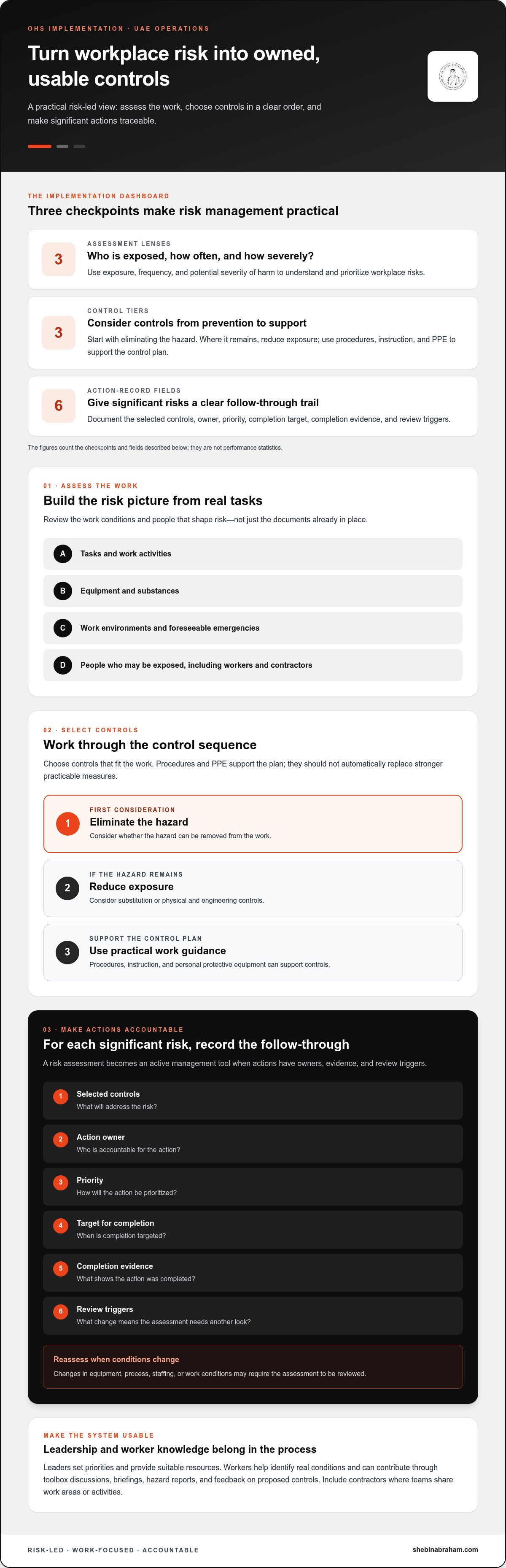
Review tasks, equipment, substances, work environments, and foreseeable emergencies. Consider who may be exposed, how often exposure occurs, and the potential severity of harm. Workers can help identify real conditions, such as access constraints during maintenance or changing interactions between people and moving equipment.
Use the findings to set priorities and choose controls. First consider whether a hazard can be eliminated, then whether exposure can be reduced through substitution or physical and engineering controls. Procedures, instruction, and personal protective equipment can support the control plan, but shouldn’t automatically replace stronger measures where those are practicable.
For significant risks, record the selected controls, action owner, priority, target for completion, and evidence that the action was completed. Set review triggers as well. A change in equipment, process, staffing, or work conditions may mean the assessment needs another look. This makes risk assessment an active management tool rather than a document completed once and filed away.
Use international references as guidance, not as automatic proof of compliance. ILO guidance on OSH management systems, including ILO-OSH 2001, offers principles for systematic improvement. ISO 45001 can also inform system design. Neither reference replaces the requirements that apply to an organization’s UAE operations.
When leadership needs practical support to connect responsibilities, consultation, and risk controls, freelance HSE and OHS consulting can help turn system expectations into workable arrangements.
Turn UAE OHS requirements into usable procedures, records, and competence
With responsibilities and significant risks identified, translate applicable requirements into controls people can follow and evidence managers can review. For how to implement OHS management system UAE operations can use, keep documentation proportionate to the work. Each document should support a decision, a control, or a review. A completed form is useful only when it reflects what actually happens.
A requirements register can connect each applicable obligation or framework requirement to the responsible role, relevant procedure, and evidence used to demonstrate implementation. Keep the register specific to your activities and applicable UAE framework. This makes gaps easier to spot and helps prevent generic templates from creating procedures that don’t fit the work.
Create controlled OHS documentation that supports work
Build a clear document set around the organization’s policy, defined responsibilities, risk controls, emergency arrangements, and review process. Link each procedure or form to the hazard, task, role, or operational decision it supports. For example, a safe-work procedure for equipment maintenance should help the people involved understand the relevant controls and sequence of work, not simply repeat broad policy language.
Control documents throughout their life cycle. Identify who approves them, record revisions, make current versions accessible where work takes place, and remove obsolete copies from use. Set appropriate retention arrangements for records. These steps help workers rely on current instructions and help supervisors confirm the system remains aligned with actual operations.
| Document | Workplace purpose |
|---|---|
| OHS policy | Sets direction and communicates commitment and responsibilities. |
| Risk assessment | Records hazards, affected people, risk priorities, and selected controls. |
| Safe-work procedure | Explains how a defined task is carried out with its controls in place. |
| Training record | Shows instruction or learning completed for a role or task. |
| Incident record | Captures what happened and supports follow-up and learning. |
Build competence and communication into implementation
Identify competence needs by role, task, hazards, and applicable framework requirements. Induction can introduce workplace arrangements, while task-specific instruction addresses the controls workers need for particular activities. Use briefings and refresher communication when procedures or work conditions change.
Track training and any role or task authorizations through controlled records, but don’t treat attendance as proof that someone can apply what they learned. Check understanding through practical demonstration, questions, or observation relevant to the task. This connects written requirements, workforce competence, and safe work in practice.
Roll out the OHS management system through controlled workplace action
Put the system into practice in stages, with a named owner, workable priorities, and planned review points for each stage. Start with controls for the highest-priority risks, then expand to lower-priority activities as teams gain experience and you confirm the essential controls are working. This keeps implementation focused on protecting people rather than completing every document at once.
Supervisors make the system real in daily operations. They can check whether controls are understood and followed, notice changing conditions, and raise issues that need additional resources or management decisions. Set clear routes for escalating control failures, overdue actions, and concerns workers cannot resolve at task level.
Pilot controls and communicate changes before wider rollout
Choose a suitable work area or activity to test new procedures and controls before applying them more broadly. Brief affected workers and contractors on changes to responsibilities, work methods, and reporting routes. During the pilot, ask whether instructions are clear and workable under actual conditions. Use the feedback to refine the process, then record what was communicated, tested, and changed before extending the approach.
A pilot is not a reason to delay action on serious hazards. Put necessary risk controls in place while testing how procedures and responsibilities can best support them. Keep affected people informed as arrangements develop.
Track actions, incidents, and operational performance
Choose a small set of indicators tied to identified risks and OHS objectives. Leading indicators can show whether preventive activity is happening, such as planned inspections completed or corrective actions closed and checked. Lagging indicators, including incidents and near misses, help reveal outcomes and emerging patterns. Select measures that prompt useful decisions, not just numbers for a dashboard.
Maintain an action log with an accountable owner, priority, due date, and status. Review overdue actions and verify that completed corrections have actually reduced risk. If the same issue returns, investigate whether the control, instruction, supervision, or resources need to change.
Review incidents, near misses, control failures, and worker feedback together. Recurring concerns may point to a weakness in a procedure or a gap between written arrangements and real work. For related examples of preventable gaps, see the article on common OHS compliance mistakes in the UAE.
For practical support with system implementation and ongoing maintenance, discuss freelance HSE and OHS consulting.
Review and improve the OHS system, then plan the next implementation step
Implementation doesn’t end when procedures are in place. Monitoring, incident learning, internal audits, and management review show whether the system controls risk in practice. Monitoring highlights changes in performance, incident reviews reveal lessons from events and near misses, and audits examine whether arrangements are followed and effective. Management review brings these findings together so leaders can set priorities.
Internal evaluation helps an organization understand and improve its own system. It is not the same as accredited certification or a regulator’s formal assessment. An internal audit can identify gaps and support corrective action, but it doesn’t issue certification or determine a regulator’s assessment outcome. Keep those roles clear when planning reviews and communicating results.
Use review findings to strengthen the system
Review OHS objectives, the effectiveness of risk controls, incident and near-miss information, relevant compliance updates, worker feedback, and open actions. Look for patterns, not just isolated results. For example, repeated delays in closing similar corrective actions may point to unclear ownership or insufficient resources.
Turn review discussions into decisions. Record what will change, who owns each action, what resources are needed, and when progress will be checked. Update priorities, controls, procedures, or competence arrangements where the evidence calls for it. Revisit the system when work changes, new risks emerge, or applicable requirements are revised. A review has value when its decisions lead to action and follow-up.
Know when implementation support can help
Some organizations benefit from practical advisory support to connect system design, implementation planning, documentation, compliance assessment, training, and ongoing maintenance. Shebin Abraham brings more than 20 years of QHSE and occupational health and safety experience in the UAE, including specialist advisory experience with ADOSH-SF and Trakhees OHS requirements. This experience can help teams translate relevant requirements into workable arrangements rather than treating the system as paperwork alone.
If you’re considering how to implement OHS management system UAE operations can sustain, use review findings to define the next practical step and discuss your implementation needs through OHS consulting support. For broader context on specialist advisory, read the UAE OHS consultant practical guide.
Make your OHS system part of how work gets done
A strong OHS management system starts with the work and the requirements that apply to your UAE operations. Set a clear scope, assign accountable owners, and involve workers in identifying hazards and shaping practical controls. Make procedures and training useful on the job, roll out improvements in stages, and review evidence so the system can adapt as work changes.
Knowing how to implement OHS management system UAE operations can rely on means building more than a compliant set of documents. It means establishing a repeatable way to protect people, learn from experience, and strengthen controls over time.
Shebin Abraham brings more than 20 years of QHSE and occupational safety experience in the UAE, including specialist advisory experience with ADOSH-SF and Trakhees OHS requirements. For practical support tailored to your operations, discuss an OHS management system for your operations.
Start with one clear, risk-led step. With steady ownership and worker participation, your system can become a practical part of safer everyday work.
Frequently Asked Questions
How do you implement an OHS management system in the UAE?
Implement it in stages, starting with the work your organization performs and the OHS requirements that apply to its activities. Define the system’s scope, assign accountable owners, assess risks, and establish practical controls, procedures, and competence arrangements. Then communicate and test the system in the workplace. Monitor controls, learn from incidents and feedback, and use reviews to plan improvements. This risk-led sequence is a practical way to approach how to implement OHS management system UAE operations can use.
What should an OHS management system include?
An OHS management system should connect leadership responsibilities, worker participation, risk assessment, operational controls, competence, communication, and review. Supporting documents may include an OHS policy, a requirements register, risk assessments, safe-work procedures, training records, and incident records. Documents should reflect actual tasks and help people make safe decisions. Keep them controlled and accessible, and review them when work changes or monitoring shows that a control or procedure needs attention.
Is ISO 45001 mandatory for UAE companies?
ISO 45001 is not generally a legal requirement for every UAE company. It is a widely used benchmark for structuring an occupational health and safety management system, but organizations must still identify the federal, emirate-level, free-zone, sector, and client requirements that apply to their operations. A regulator, client, or contract may set specific expectations. Treat ISO 45001 as a management-system reference, not a replacement for applicable requirements or a guarantee of compliance.
How do I identify which OHS requirements apply to my UAE business?
Start by mapping your business activities, work locations, workforce, contractors, and operating interfaces. Identify the relevant federal, emirate-level, free-zone, sector, and client frameworks, then check current requirements and regulator guidance. For example, ADOSH-SF or Trakhees OHS requirements are relevant where the organization’s activities fall within their scope. Record each applicable requirement, the responsible owner, related procedure, and evidence of implementation in a requirements register.
Can a small business implement an OHS management system without a full-time HSE team?
Yes. A small business can establish a system proportionate to its activities, workforce, and risks without creating unnecessary layers of paperwork. Managers can assign clear responsibilities, involve workers, and maintain practical controls and records. Where specialist knowledge or implementation capacity is needed, freelance HSE and OHS consulting can support system design, documentation, training, and maintenance. The key is to ensure arrangements are understood and used, not simply written down.
How often should an OHS management system be reviewed?
Set planned review points that suit the organization’s activities and applicable framework, and review relevant parts sooner when circumstances change. Triggers may include a new process or work area, an incident or near miss, a control failure, updated requirements, or worker feedback that identifies a concern. Monitoring and internal audits can inform management review. Record decisions, action owners, required resources, and follow-up dates so findings lead to improvement.
What is the difference between an OHS management system and OHS certification?
An OHS management system is the organization’s ongoing framework of responsibilities, processes, controls, and reviews for managing workplace risks. Certification is a separate formal assessment against a specified standard by an accredited certification body. Internal audits and reviews help an organization evaluate and improve its system, but they do not issue accredited certification. A regulator’s assessment is also distinct and focuses on the requirements and authority relevant to that organization.


